
Jatropha curcas is a perennial woody plant species of the Euphorbiaceae family. This drought-resistant shrub is widely recognized for its potential to produce biodiesel and bio-jet fuel on marginal lands, avoiding competition with food production. However, its naturally low seed production has limited the commercial use.
In a study published in Plant Biotechnology Journal, researchers from the Xishuangbanna Tropical Botanical Garden (XTBG) of the Chinese Academy of Sciences identified a key gene, JcSPL9, which can significantly increase both seed yield and oil content in Jatropha.
Focusing on plant development genetics, researchers highlighted the important role of a gene called JcSPL9 which belongs to the squamosa promoter binding protein-like (SPL) family. This gene acted as a master switch, controlling when the plant shifted from growing leaves to producing flowers and seeds.
Experiments showed that plants engineered to overexpress a modified form of JcSPL9 (called rJcSPL9) produced 80.76% more seeds and had 12.6% higher oil content compared to normal plants. In contrast, boosting a related molecule called JcmiR156a led to a 51.67% drop in seed yield and an 8.28% decrease in oil content.
Further analysis revealed that rJcSPL9 turned on genes involved in oil production, while JcmiR156a turned them off, which confirmed that JcSPL9 enhanced oil accumulation by regulating metabolic pathways. Besides, changes were found in the types of fatty acids produced in the seeds, indicating that this genetic mechanism largely affected oil composition.
“By using the rJcSPL9 and JcmiR156a transgenic Jatropha, we demonstrate, for the first time, that SPL9 plays an important role in regulating fatty acid biosynthesis and lipid accumulation in seeds,” said TANG Mingyong from XTBG, one corresponding author of the study.
The dual effect on both yield and oil content makes SPL9 a promising target for molecular breeding. “The strategy of using a miR156-resistant SPL9 gene could be applied to other crucial oilseed crops, such as soybean, canola, and sunflower, to meet the growing global demand for biofuels and renewable resources,” said TANG.

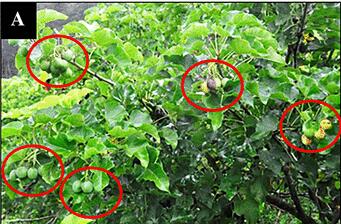
Jatropha curcas (Image by TANG Mingyong)
Researchers from Xishuangbanna Tropical Botanical Garden conducted a study to investigate the role of GA in the floral initiation of Jatropha. They found that the exogenous application of GA inhibited flowering in Jatropha, while GA biosynthesis inhibitors promoted flower...

Prof. XU Zengfu’s team of Xishuangbanna Tropical Botanical Garden (XTBG) has previously reported that 6-benzyladenine (BA, a synthetic compound with CK activity) treatment significantly increased the number of female flowers per inflorescence and induced bisexual flowers...

86-10-68597521 (day)
86-10-68597289 (night)

52 Sanlihe Rd., Xicheng District,
Beijing, China (100864)
Copyright © 2002 - Chinese Academy of Sciences


