
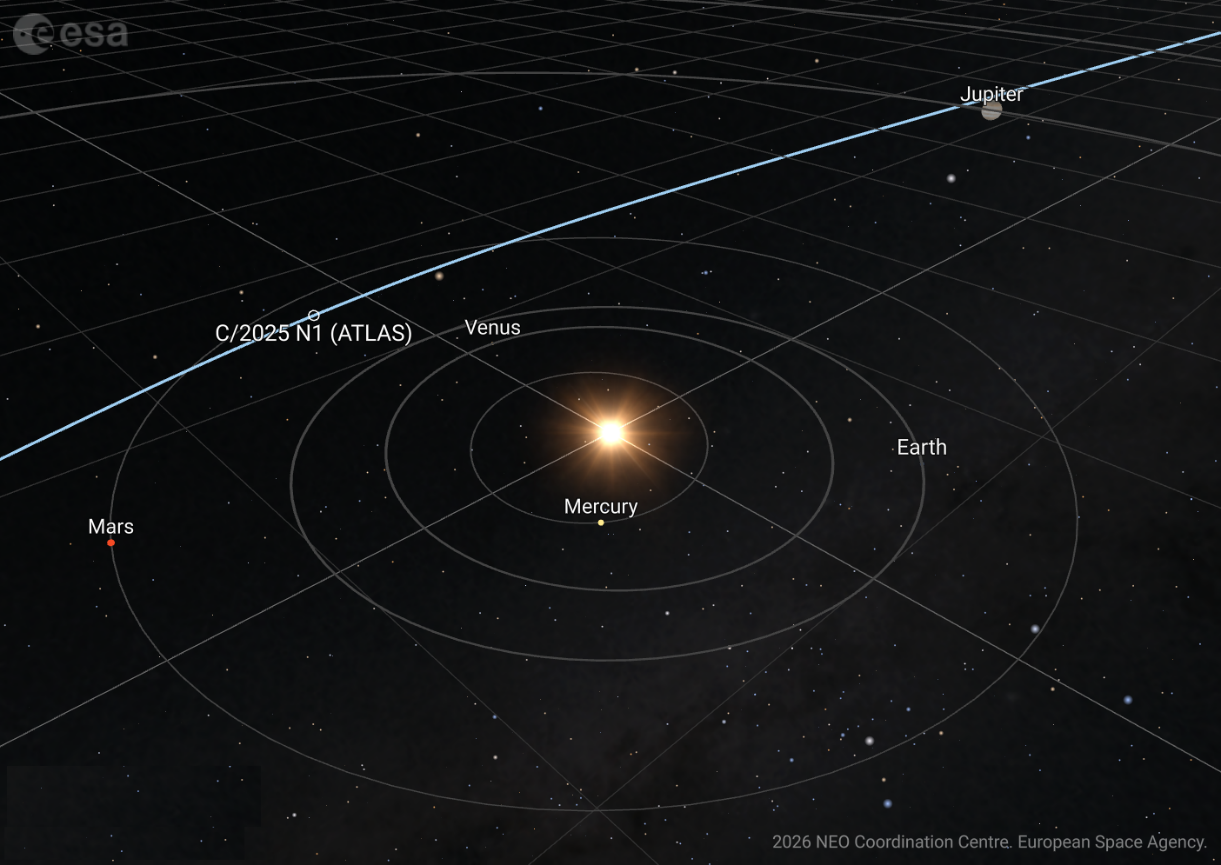
Diagram showing the trajectory of comet 3I/ATLAS through inner part of solar system. (Credit: ESA NEOCC)
Interstellar objects (ISOs) represent a rare opportunity to study the physical properties and composition of extrasolar matter in detail, the discovery of the third such kind object has raised interest in a new aspect: orbital dynamics. Unlike its predecessors, 1I/'Oumuamua and 2I/Borisov, which traversed the solar system on high-inclination trajectories that kept them largely clear of planetary population fields, 3I/ATLAS (also known as C/2025 N1) presents a far more complex interaction profile. It has provided the first quantitative look at the "encounter environment" for a low-inclination ISO.
3I/ATLAS follows a retrograde, nearly ecliptic orbit with an inclination of approximately 175° and a relatively small perihelion distance of about 1.36 astronomical units (AU). This geometry effectively sends the object "against traffic" through the densest regions of the inner solar system. This significantly increases the probability of close encounters and potential interactions (including collisions) with native objects, specifically Main Belt and near-Earth asteroids.
To investigate this unique dynamical scenario, researchers from the Shanghai Astronomical Observatory of the Chinese Academy of Sciences, Shanghai Jiao Tong University and the Main Astronomical Observatory of Ukraine, conducted a detailed numerical study of the object's encounter environment.
Their results were published in The Astronomical Journal on January 19.
Using systematic N-body integrations spanning from August 1, 2025, to April 1, 2026, the researchers quantified close-approach statistics and assessed collision probabilities. By filtering the trajectories of over 38,000 near-Earth asteroids (NEAs) and 1.4 million Main Belt asteroids (MBAs), they identified a considerable number of close approaches, with 31 NEAs and 736 MBAs passing within 0.03 AU of 3I/ATLAS. The frequency of these encounters underscores the importance of low-inclination ISOs in studying the dynamical interactions between extrasolar and native matter in detail.
Although the nominal orbits of the identified asteroids did not predict direct collisions, their orbital uncertainties are critical for assessing impact risks. This is demonstrated by the exceptional case of Main Belt Asteroid 2020 BG107, whose orbit is poorly constrained due to a short observational arc (uncertainty parameter U=7). At the time of the identified close encounter (≈0.019 AU), its 3-sigma "uncertainty ellipsoid" (the region where it might actually be) was larger than the nominal approach distance to 3I/ATLAS (≈0.0023 AU).
Through Monte Carlo (MC) simulations involving 100,000 orbital clones, the researchers estimated a nucleus impact probability of approximately 0.025%. When the cometary nature of 3I/ATLAS was considered, the probability that the asteroid passed through the object’s dust coma increased to 2.7%.
Unfortunately, the identification of this specific case was derived post-facto (the actual solution was obtained on August 21, 2025, a few days after the predicted close approach on August 17), highlighting the importance of timely analysis to strengthen observational efforts to confirm or rule out predicted impacts. Nevertheless, had such an event occurred, it would have been a "natural" hypervelocity experiment, offering insights into ISO (and asteroid) internal structure comparable to controlled missions such as DART, but at significantly higher energy levels due to the retrograde (in the case of 3I/ATLAS) relative velocity.
Overall, the results demonstrate that physical interactions between ISOs and native bodies are statistically possible events.
The researchers noted that the implications of this work extend beyond 3I/ATLAS, or ISOs in general. These results can be extrapolated to dynamically new objects, including comets making their first perihelion passage from the Oort cloud, which may share similar low-inclination primordial orbits.
This study provides a methodological framework for the proactive analysis of future ISOs and dynamically new comets. As the Vera C. Rubin Observatory (LSST) is expected to significantly increase the discovery rate of such objects, the ability to rapidly identify and monitor potential close encounters will be essential.
This work shows that the inner solar system is a busy intersection. With the right orbital geometry, physical interactions between newcomers and native bodies are a statistically viable phenomenon worthy of dedicated observational campaigns.
Dr. MAO Yindun's research team at SHAO has been engaged in long-term research on Near-Earth Asteroids (NEAs), developing a Global Observation Network with a special focus on high-precision astrometry of fast-moving objects and collision assessments for potentially hazardous asteroids. Over the past several years, the research group has performed specialized observations using original methods to overcome one of the biggest challenges: accurately tracking fast-moving objects during close approaches to Earth. This capability is crucial for newly discovered NEAs. Without immediate, high-quality astrometry to extend the observational arc, these objects risk becoming "lost" before their orbits can be reliably determined for future apparitions.
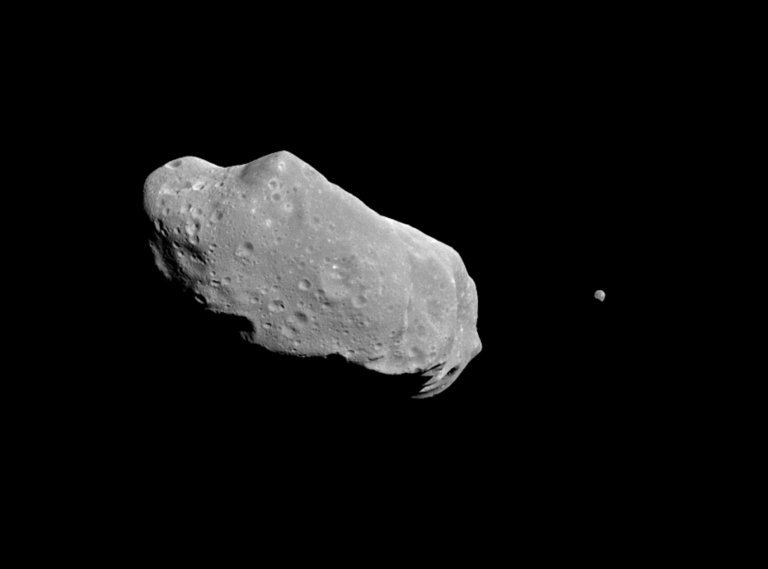
Leading figures involved in China's space programme are looking at a range of ideas for utilising asteroids and other small bodies, including resource extraction, learning about the origins of the solar system - and even escaping from it - but such activities are a long w...
A leading Chinese science-technology institution announced Tuesday that it was going to establish a deep-space lab in Luxembourg. The lab will focus on the coordinated design and analysis of deep-space probes, as well as the development of key technologies in exploring an...

86-10-68597521 (day)
86-10-68597289 (night)

52 Sanlihe Rd., Xicheng District,
Beijing, China (100864)
Copyright © 2002 - Chinese Academy of Sciences


