
In natural ecosystems, soundscapes consist of animal sounds, environmental noises, and human activity. Since different animals vocalize at different times and frequencies, researchers can analyze audio recordings to study local biodiversity. Machine learning algorithms are often used to analyze how biodiversity changes over time and across regions. However, it is still difficult to accurately identify species and measure biodiversity in ecosystems with many species and complex sounds, which limits the wider use of soundscape analysis in ecological monitoring.
A research team led by Prof. LIU Fanglin from the Hefei Institutes of Physical Science of the Chinese Academy of Sciences has developed a novel generative model-based method for ecological soundscape analysis.
Their study was published in Methods in Ecology and Evolution.
The researchers used generative adversarial networks (GANs) to learn the underlying patterns of sound signals from real spectrograms. They then applied this knowledge to reconstruct species-specific vocal components, generating sounds that closely mimic natural soundscapes.
Unlike conventional discriminative models, this generative strategy captures intrinsic structures and hidden features of the acoustic space such as the frequency ranges, temporal patterns and energy intensities of animal calls, thereby enabling more precise separation of target sound sources, effective removal of environmental noise and clearer restoration of bioacoustic events.
This work expands the theoretical and methodological boundaries of biodiversity and soundscape analysis, providing new ways for automated ecosystem monitoring and ecosystem health assessment.
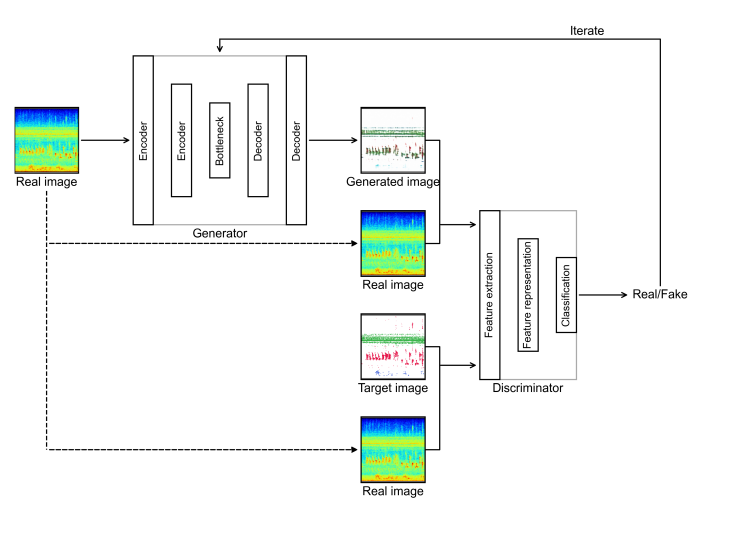
Schematic of the GAN architecture. (Image by WANG Mei)
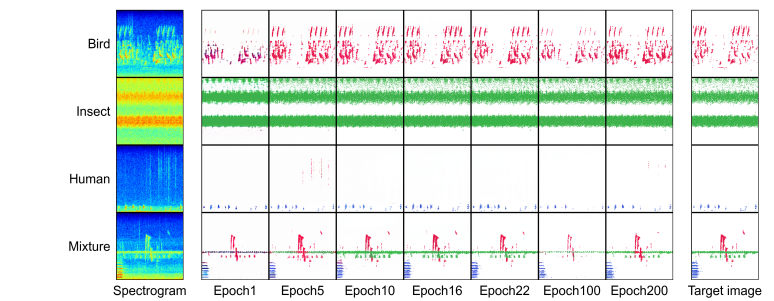
Visual comparison of images generated by the community GAN model. (Image by WANG Mei)

Researchers from the Shenzhen Institutes of Advanced Technology and their collaborators proposed a novel and effective automatic segmentation method by using Generative Adversarial Networks with dual discriminators.
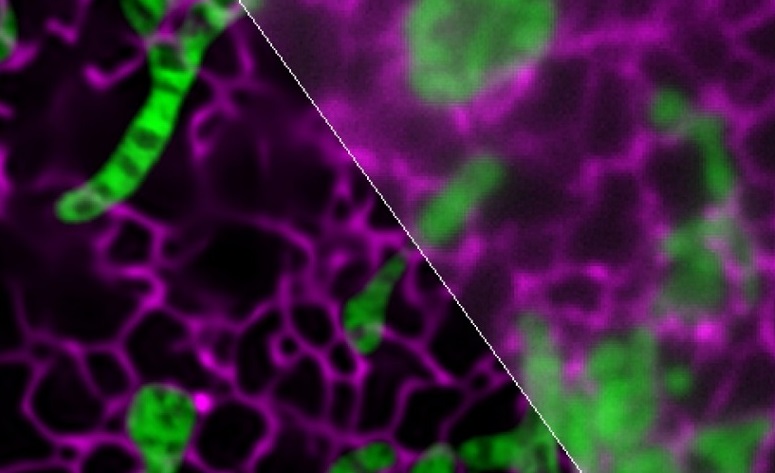
LI Dong's group from Institute of Biophysics of the Chinese Academy of Sciences, and the collaborators, developed the deep Fourier channel attention network (DFCAN) and its derivative that was trained with generative adversarial network (GAN) strategy, termed as DFGAN.

86-10-68597521 (day)
86-10-68597289 (night)

52 Sanlihe Rd., Xicheng District,
Beijing, China (100864)
Copyright © 2002 - Chinese Academy of Sciences


