
Understanding how water moves through the Earth system is fundamental to predicting climate impacts and ensuring sustainable water management. Yet despite decades of research, uncertainties persist regarding how global precipitation is partitioned into evapotranspiration and river flow—the two dominant pathways by which water returns from land to the atmosphere and oceans.
To address this knowledge gap, a new study led by Prof. ZHANG Yongqiang from the Institute of Geographic Sciences and Natural Resources Research of the Chinese Academy of Sciences, has delivered a highly observation-constrained assessment of the global water cycle to date. Published recently in Nature Geoscience, the study integrates satellite-derived hydrological estimates, multi-model Earth system simulations, and long-term observations from 50 major river basins worldwide via an advanced Emergent Constraint framework.
The research team found that global river flow is significantly lower—by approximately 14%—than the central estimates of current Earth system models, with global land evapotranspiration correspondingly higher. Their analysis shows that between 1980 and 2014, global river flow averaged 39.1 ± 5.4 × 10³ km3 per year, with a global runoff coefficient of 0.35 ± 0.03; both figures fall below widely cited values.
The researchers also revealed that Earth system models systematically overestimate increases in global river flow under warming conditions. The new constrained estimate indicates that river flow will rise by 7.8 ± 5.5 mm per year per degree of global warming—roughly 9% lower and 66% less uncertain than the multi-model mean. Similar overestimations were observed for ocean precipitation and evaporation.
"Our study shows that global models tend to exaggerate the magnitude of river flow increases in a warmer world," Prof. ZHANG said. "By integrating real-world observations, we have provided a more realistic and robust estimate of how the global water cycle is partitioned, both currently and in the future."
The researchers noted that this work provides the first globally consistent benchmark for water cycle partitioning and highlights the essential role of human impacts in shaping global river flow.
The findings carry implications for improving climate model projections, refining global water resource assessments, and guiding long-term adaptation strategies.
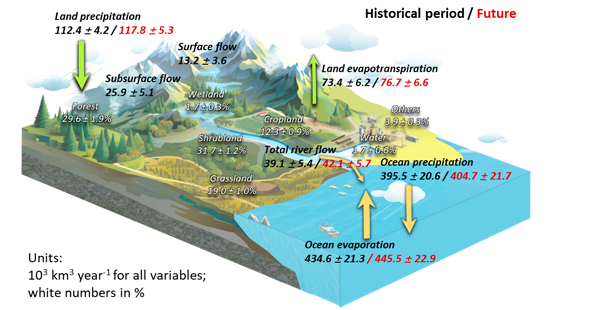
Partitioning of the global water cycle using the Emergent Constraint approach. (Image by Prof. ZHANG Yongqiang's team)

86-10-68597521 (day)
86-10-68597289 (night)

52 Sanlihe Rd., Xicheng District,
Beijing, China (100864)
Copyright © 2002 - Chinese Academy of Sciences


