
A research team led by Associate Professor WANG Yaqiong from the Nanjing Institute of Geology and Palaeontology of the Chinese Academy of Sciences (NIGPAS), in collaboration with colleagues from multiple domestic and international institutions, has for the first time documented two marine ostracod fossil species—Bicornucythere bisanensis s.l. and Pistocythereis bradyformis—in Pleistocene lacustrine deposits of the Qaidam Basin.
The findings were recently published in the journal Palaeoentomology.
Long-distance dispersal (LDD) is defined as the process by which organisms or their dispersal units spread, within a specific time frame, to regions that are difficult or impossible to reach through their normal dispersal capabilities. Previous studies on intercontinental, intra-oceanic, and interoceanic LDD of marine ostracods have generally ruled out migratory birds as a potential dispersal vector.
These fossil specimens were previously misidentified as Cytherissa qaidamensis, a non-marine ostracod species. Both fossil and extant records confirm that B. bisanensis s.l. and P. bradyformis are predominantly restricted to coastal areas of the western Pacific, including China, South Korea, Japan, and the Russian Far East, spanning a latitudinal range of approximately 20°–43° N.
The discovery of these marine ostracods in Pleistocene terrestrial deposits of the Qaidam Basin—far from any modern coastline—strongly suggests that the species underwent long-distance dispersal via migratory waterfowl during the Pleistocene epoch. This journey would have covered over 2,000 kilometers and traversed extensive continental interiors.
The finding not only provides new fossil evidence supporting the potential role of migratory birds in marine ostracod LDD but also implies that the East Asian Flyway or East Asia–Australasia Flyway—one of the world's three major modern migratory bird flyways—was already established by the Pleistocene. Additionally, the ancient Qaidam Lake may have served as a key stopover site within this migratory network.
This study was supported by the National Key Research and Development Program of China and the National Natural Science Foundation of China.
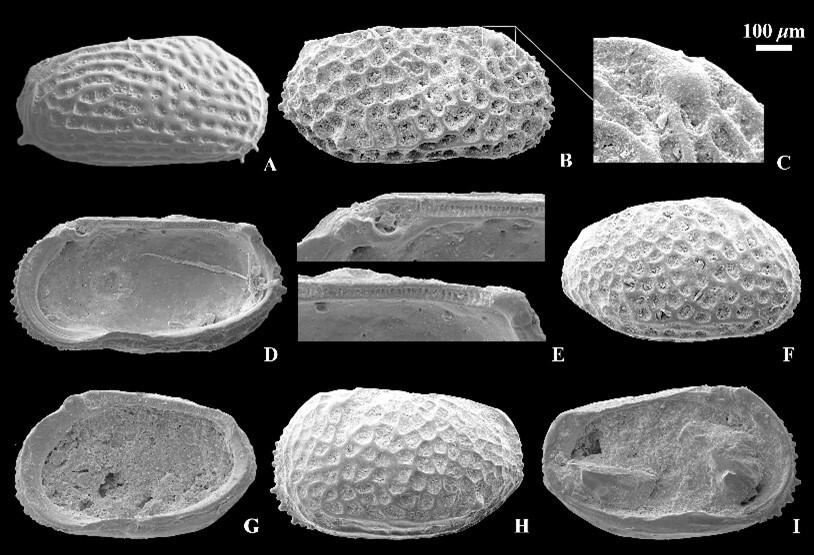
Bicornucythere bisanensis s.l. (A) and Pistocythereis bradyformis (B–I). (Image by NIGPAS)

Long-distance dispersal of marine ostracods via water birds from the coastal areas of the West Pacific Ocean to the Qaidam palaeo-lake. (Image by NIGPAS)

86-10-68597521 (day)
86-10-68597289 (night)

52 Sanlihe Rd., Xicheng District,
Beijing, China (100864)
Copyright © 2002 - Chinese Academy of Sciences


