Seeds play a vital role in the plant life cycle, and seed longevity is a key factor in determining their suitability for long-term storage. Lotus seeds can survive for thousands of years in natural conditions and even germinate under suitable conditions. Understanding the mechanisms underlying lotus seed longevity could provide new strategies for the successful long-term storage of seed crops.
Recently, a research team from Wuhan Botanical Garden systematically investigated the components of lotus seeds, specifically the pericarp, cotyledon, and plumule, at physiological, biochemical, and molecular levels, trying to elucidate the inherent mechanisms contributing to their longevity.
The lotus seed pericarp serves as a crucial protective shield for the seed with a robust structure and high levels of antioxidants. “In mature seeds, the pericarp loses water and became denser, thereby enhancing its hardness and water resistance,” said SUN Heng, the first author of this study. “During the lotus seed development, key cell wall synthesis genes-NnCesAs were predominantly expressed in pericarp.”
The cotyledons of lotus seeds, the part we often eat, reserved rich starch to provide sufficient energy for long-term storage and germination. The researchers identified several key structural genes (e.g. NnAGPL2a and NnGBSS1) and transcription factors (e.g. NnMYBs and NnNACs) involving in starch synthesis in the cotyledons.
They found that the chlorophyll degradation pathway remains inactive in plumules during later developmental stages, the chlorophyll-retained lotus seed plumule enabled rapid germination of lotus seeds after pericarp breakage and quick acquisition of photosynthetic capability.
Further studies found that the decline vitality in lotus seed was associated with down-regulated expression of HSP (heat shock protein) genes in the transcriptome sequencing analysis of both artificially aged and ancient lotus seeds.
Additionally, there was an expansion in the number of seed maturation and defense response genes within the lotus genome, potentially reflecting an adaptive strategy against the challenges of long-term storage conditions.
“These findings significantly enhance our understanding of lotus seed longevity and provide valuable insights for improving seed storage and production practices,” said SUN.
This research was funded by the Biological Resources Programme, Chinese Academy of Sciences, the Hubei Province Supporting High Quality Development Fund Project for Seed Industry, and the National Natural Science Foundation of China.
The results have been published in the Journal of Experimental Botany entitled “Unveiling the secrets of lotus seed longevity: insights into adaptive strategies for extended storage”.
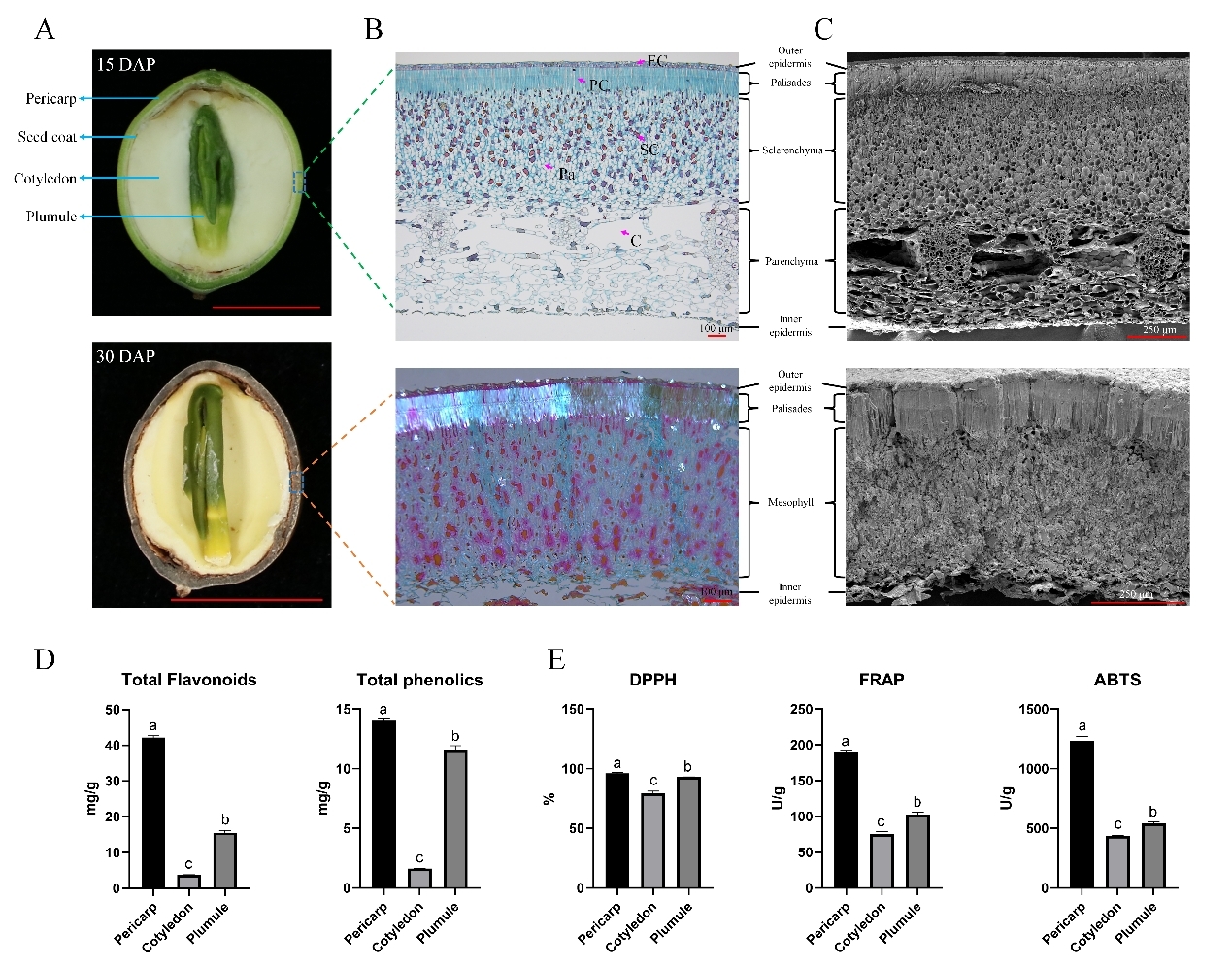
Lotus seed pericarp observations at 15 and 30 days after pollination (DAP). (A) The lotus seed structure. (B) Light microscopic and (C) scanning electron microscopic (SEM) images of lotus seed pericarp. (D) Contents of total flavonoids and total phenolics in the seeds of the lotus cultivar ‘Jianxuan17’. (E) Antioxidant activities in the seeds of the lotus cultivar ‘Jianxuan17’ (Image by WBG)

86-10-68597521 (day)
86-10-68597289 (night)

52 Sanlihe Rd., Xicheng District,
Beijing, China (100864)
Copyright © 2002 - Chinese Academy of Sciences