
In a study published in Cell & Bioscience, the research team led by Prof. LIU Jing at the Guangzhou Institutes of Biomedicine and Health of the Chinese Academy of Sciences revealed the molecular mechanisms by which the base analogues BrdU and IdU promote somatic cell reprogramming through DNA damage repair pathways, regulating histone acetylation and DNA demethylation, and summarized the correlation between BrdU dosage and effects across multiple reprogramming systems.
This study is based on the highly efficient chemical reprogramming system with well-defined chemical components previously established by the team. In this system, BrdU plays a crucial role as a base analogue, but its mechanism is unclear. Therefore, this study answers the key questions that how the randomness of base analogues, integrating randomly into the genome, participates in the precise process of somatic cell reprogramming, which is fundamentally an epigenetic reprogramming process, and how these impacts and regulates epigenetic reprogramming.
The researchers found that BrdU can play a role in two stages of chemical reprogramming and can be substituted by IdU.
In the first stage, the transition of somatic cells to an XEN(extraembryonic endoderm)-like intermediate state, continuous treatment with BrdU/IdU causes DNA damage accumulation. Inhibiting the main repair pathway for double-strand breaks, ataxia telangiectasia-mutated (ATM), can significantly reduce the efficiency of chemical reprogramming. The acetylation of key genes in the XEN-like state, is specifically upregulated under base analogue treatment. The activation of ATM leads to a phosphorylation-acetylation cascade, suggesting that base analogues can activate the ATM signaling pathway by inducing DNA damage, leading to the accumulation of acetylation at the damage sites and thus regulating gene expression.
In the second stage, during the transition from XEN-like state to pluripotency, DNA methylation is a major limiting factor. The sustained damage caused by base analogues can lead to the demethylation of newly synthesized DNA strands, losing their original methylation modifications.
Besides, after discovering the specific molecular mechanisms of base analogues, the researchers validated the universality of these mechanisms in factor reprogramming systems and established an efficient somatic cell reprogramming system centered around BrdU with KLF4 and SOX2 (KS). In this system, BrdU can still promote somatic cell reprogramming through the ATM signaling pathway by activating XEN genes. The researchers also identified the molecular action characteristics of base analogues in different reprogramming systems and summarized the correlation between BrdU dosage and effects.
This study showed that BrdU/IdU can activate the DNA damage repair pathway (homologous recombination repair), leading to increased histone acetylation and genome-wide DNA demethylation, thereby regulating somatic cell reprogramming. It revealed the interplay between the genome and epigenetics in somatic cell reprogramming, providing new insights into the mechanisms of cell fate transition.
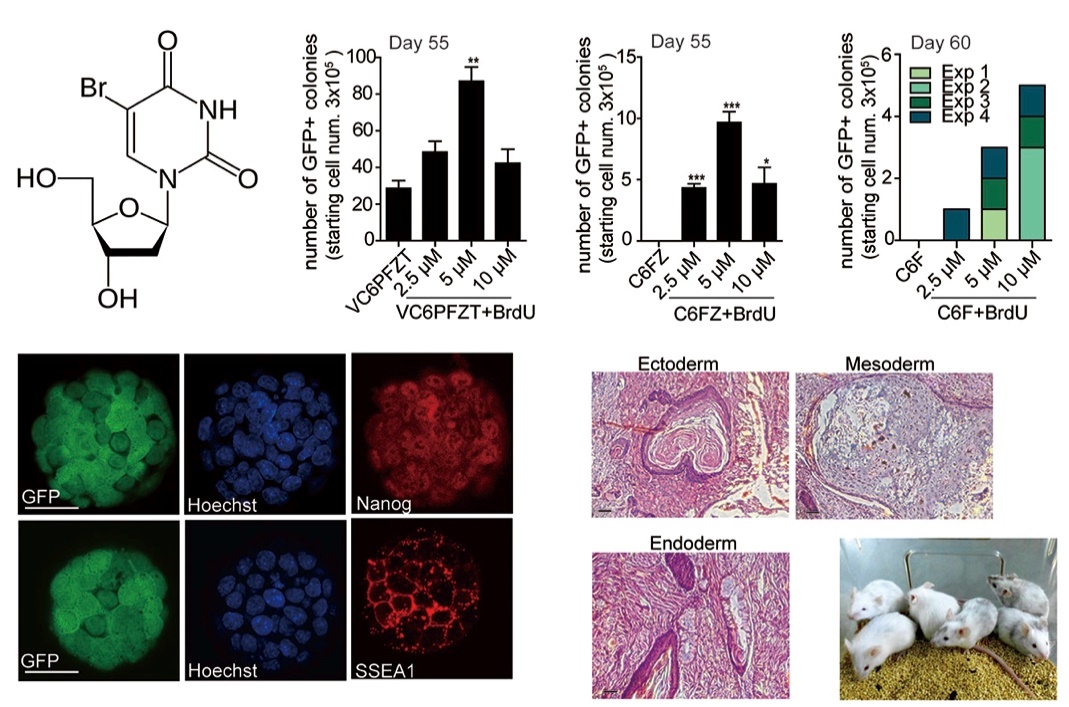
Prof. XIE Xin's group from Shanghai Institute of Materia Medica (SIMM) of Chinese Academy of Sciences recently discovered that the commonly used biological reagent bromodeoxyuridine (BrdU) can enhance Yamanaka factor-mediated reprogramming and BrdU can replace Oct4, the m...
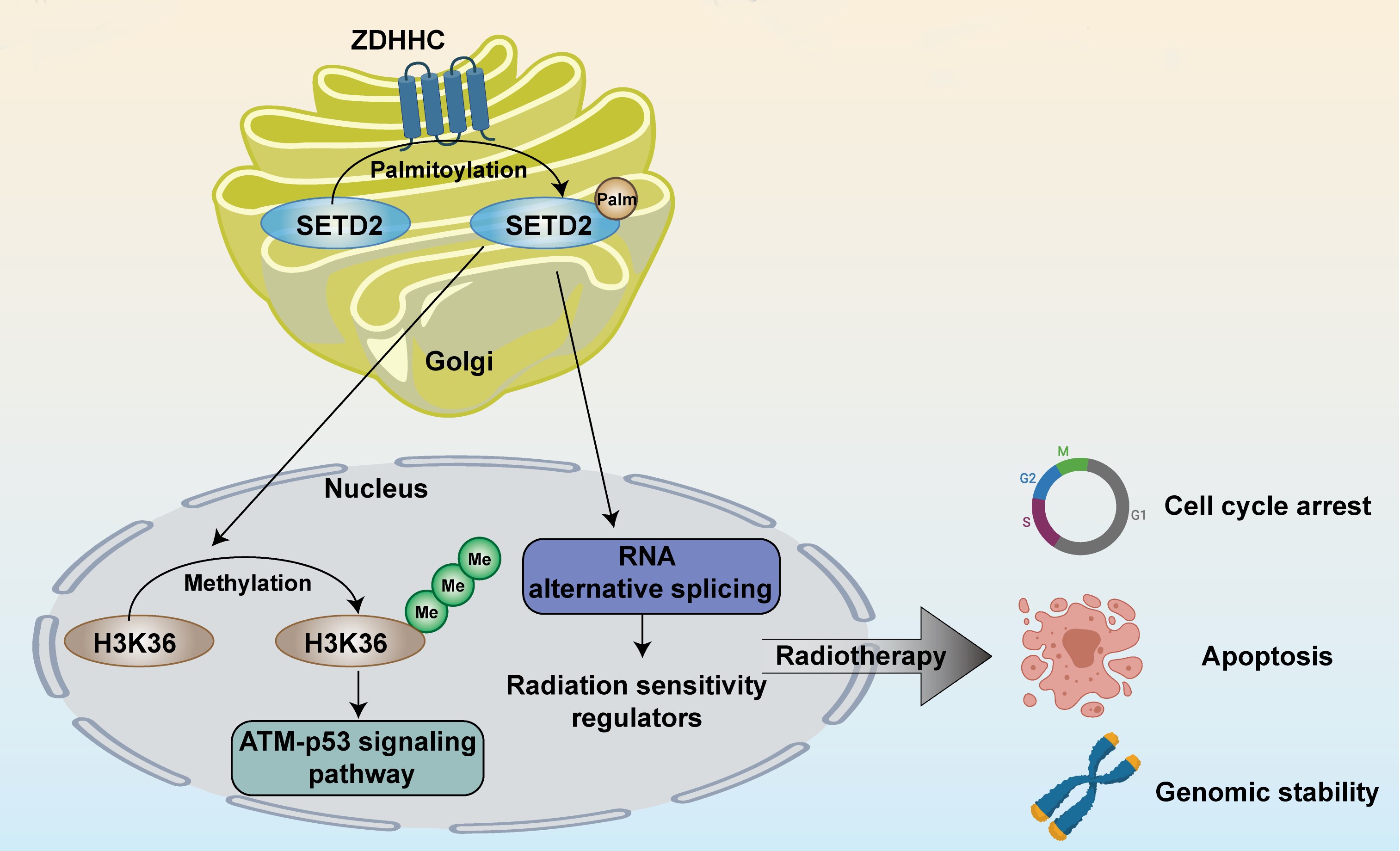
According to a recent study, researchers led by Prof. FANG Zhiyou and Prof. CHEN Xueran from the Hefei Institutes of Physical Science first found that palmitoylation regulates the activity of a protein called SETD2, affecting H3K36me3 methylation levels and RNA selective ...

86-10-68597521 (day)
86-10-68597289 (night)

52 Sanlihe Rd., Xicheng District,
Beijing, China (100864)
Copyright © 2002 - Chinese Academy of Sciences


