
Recently, new progress has been made in the degradation of oxytetracycline (OTC) by the method of intimately coupled photocatalysis and biodegradation (ICPB).
Researchers from the key laboratory of Urban Pollutant Conversion of the Institute of Urban Environment, Chinese Academy of Sciences, reported a modified synergistic degradation protocol by simultaneously combining photoelectrons transfer between photocatalysts and microbes without adding additional electron donor or improving the loading rate of photocatalysts.
The results were published in Water Research titled "Light-excited photocatalytic coupled with bio-photocatalysis enhanced the degradation efficiency of oxytetracycline."
Intimate coupling of photocatalysis and biodegradation is a new method of pollutant removal, which contains both the advantages of biological treatment and the efficient and rapid characteristics of photocatalytic reactions. The photocatalysts and biofilms are coated onto a porous carrier simultaneously.
The refractories are first converted into biodegradable substances by photocatalytic oxidation, and then further degraded by microorganisms through metabolism. Thus, compounds can be effectively degraded or even completely mineralized.
However, many studies have illustrated the sterilization effect of photocatalysis. In order to maintain the degradation performance of the synergistic system, the photocatalytic performance always occurred on the outer surface, while biodegradation toke place in the interior.
In this study, a higher porosity (porosity of 95%) carrier than the previous works was used. Instead of protecting biofilms inside carriers, the photocatalysts and microorganisms were coated full of the carriers. Thus, the electron transfer between semiconductors and microbes could be stimulated.
During the tests, the initial concentration of OTC was 10 mg/L. In the static test, 96.17 ± 3.79% removal rate of OTC was achieved within just 2 hours by synergistic function.
In addition, about 94% of the degradation rate was sustained for 400 hours in a perturbation setup with a hydraulic retention time of 4 hours. The stable and antimicrobial intermediate compound β-apo-oxytetracycline (half-life to 270 days in soil interstitial water) could be further degraded within 10 min.
This work was supported by the National Nature Science Foundation of China, the Xiamen Science and Technology Program, and the Fujian STS Project.
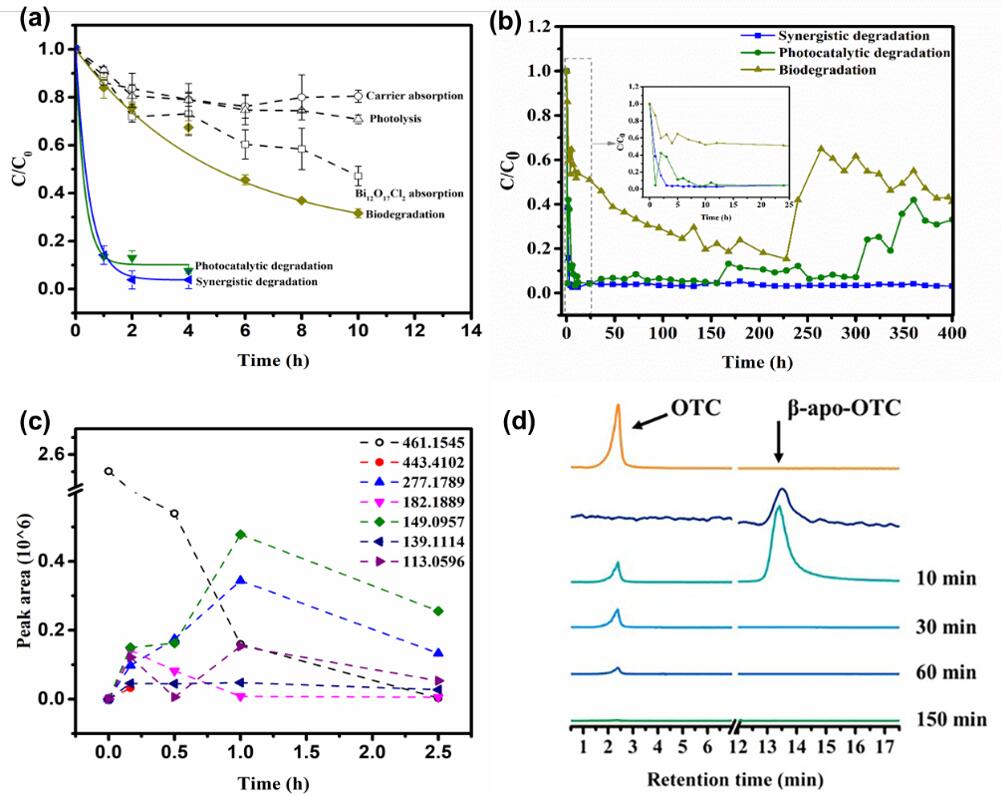
The degradation performance of the synergistic function to OTC in (a) static system and (b) dynamic system; The relative intensity evolution of (c) the main degradation byproducts and (d) β-apo-oxytetracycline. (Image by ZHAO Feng)
A research group led by Prof. WANG Feng from the Dalian Institute of Chemical Physics recently developed a photocatalytic method for the conversion of biopolyols and sugars to methanol and syngas.


86-10-68597521 (day)
86-10-68597289 (night)

52 Sanlihe Rd., Xicheng District,
Beijing, China (100864)
Copyright © 2002 - Chinese Academy of Sciences


