Newsroom


In the face of increasing drought and rising nitrogen levels in the atmosphere, a new study led by researchers from the Wuhan Botanical Garden (WBG) of the Chinese Academy of Sciences and Xinjiang Normal University sheds light on a significant difference in how C3 and C4 grassland plants adapt to changing environments. Published in New Phytologist, the study shows that, although both plant types respond similarly to drought, they use nitrogen and allocate carbon differently.
Based on 2,747 root-to-shoot ratio (RSR) observations across the globe, the researchers systematically explored these complex interactions. The findings highlight a fundamental decoupling in plant adaptation mechanisms.
According to the researchers, both C3 and C4 grassland plants exhibit a similar, "convergent" response to drought. As aridity increases, their root-to-shoot ratio rises, indicating a greater investment in belowground biomass. This strategy enhances water acquisition under drier conditions, suggesting that increased root investment is a widespread and fundamental drought adaptation strategy shared by both photosynthetic types, despite their differences in water-use efficiency.
However, in contrast to their convergent drought responses, C3 and C4 plants showed distinctly different responses to increasing soil nitrogen under arid conditions. For C3 plants, higher soil nitrogen directly increases the root-to-shoot ratio. This means they sustain belowground investment even when nitrogen availability increases. C4 plants, however, do not directly promote root allocation with increased soil nitrogen. Instead, higher nitrogen boosts their net primary productivity, which indirectly lead to a reduction in their root-to-shoot ratio. This reflects a stronger tendency toward aboveground growth. In other words, when more nitrogen becomes available, C3 plants tend to "invest in roots", whereas C4 plants tend to "invest in leaves and shoots."
The researchers further clarified, although aridity does not fundamentally alter the common tendency of C₃ and C₄ plants to increase belowground investment under dry conditions, it significantly influences the impact of nitrogen availability. These distinct nitrogen use strategies ultimately lead to different carbon allocation outcomes between C3 and C4 plants.
These findings suggest that, under future climate scenarios featuring intensifying aridity and increasing nitrogen deposition, carbon allocation patterns and storage potential may diverge further among different types of grasslands. This underscores the critical need for vegetation models to represent C3 and C4 plants with greater ecological specificity.
This work was supported by the National Natural Science Foundation of China, the Natural Science Foundation of Hubei Province, and others.
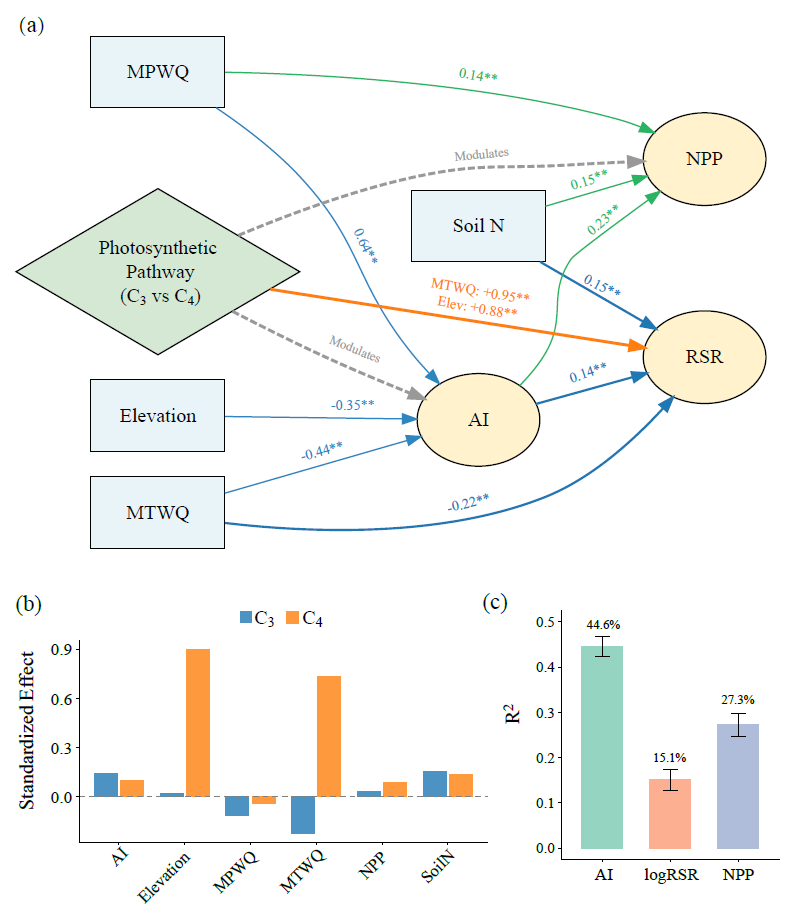
Pathways through which environmental factors influence root-to-shoot ratio in C3 and C4 grassland plants, and the differences between the two groups (Image by WBG)