
2024


In a review article published in Global Change Biology, researchers led by Prof. ZENG Fanjiang from the Xinjiang Institute of Ecology and Geography (XIEG) of the Chinese Academy of Sciences provided valuable insights into the effects of changing aridity on plant-soil systems and biodiversity in arid regions.
Long-term (<15–20 years) increases in aridity in current drylands have reduced carbon, nitrogen, and phosphorus content in plant biomass and the soil organic fraction. In contrast, the inorganic fractions of these three elements have increased, primarily in forms unavailable to plants and microbes. The decline in biologically active carbon and nutrients, coupled with reduced water availability, hinders the regeneration potential and weakens the ability of plant-soil systems to adapt to and withstand further aridity.
As aridity increases in arid lands, plant communities lose cover and diversity, except for plants with access to the water table. Under more arid conditions, non-drought-tolerant species disappear, and drought-tolerant species tend to persist, often with the protection of phreatophyte species. In the most extreme arid conditions, if the water table is affected, all remaining species are impacted, and phreatophytes may lose part of their aboveground biomass, resulting in very sparse cover.
When warming is accompanied by increased aridity in current arid lands, a feedback loop is triggered. Certain land uses, such as overgrazing and fire, exacerbate this effect, leading to reduced plant coverage, lower biocrust, and soil roughness. This, in turn, increases albedo, which tends to decrease precipitation and intensify aridity, reinforcing the loop.
Frequent increases in aridity, often accompanied by inappropriate land use in drylands, reduce available soil organic matter, nutrients, water, and biodiversity, and hinder restoration processes, affecting the provision of various ecosystem services.
"Responses to changing aridity are heterogeneous, and more research is needed to better understand the varying impacts on different arid ecosystems," said Dr. Akash Tariq, first author of this study.
"By 2100, half of the world's landmass may become dryland, creating significant challenges for maintaining essential services, and impacting human well-being,” he added.
The study highlights the impact of increasing aridity in arid lands on the global biogeochemistry in plant-soil systems and climate change across different scales.
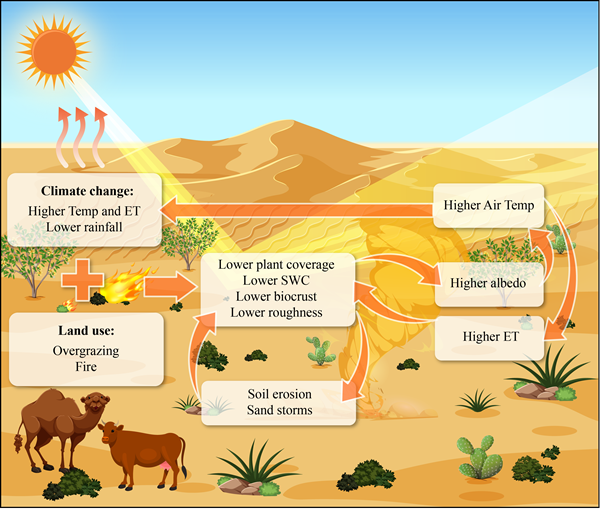
Increasing temperature (Temp) and evapotranspiration (ET) and/or decreasing precipitation, the coverage, and the soil water content (SWC), the biocrusts and the surface roughness decrease in arid areas. (Image by XIEG)
