Newsroom


Mid-infrared lasers at around 2.7 μm have potential applications in the fields such as medical treatment and manufacturing. However, achieving high-energy output in this wavelength range remains difficult.
Most existing high-energy lasers use xenon-lamp pumping, which have efficiency and thermal limitations. Although laser diode (LD) pumping provides a solution, obtaining high pulse energy remains a challenge.
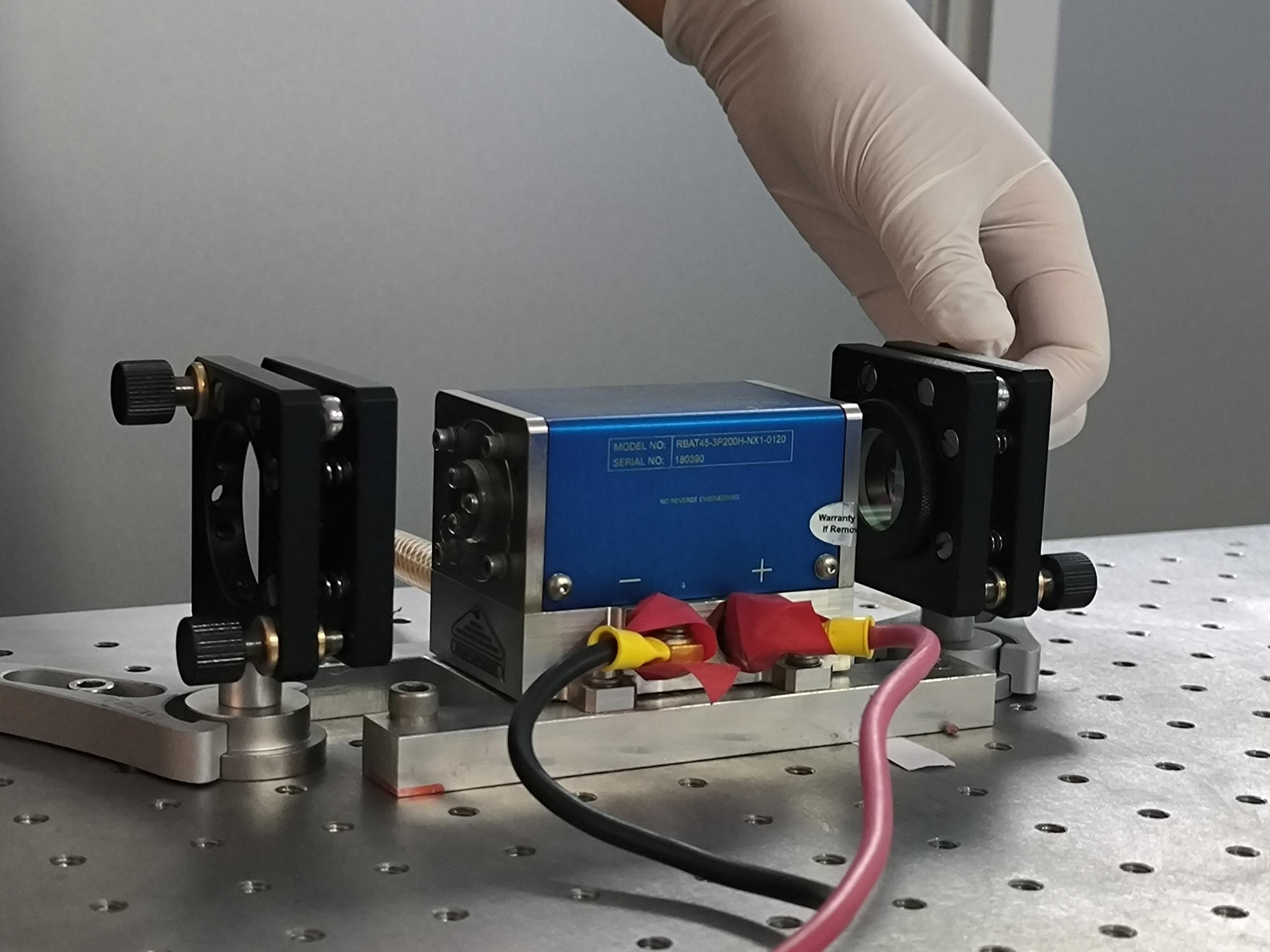
In a study published in Optics Express, a team led by Prof. SUN Dunlu from the Hefei Institutes of Physical Science of the Chinese Academy of Sciences developed a high-energy mid-infrared laser which achieves record pulse energies among LD-pumped Er3+-doped solid-state lasers operating at 2.7 μm.
Through the introduction of Gd3+ and Pr3+ ions into the YAP lattice, researchers designed a novel gain medium: Er,Pr:GYAP. This crystal helps improve laser performance by expanding the emission range and reducing energy losses during operation.
Using this crystal with LD side pumping, researchers achieved free-running pulse energies of 1.21 J and 0.94 J with bonded and unbonded crystal rods, respectively. In Q-switched operation, the laser produced a pulse energy of 125 mJ, with a pulse width of 33.55 ns, and a peak power of 3.7 MW.
These results demonstrated the potential of LD-pumped Er3+-doped solid-state lasers for achieving high-energy output at the 2.7 μm wavelength. This work provides a new approach for developing high-energy mid-infrared lasers.