
2024


A research group led by Prof. SUN Dunlu from the Hefei Institutes of Physical Science of the Chinese Academy of Sciences synthesized novel mid-infrared Ho,Pr:YAP and Er:YGGAG crystals by the Czchralski (Cz) method and improved the continuous wave laser performance of laser diode (LD) side-pumped Er:YSGG crystal by thermal bonding technology.
The 2.7~3 μm mid-infrared lasers are located at the strong absorption band of water molecules, which have wide application prospects in fields such as biomedical, optical remote sensing, and nonlinear optics.
In view of this, the researchers have found a way to make lasers more powerful and efficient. By adjusting the components in the laser material, they discovered that the performance could be improved. Specifically, they increased the concentration of one component of Ho3+ ions and added just the right amount of another component of Pr3+ ions. This adjustment helped to make the laser operate more efficiently by inhibiting the "self-termination effect".
Using the Cz method, they were able to grow a novel Ho,Pr:YAP crystal to emit lasers at about three micrometers. It's a significant improvement over older Ho:YAP lasers because it requires less pump power to start working and emits laser more efficiently.
Meanwhile, the researchers have discovered that by co-doping appropriate amounts of Gd3+ and Ga3+ ions into the YAG crystal, the crystal disorder is increased, resulting in broad emission in the mid-infrared region. Using the Cz method, a new Er:YGGAG crystal was grown, enabling the realization of the mid-infrared tunable and ultra-short laser around 2.8 micrometers.
To overcome the limitations in continuous-wave laser output, the researchers developed a thermal bonding technique. By bonding ab undoped YSGG crystal to both ends of another Er:YSGG crystal, they were able to reduce "thermal effects". As a result, the laser performance improved significantly, and a maximum output power of 28.02 watts was achieved.
These studies laid the material foundation for the development of all-solid-state mid-infrared lasers, and provided references for the design and development of novel and efficient mid-infrared laser gain materials.
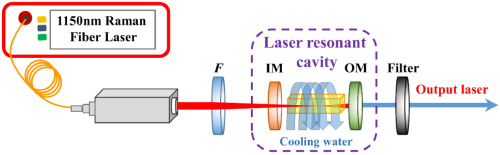
Schematic diagram of the experimental setup for end-pumped Ho,Pr:YAP crystal by 1150nm Raman laser. (Image by ZHANG Huili)
