
Increasing droughts are affecting how natural ecosystems function. In tropical savannas, the immediate impacts of drought are well known, but less is known about how droughts change plant communities and ecosystem functions in the long run.
In a study published in Ecology Letters, researchers from the Xishuangbanna Tropical Botanical Garden (XTBG) of the Chinese Academy of Sciences revealed that extreme droughts trigger long-lasting shifts in savanna vegetation, leading to complex and divergent effects on carbon storage, water cycles, and surface energy balance.
The study was carried out in a tropical savanna in Southwest China. Researchers found that although the ecosystem regained its ability to absorb carbon relatively quickly after the drought, its capacity to reflect sunlight and release water vapor had reduced for years. This combination could worsen the local warming.
Based on data collected between 2017 and 2022 from an eddy covariance flux tower site in the hot-dry valley savannas of Yunnan Province, China, researchers investigated the long-term impacts of a severe drought in 2019. They tracked changes in plant types, carbon dioxide (CO2) exchange, surface reflectivity (albedo), and water evaporation.
Researchers observed a significant shift in plant types. Over three years, the number of shrubs fell by about half, while trees declined only 12%. As shrubs disappeared, more dark soil and rock were exposed, reducing the land’s ability to reflect sunlight and increasing heat absorption.
Furthermore, researchers found that the drought impacts on energy balance and water cycling lasted longer than those on carbon uptake, and the ecosystem’s photosynthesis rate recovered within a year after the drought. In contrast, surface reflectivity and water evaporation stayed lower than pre-drought levels for at least four years. Deep-rooted, drought-tolerant trees became more common, while shallow-rooted shrubs suffered most.
"As droughts become more frequent and intense, more vegetation shifts may occur across savannas, which could create a feedback loop: Drought changes the ecosystem which then adds to regional warming and alters local climate patterns. It’s very important to include the long-term physical and biological effects, not just carbon, in climate models and conservation planning," said SONG Qinghai from XTBG, one corresponding author.
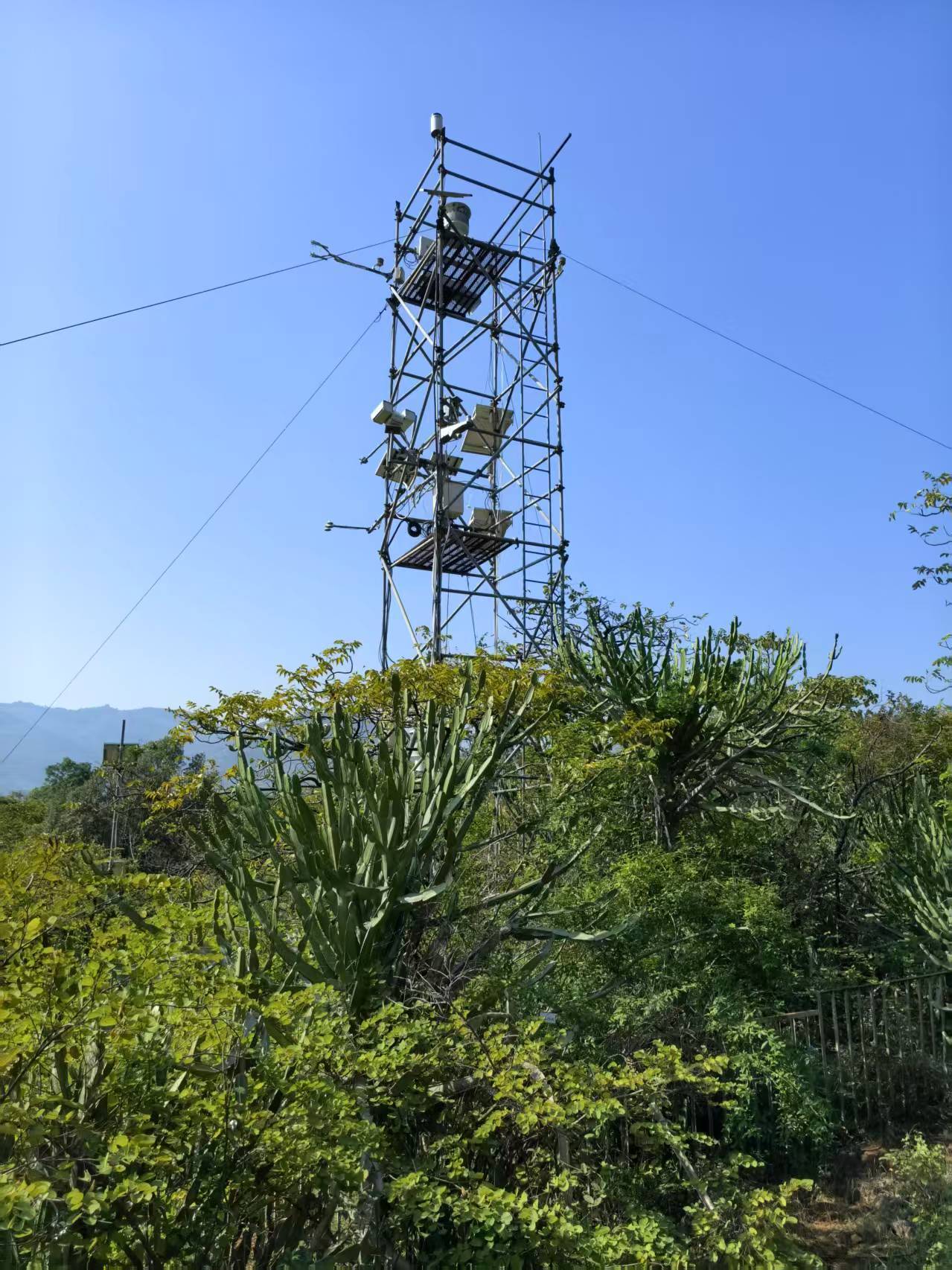
An eddy covariance flux tower site in the hot-dry valley savannas of Yunnan. (Image by SONG Qinghai)

Prof. ZHANG Yiping and his team of Xishuangbanna Tropical Botanical Garden (XTBG) applied biometric-based method (BM) and eddy covariance technique (EC) to determine carbon exchange over the Yuanjiang savanna ecosystem in Southwest China.
Dr. Tristan Charles-Dominique from Xishuangbanna Tropical Botanical Garden (XTBG) of the Chinese Academy of Sciences and his cooperators conducted a study to test the effect of plant structure on the bite rate of large herbivores. They also investigated what developmental...

86-10-68597521 (day)
86-10-68597289 (night)

52 Sanlihe Rd., Xicheng District,
Beijing, China (100864)
Copyright © 2002 - Chinese Academy of Sciences


