
In a study published in Communications Biology, a team led by Prof. SUN Yonghua from the Institute of Hydrobiology (IHB) of the Chinese Academy of Sciences constructed a transgenic Juji line, Tg(ddx4:EGFP-UTRddx4), which enables continuous labeling of the germ cell lineage across all developmental stages, demonstrating that the Juji is an excellent model for studying germ cell development and gonadal differentiation.
The zebrafish serves as a classical vertebrate model widely used in studying gametogenesis and gonadal differentiation. However, commonly used laboratory strains have lost their genetic sex-determining regions. Numerous studies have mistakenly identified genes affecting zebrafish oogenesis as those influencing sex differentiation.
The Juji (Gobiocypris rarus) is a small freshwater cyprinid fish native to streams in Sichuan Province, China. Since the 1990s, a team led by Academician CAO Wenxuan from IHB has detailed the biological characteristics of this species and conducted systematic research on its establishment as an experimental animal which is now widely used in research areas such as molecular toxicology and fish pathology.
In this study, researchers cloned the regulatory element of the germ cell-specific gene ddx4 in Juji to create the transgenic line Tg(ddx4:EGFP-UTRddx4). They found that unlike in zebrafish, the number of early primordial germ cells in Juji did not affect subsequent sex differentiation, and the fluorescence intensity in the gonads of the transgenic line at 20 days post-fertilization (dpf) directly predicted subsequent ovarian or testicular development.
Furthermore, researchers detailed the germ cell developmental trajectories in both sexes. In ovaries, germ cells underwent rapid proliferation and initiated meiosis around 25 dpf. In testes, germ cells remained in a proliferating spermatogonial state from 20 to 60 dpf, after which spermatogenesis began rapidly. Males reached sexual maturity and produced spermatozoa around 90 dpf, while females matured and produced oocytes around 120 dpf.
To identify regulatory genes at gonadal differentiation stage, researchers selected 20 dpf juveniles whose germ cells showed no differentiation. Through RNA-seq analysis on primitive ovaries and testes, they identified a total of 123 sexually dimorphic genes (SDGs). They revealed the differential expression of typical SDGs including oogenesis‑related genes and spermatogenesis‑related genes, which indicated that distinct gene-expression programs in female and male gonads emerge even before germ cell differentiation.
Moreover, using dmrt1 knockout Juji lines, researchers found that all mutants developed into fertile females, confirming that dmrt1 is essential for male development. Germline stem cell transplantation experiments demonstrated that the loss of dmrt1 function in host gonadal somatic cells is sufficient to drive gonadal feminization and direct the differentiation of donor testis-derived germ stem cells into oocytes. In other words, the fate reversal of somatic cells can reprogram the fate of germ cells.
This study develops a Juji line with continuous labeling of the germ cell lineage across all developmental stages. It reveals the advantages of Juji as a fish model for studying gonadal differentiation and gametogenesis.
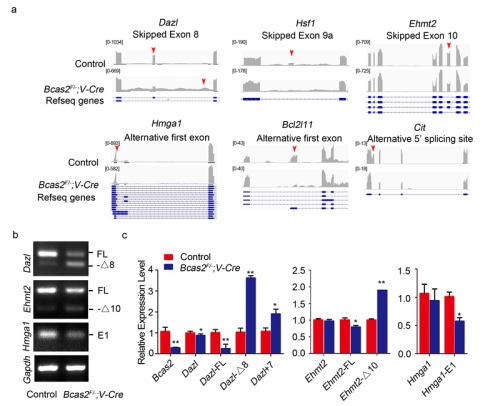
Recently, a work led by Prof. LI Lei in Institute of Zoology, Chinese Academy of Sciences, reported that BCAS2 is involved in alternative mRNA splicing in mouse spermatogonia and the transition to meiosis. In fact, BCAS2 is a small protein conserved in organisms and may p...
Scientists at Tsinghua University have led the world in inducing in-vitro differentiation of human embryonic stem cells into follicle-like cells. The breakthrough is expected to help the study of premature ovarian failure and improve assisted reproductive technology.

86-10-68597521 (day)
86-10-68597289 (night)

52 Sanlihe Rd., Xicheng District,
Beijing, China (100864)
Copyright © 2002 - Chinese Academy of Sciences


