
A central challenge in neuroimaging research is obtaining comprehensive, precise, and stable measurements of complex brain activity. These measurements are necessary to create functional representations that are both specific to individuals and generalizable across populations and contexts.
In addressing this challenge, researchers from the Institute of Biophysics of the Chinese Academy of Sciences and Beijing Normal University collaborated on a study that introduced a novel analytical framework focusing on intrinsic dynamic patterns within individual brain regions.
The study was published on October 30 in Nature Human Behaviour.
In this stuy, the researchers systematically evaluated the role and generalizability of regional dynamic properties in explaining individual differences and brain-behavior associations. They developed a robust and individually distinctive functional representation framework, termed Resting-State Regional Dynamics (RSRD), and demonstrated that RSRD-based brain-behavior association patterns generalize across independent cohorts spanning the human lifespan (ages eight to 82).
RSRD integrates multidimensional time series features, including linear, nonlinear, nonstationary, and stochastic properties, to comprehensively characterize the multilevel dynamic attributes of regional brain activity.
Using this framework, the researchers revealed that the cognitive mode is primarily driven by random-walk-like dynamics within higher-order networks. In contrast, the substance-use mode predominantly reflects nonlinear autocorrelation features that emerge from the sensorimotor network and reward-related circuits.
Further analyses in independent developmental and older adult cohorts showed that these two association modes are generalizable across life stages and uncover distinct developmental patterns. The cognitive mode appears relatively stable early in life, while the substance-use mode likely emerges gradually from adolescence into early adulthood.
The findings demonstrate that the RSRD framework can serve as a reliable "functional barcode" across analytical contexts, enabling the precise characterization of individual differences.
The framework's systematic associations with behavior highlight the substantial potential of the temporal dimension for understanding variability in brain function and brain-behavior relationships at the individual level.
This work paves the way for a new methodological approach to understanding individual variability in brain function.
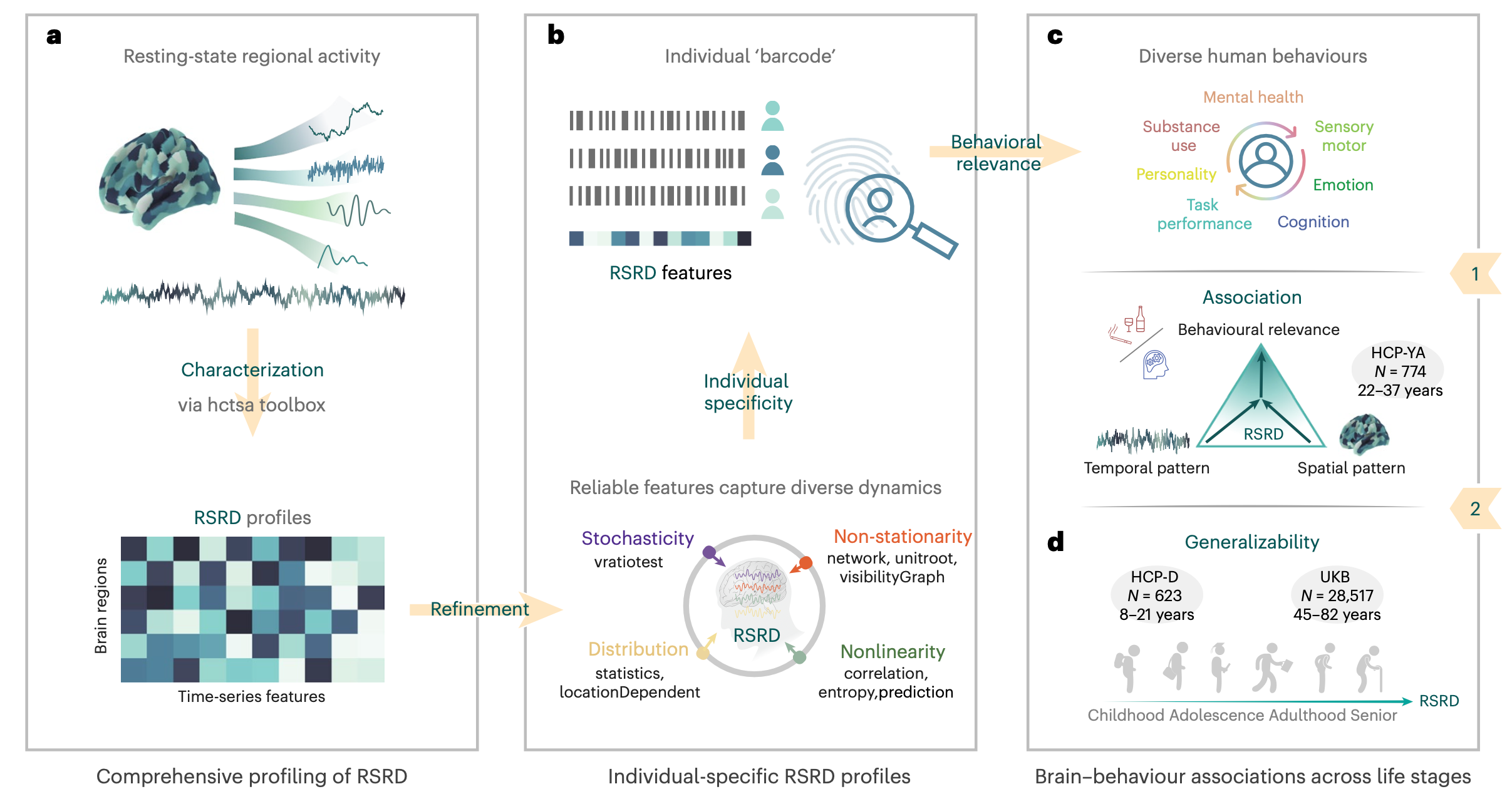
Framework for Brain-Behavior Association Research Based on RSRD (Image by LI Ang's group)

86-10-68597521 (day)
86-10-68597289 (night)

52 Sanlihe Rd., Xicheng District,
Beijing, China (100864)
Copyright © 2002 - Chinese Academy of Sciences


