
Scytodaes thoracica, also called spitting spiders, is a type of hunting spiders with globally distributions. One of the most fascinating characters of the spitting spider’s hunting behavior is that when it get close enough to the potential prey, it will raise its fangs and then eject a sticky concoction of liquid silk, which will congeal upon contact and immobilize the prey. Then, the hunting spider will start to enjoy the meal.
In a study published in Zoological Research, Prof. LI Shuqiang from the Institute of Zoology of the Chinese Academy of Sciences, collaborating with Prof. LUO Yufa from Shaoxing University, has conducted research in identifying the spatiotemporal distributions of the cosmopolitan thoracica group, and the mechanisms driving their distribution.
The global biogeography of the Scytodes thoracica group of spitting spiders of this study was based on 23 years of sampling at the species level, including 61 species in the thoracica group and 84 species of Scytodes. DNA data from six loci were incorporated.
The molecular phylogeny results showed that the thoracica group comprised four major clades, among which, Clade I distributes in Malay Archipelago, South Africa, and Madagascar, Clade II dwells in Central Asia to Europe and Canada, Clade III shows in southern USA, Central America, and China, and Clade IV, habitats in China, the Indochina Peninsula, South Asia, the Malay Archipelago, and the Seychelles.
Based on fossil timeline, molecular clock, biogeographical reconstruction analysis, this study indicated that the thoracica group initially dispersed from Southeast Asia to East Africa between 46.5 and 33.0 million years ago, and dispersal events intensified between Southeast/South Asia and East/South Africa from the early to late Miocene.
The timing of these events indicated that Asian-African faunal exchange of the thoracica group was driven by the Indian monsoon, and the pattern of dispersal suggested that colonialization took root when the Indian monsoon shifted from a North-South direction to an East-West direction from the middle Eocene.
“The timelines of these dispersals are in accordance with the shifts in the directionality of the Indian monsoon from North-South to East-West from the middle Eocene due to the uplift of the Himalayan-Xizang Plateau (HTP). The findings are useful for us to understand how the complex interplay of prehistoric geological events has shaped the evolution of Asian biodiversity,” Prof. LI said.
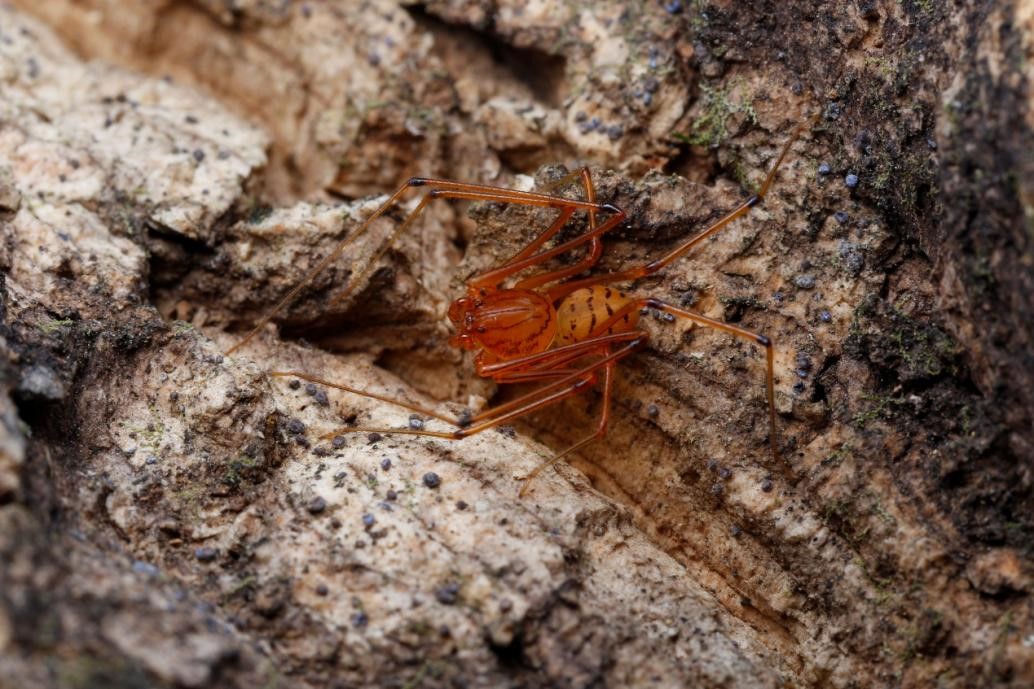
Scytodaes thoracica (Image by LU Qianle)

86-10-68597521 (day)
86-10-68597289 (night)

52 Sanlihe Rd., Xicheng District,
Beijing, China (100864)
Copyright © 2002 - Chinese Academy of Sciences


