
Scientists have long been fascinated by the silk-producing abilities of silkworms and spiders. However, there is a lack of comprehensive understanding of the basic structural units and assembly process of fibroin proteins. A major challenge limiting scientists is the denaturation of natural silk fibroin (NSF) protein when it leaves its natural environment, making it difficult to study.
In a study published in Science Bulletin, researchers led by Prof. ZHU Ping from the Institute of Biophysics of the Chinese Academy of Sciences (CAS), together with Prof. XIA Qingyou and HE Huawei from Southwest University in China, have proposed a method to keep NSF stable and maintain its in vivo structure outside the body through extensive screening.
Based on this finding, they conducted a systematic and detailed study of the morphology, structure, and potential control factors of NSF in the silk gland lumen of silkworms.
They found that the basic structural units of spinning dope consisted of flexible nanofibrils. Under the induction of metal ions, the NSF polypeptide chain folded reversibly into nanofibrils predominantly composed of random coils. A continuous decrease in pH increased the hydrophobicity of silk fibroin nanofibrils, causing water molecules to separate from NSF. This transformation turned the nanofibrils solution into a gel-like state, increasing the concentration of the spinning solution and facilitating fiber formation.
Importantly, the researchers found that NSF nanofibrils were self-assembled into anisotropic herringbone patterns at the anterior of silk gland near the spinneret (ASG-2), where the adjacent NSF nanofibrils were aligned parallel to each other, ultimately preparing for the silk spinning.
This work reveals the self-assembly mechanism of NSF, from nanofibrils to a herringbone structure. It provides new insights into the biomimetic design of insect spinning and high-performance fibers.
Understanding the spinning mechanism of silkworm silk is important for the biomimetic production of high-performance synthetic fibers, particularly for the development of high-strength and high-elongation composites.
This work was supported by the National Key Research and Development Program of China, the National Natural Science Foundation of China and the Strategic Priority Research Program of CAS.
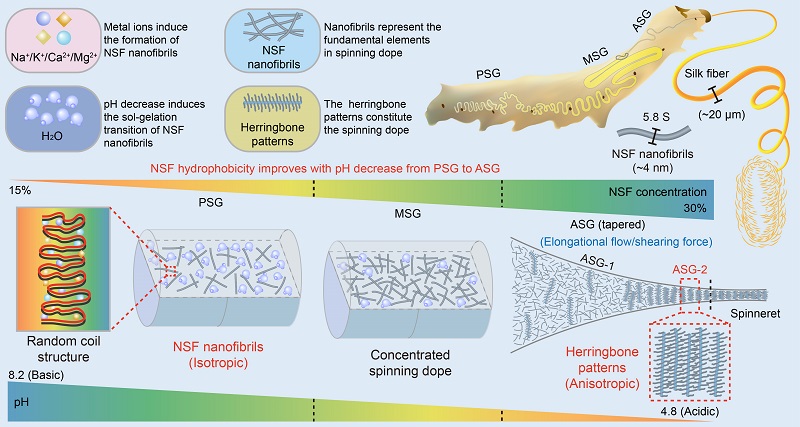
A schematic diagram of silkworm spinning (Image by ZHU Ping's group)
The greatest hurdle in utilizing the genetic resources of other non-mulberry silk worms is a severe lack of genomic and genetic data on Saturniidae worms and their silk production which are necessary to make gene mining and genetic manipulation possible. In light of this ...

The six silkworms that were sent into space on the Shenzhou-11 manned aircraft last October have produced cocoons, turned into moths and successfully spawned since returning to earth. After undertaking research and comparisons between silk made from normal silkworms and t...

86-10-68597521 (day)
86-10-68597289 (night)

52 Sanlihe Rd., Xicheng District,
Beijing, China (100864)
Copyright © 2002 - Chinese Academy of Sciences


