
A research team led by the Institute of Atmospheric Physics (IAP) of the Chinese Academy of Sciences (CAS) has confirmed that lunar observations provide a unique solution to accurately capturing Earth's outgoing radiation—an essential step in understanding the planet's radiation budget, which is closely tied to global climate and environmental changes. The findings were recently published in Journal of Geophysical Research: Atmospheres.
Earth's radiation budget is a core process of the Earth-atmosphere system, but current satellite observations—whether from low-Earth orbit or geostationary platforms—struggle to achieve both temporal continuity and spatial consistency, creating a critical knowledge gap in studying outgoing radiation patterns.
To address this gap, the IAP-led team collaborated with scientists from the CAS Aerospace Information Research Institute and the University of Chinese Academy of Sciences. Their research found that observing Earth from the Moon offers a distinct advantage. "Traditional observations mostly focus on regional or local radiation characteristics," said Dr. YE Hanlin, first author of the study. "From the Moon, Earth appears as a complete disk, allowing us to extract planet-scale dominant signals while suppressing small-scale weather noise."
Specifically, the team discovered that changes in Earth's emitted radiation observed from the lunar platform are mainly dominated by first-order and second-order spherical harmonic functions, which account for approximately 90% of the variation patterns. This acts as a "noise reduction" process, filtering out interference from local weather events and clearly capturing planet-scale radiation features—features the researchers describe as Earth's unique "radiation fingerprints."
The study also clarified the periodic patterns of these radiation changes: Synodic month periodicity, linked to the Moon's phases relative to Earth, is dominated by sectorial harmonic components. Sidereal month periodicity and its half-period stem from zonal harmonic components, driven by the periodic latitudinal shift of the observation point caused by the Moon's orbit. Intraday periodicity, meanwhile, reflects dynamic changes in the field of view due to Earth's rotation.
"A Moon-based platform provides a new, long-lasting holistic view of Earth, which is highly unique," said Prof. GUO Huadong, CAS member and corresponding author of the study.
The research confirms that holistic Earth observations from the Moon can provide support for accurately estimating Earth's outgoing radiation, advancing global climate change observation studies in the process.
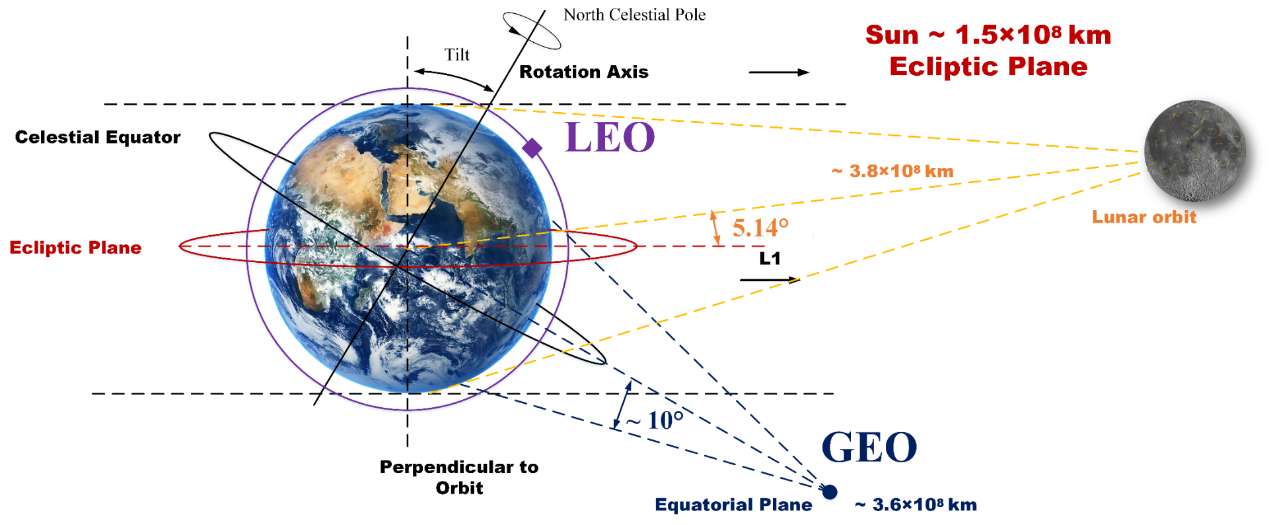
Diagram comparing ultra-long-range, low-Earth orbit, and geostationary satellite observation systems. (Image by YE Hanlin)

Chinese scientist WANG Zhenzhu and his colleagues with Hefei Institutes of Physical Science have been involving in cirrus cloud study. More recent, they made new improvement on modeling for cirrus clouds through international cooperation with Institute of Atmospheric Opti...

86-10-68597521 (day)
86-10-68597289 (night)

52 Sanlihe Rd., Xicheng District,
Beijing, China (100864)
Copyright © 2002 - Chinese Academy of Sciences


