
A new international analysis has found that the world's oceans absorbed more heat in 2025 than in any year since the start of modern measurements. The 2025 heat gain totalled 23 zetta joules—equivalent to roughly 37 years of global primary energy consumption at 2023 levels, when the world used about 620 exajoules annually.
Published recently in Advances in Atmospheric Sciences, the study was led by researchers from the Institute of Atmospheric Physics (IAP) of the Chinese Academy of Sciences (CAS), in collaboration with a global team of scientists.
Its findings draw on data pooled from international research centers and independent groups across three continents—Asia, Europe and the Americas. The dataset integrates three observational products (from IAP, the Copernicus Marine Service, and the U.S. National Oceanic and Atmospheric Administration's National Centers for Environmental Information, NOAA/NCEI) and one ocean reanalysis product (CIGAR-RT). Collectively, these sources confirm that 2025 saw the highest recorded ocean heat content (OHC) to date, underscoring the oceans' ongoing accumulation of heat.
The study also highlights that ocean warming is geographically uneven, with some regions heating up far more rapidly than others. In 2025, approximately 16% of the global ocean surface reached a record-high OHC, while about 33% registered temperatures among the top three warmest in their observational histories. The most extreme warming occurred in the tropical and South Atlantic Oceans, the North Pacific Ocean, and the Southern Ocean.
Ocean warming trends have accelerated significantly since the 1990s, the analysis shows. While the rise in OHC in the upper 2,000 meters of the ocean has been relatively steady over recent decades, a subtle uptick in the warming rate is detectable. Notably, 2025 marked the ninth consecutive year that ocean heat content hit a new all-time high.
Globally, the annual average sea-surface temperature (SST) in 2025 ranked as the third warmest on record, sitting roughly 0.5 degrees Celsius (1 degree Fahrenheit) above the 1981–2010 baseline average. SSTs in 2025 were slightly cooler than in 2023 and 2024, a shift attributed primarily to the tropical Pacific's transition from an El Niño to a La Niña climate pattern.
Sea-surface temperatures are a critical climate metric because they shape weather systems worldwide. Oceans absorb more than 90% of the excess heat trapped by greenhouse gas emissions, making them the planet's primary heat reservoir. Because OHC reflects the long-term accumulation of stored heat, it is widely regarded as one of the most reliable indicators of climate change.
Warmer surface waters boost evaporation rates, fueling heavier rainfall, more intense tropical cyclones, and increasingly severe extreme weather events. In 2025, such conditions contributed to widespread flooding and disruption across much of Southeast Asia, drought in the Middle East, and flooding in Mexico and the U.S. Pacific Northwest.
Beyond extreme weather, rising ocean heat drives global sea-level rise through thermal expansion, amplifies and prolongs heatwaves, and intensifies atmospheric instability by increasing heat and moisture in the air. As the researchers emphasized: so long as the planet continues to accumulate heat, ocean heat content will keep rising—and record highs will keep being set.
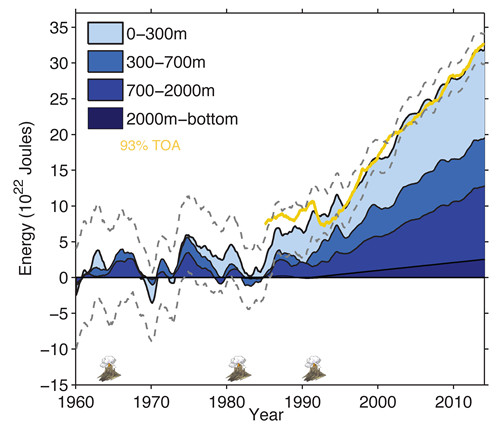
The study provided a new reconstruction on ocean subsurface temperature change since 1960 for 0-2000m depths, and assessed historical ocean energy budget more accurately. It will be a valuable resource for future studies of oceanic variability and its climatic impacts on ...
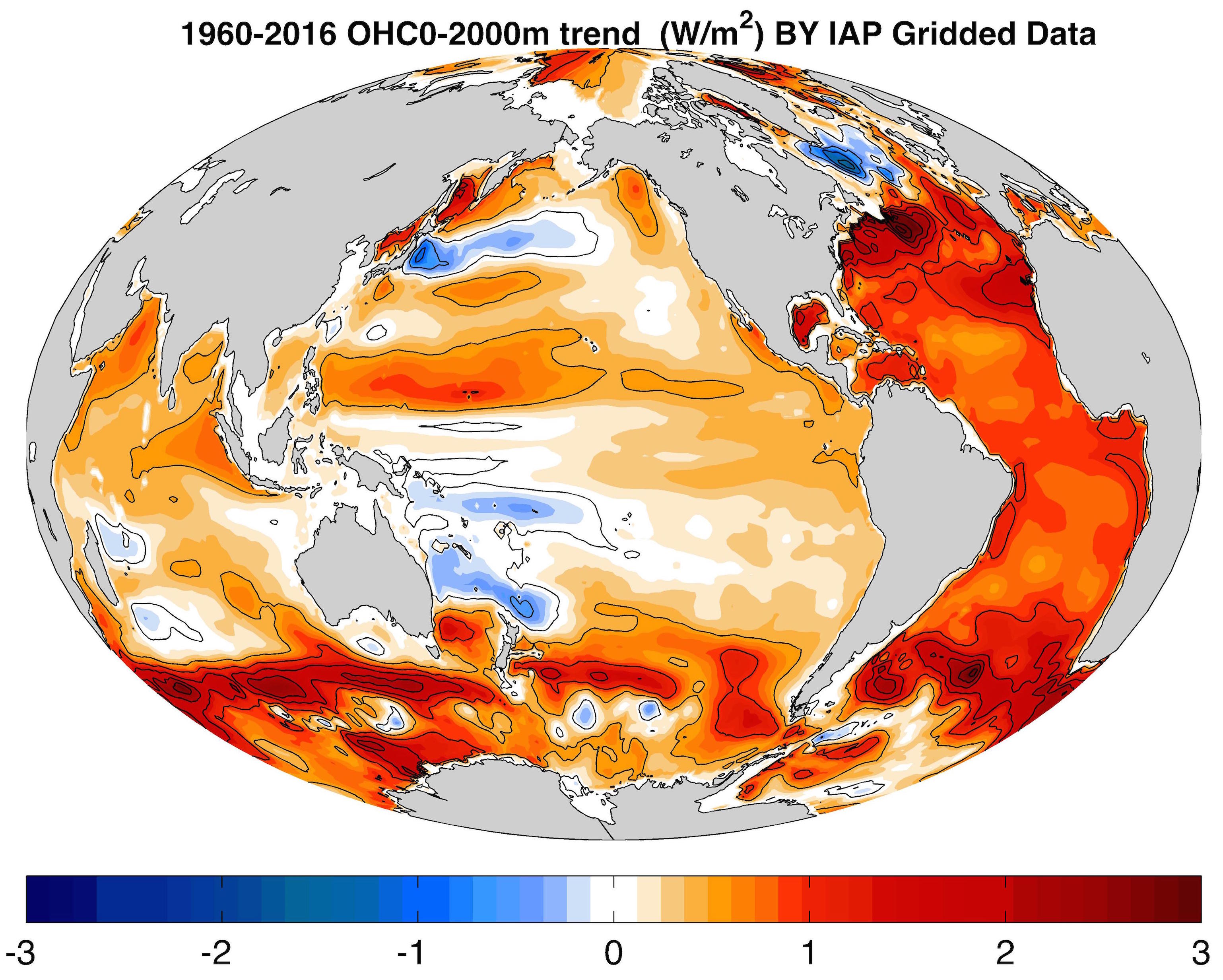
Scientists examined the ocean heat content change on decadal and multi-decadal scales and at different ocean basins and find that the oceans are robustly warming, regardless of which data was used.

86-10-68597521 (day)
86-10-68597289 (night)

52 Sanlihe Rd., Xicheng District,
Beijing, China (100864)
Copyright © 2002 - Chinese Academy of Sciences


