
Cesium (137Cs) possesses long half-life and emits high-energy γ rays. It is highly soluble and easy to migrate in the environment and biosphere. 137Cs is one of the main sources of radioactivity in spent fuel. It is very important to remove the strongly radioactive 137Cs+ from high-level liquid wastes (HLLWs) to reduce its radioactivity level before any further disposal. HLLWs are generally acidic.
However, the effective capture of Cs+ ions from acidic solutions remains a challenging task. Most of the current materials don’t perform well under the acidic conditions due to the stability issue of the materials and the strong competition of protons. On the other hand, the Cs+ capture mechanism under strongly acidic conditions is still unclear.
In a study published in Nat. Commun., Prof. FENG Meiling and her colleagues from Prof. HUANG Xiaoying’s research group at Fujian Institute of Research on the Structure of Matter of the Chinese Academy of Sciences, reported a robust layered compound KInSnS4 (InSnS-1) that can effectively capture Cs+ under both neutral and acidic conditions.
The researchers found that InSnS-1 has excellent acid and irradiation resistances, maintaining its layered network under strongly acidic (1 - 4 mol/L HNO3) and irradiation (200 kGy γ irradiation) conditions. InSnS-1 exhibits fast adsorption kinetics, high adsorption capacities for Cs+ ions under both neutral and acidic (1 mol/L HNO3) conditions, and easy desorption and reuse. It can realize effective separation of Cs+/Mn+ (Mn+ = Na+, Sr2+, Ca2+and La3+) under strongly acidic conditions (1 and 3 mol/L HNO3).
They also unveiled that InSnS-1 can be used as a stationary phase in ion exchange column for the convenient and efficient treatment of neutral or acidic wastewater containing high concentrations of Cs+ ions.
Meanwhile, the researchers directly visualized the entry of Cs+ and H3O+ ions by single-crystal structural analysis, and illuminated the underlying mechanism of selective Cs+ capture from acidic solutions at the molecular level. All promising features of InSnS-1 for the Cs+ capture originate from the extremely strong interactions between soft S2- of sulfide layers and relatively soft Cs+, the adjustable interlayer spacing and structural flexibility of InSnS-1 under acidic conditions.
Besides, they revealed the non-negligible facilitating role of H3O+ in the selective capture of Cs+ ions under acidic conditions, and the important influence of the shortest K-S distance of K+-directed metal sulfides on the ion exchange performance.
This study represents a breakthrough in the research of the Cs+ capture under highly acidic conditions through developing an effective material, and provides a deep insight into the mechanism of selective Cs+ capture from the view of microstructural illumination. It is pioneering to study the selective capture of Cs+ by metal sulfides under strong acidic conditions, which sheds light on the design of novel acid-tolerant sulfide-based ion exchange materials for radiocesium decontamination with practical applications.
FENG Meiling
Fujian Institute of Research on the Structure of Matter
E-mail: fml@fjirsm.ac.cn
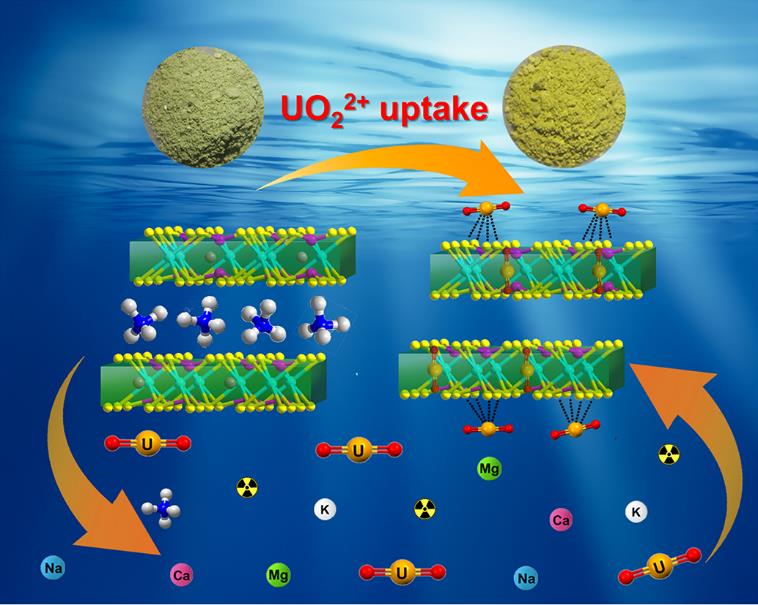
Prof. FENG Meiling from Prof. HUANG Xiaoying's research group at the Fujian Institute of Research on the Structure of Matter reported a layered manganese thiophosphate intercalated with NH4+, which could rapidly and selectively separate uranium(VI) from complex solutions....
Prof. FENG Meiling from Fujian Institute of Research on the Structure of Matter of the Chinese Academy of Sciences and the collaborators realized the efficient uptake of Cs+ by two robust layered metal organic frameworks (MOFs).

86-10-68597521 (day)
86-10-68597289 (night)

52 Sanlihe Rd., Xicheng District,
Beijing, China (100864)
Copyright © 2002 - Chinese Academy of Sciences


