
137Cs is one of the common radioactive elements in nuclear waste that is produced by fission of 235U. It is a high-level thermal fission nuclide with a half-life of about 30.17 years emitting strong γ radiations. It still remains a challenge to efficiently capture 137Cs+ from complex aqueous solutions due to its high solubility, easy mobility and the influence of interfering ions.
Metal organic frameworks (MOFs) have received much attention for the removal of radionuclides due to their highly ordered porous structure, various functional groups, etc. Compared with three-dimensional MOFs, layered MOFs have advantages including more exposed active sites, various stacking modes and adjustable interlayer spacing, which are beneficial to the efficient Cs+ uptake. However, using layered MOFs for Cs+ uptake is still rare.
In a study published in JACS Au., Prof. FENG Meiling from Fujian Institute of Research on the Structure of Matter of the Chinese Academy of Sciences and the collaborators realized the efficient uptake of Cs+ by two robust layered MOFs, namely [(CH3)2NH2]In(L)2×DMF×H2O (DMF=N, N’-dimethylformamide, H2L= H2aip (5-aminoisophthalic acid) and H2hip (5-hydroxyisophthalic acid).
The researchers found that both of the two robust layered MOFs have high acid/base and γ irradiation resistances and exhibit excellent adsorption performance towards Cs+ with fast kinetics, outstanding capacity, and excellent selectivity even in the presence of interfering Na+, K+, Mg2+, Ca2+ and Sr2+ ions. They also found that the two layered MOFs could achieve the efficient Cs+-Sr2+ separation under a wide range of Sr/Cs molar ratios, e.g., the separation factor (SFCs/Sr) is up to ~320 for 5-aminoisophthalic acid. Furthermore, the material could be completely regenerated and recycled by a cost-affordable and environmentally friendly method.
Unprecedentedly, the researchers have directly "visualized" the adsorption and elution of Cs+ by single-crystal structural analysis, and thus the underlying mechanism of Cs+ recovery by layered MOFs has been clearly illuminated at the molecular level for the first time.
All promising features of the current layered MOFs for the Cs+ uptake originate from the strong interactions between COO- functional groups and Cs+ ions, easily exchangeable cations of [(CH3)2NH2]+ and flexible and robust layer frameworks.
This study not only confirms that layered MOFs have application potential for highly efficient Cs+ recovery from complex environments, but also deepens the understanding of the relationship between materials structure and property for the removal of radionuclide.
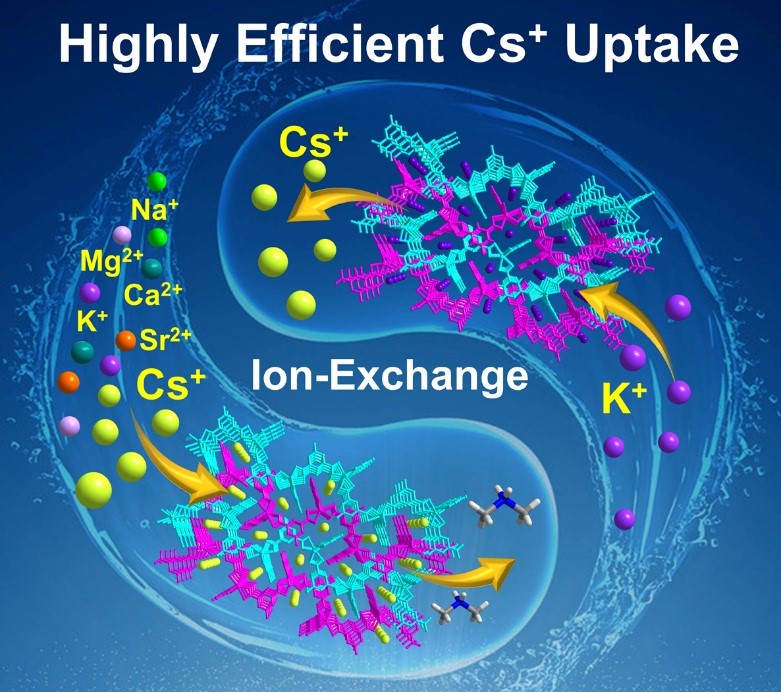
Diagram showing the uptake-elution of Cs+ by the layered MOF with structural transformation (Image by Prof. HUANG Xiaoying’s group)
FENG Meiling
Fujian Institute of Research on the Structure of Matter
E-mail: fml@fjirsm.ac.cn
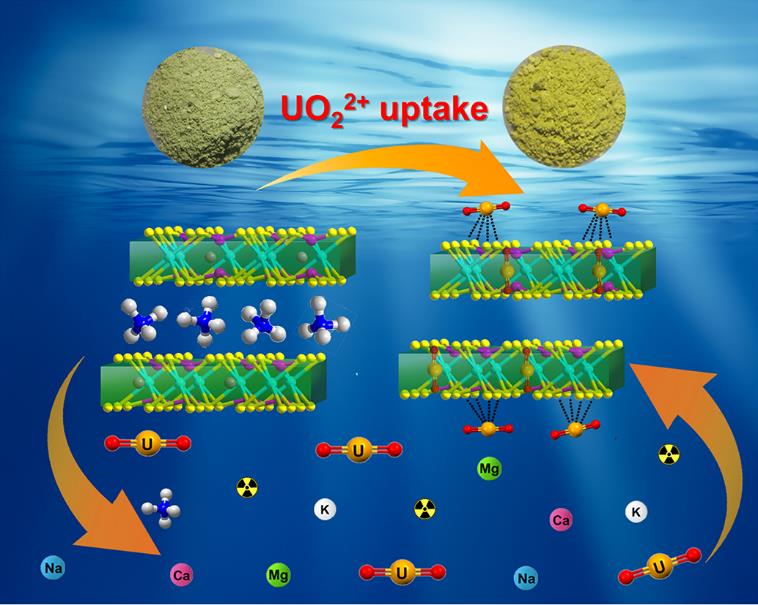
Prof. FENG Meiling from Prof. HUANG Xiaoying's research group at the Fujian Institute of Research on the Structure of Matter reported a layered manganese thiophosphate intercalated with NH4+, which could rapidly and selectively separate uranium(VI) from complex solutions....
Prof. FENG Meiling and her colleagues from Prof. HUANG Xiaoying's research group at Fujian Institute of Research on the Structure of Matter of the Chinese Academy of Sciences, reported a robust layered compound KInSnS4 (InSnS-1) that can effectively capture Cs+ under both...

86-10-68597521 (day)
86-10-68597289 (night)

52 Sanlihe Rd., Xicheng District,
Beijing, China (100864)
Copyright © 2002 - Chinese Academy of Sciences


