
Obesity poses a threat to people's health. Identification of proper agents to increase or activate thermogenesis in adipose tissues remains a potent therapeutic strategy to combat obesity.
In a study published in Theranostics, Dr. DING Qiurong's group from Shanghai Institute of Nutrition and Health of the Chinese Academy of Sciences identified a rhodanine derivative BML-260 that can activate mitochondrial activity, and in the meantime, promote thermogenesis via upregulating uncoupling protein 1 (UCP1). The finding uncovered the potential medical value of rhodanine derivatives in the prevention and treatment of obesity.
To identify reagents that can upregulate UCP1 in adipocytes, researchers applied a Ucp1-2A-GFP brown adipocytes screening system to a small molecule library. They then discovered a rhodanine derivative BML-260 that can significantly induce UCP1 upregulation. Characterization demonstrated that BML-260-treated adipocytes have increased mitochondrial activity, enhanced oxidative phosphorylation (OXPHOS) levels, and expression of thermogenesis genes.
Besides, animals were treated with BML-260 via in situ injection into white adipose tissues (WAT) to assess the in vivo effects. BML-260-treated mice displayed consistent upregulation of UCP1 and the OXPHOS proteins in WAT, and consequently improved cold tolerance in the cold challenge experiment.
Originally, BML-260 was designed as an inhibitor of JNK Stimulatory Phosphatase-1 (JSP-1), which is a dual-specific phosphatase (DUSP22), also known as JNK pathway-associated phosphatase (JKAP). However, researchers found that the activity of BML-260 in adipocytes was JSP-1 independent. Instead, BML-260 can potently activate multiple pathways including CREB, STAT3, and PPAR pathways that jointly lead to enhanced thermogenesis in adipocytes.
Rhodanine derivatives, classified as non-mutagenic, can easily undergo different chemical optimizations, and are considered to have overall low mammalian toxicity, presenting a pharmacologically attractive and sufficiently affordable class of small organic molecules.
The discovery that BML-260 can significantly activate UCP1 expression and enhance thermogenesis, provides the possibility that rhodanine derivatives can be applied to combat obesity and offers BML-260 as a starting reagent.
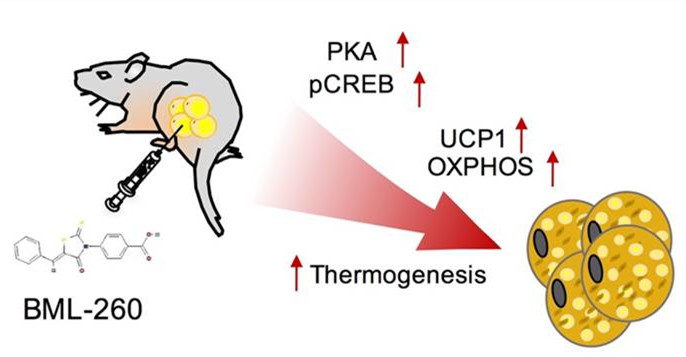
Rhodanine derivative BML-260 can modulate adipose thermogenesis as revealed in this study. (Image by Dr. Ding's Group)
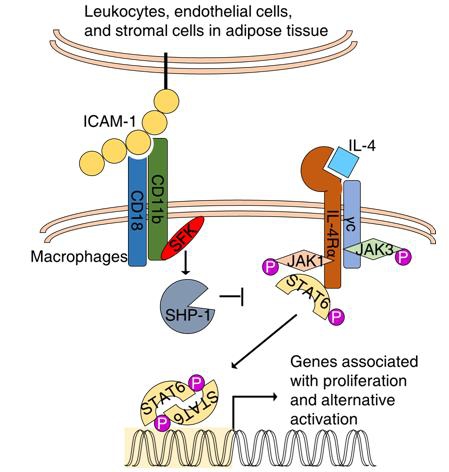
A team led by Drs. SHI Yufang and WANG Ying of the Institute of Health Sciences, Shanghai Institutes for Biological Sciences under Chinese Academy of Sciences just reported that CD11b (integrin αM) is important in mediating monocyte immigration into adipose tissue.
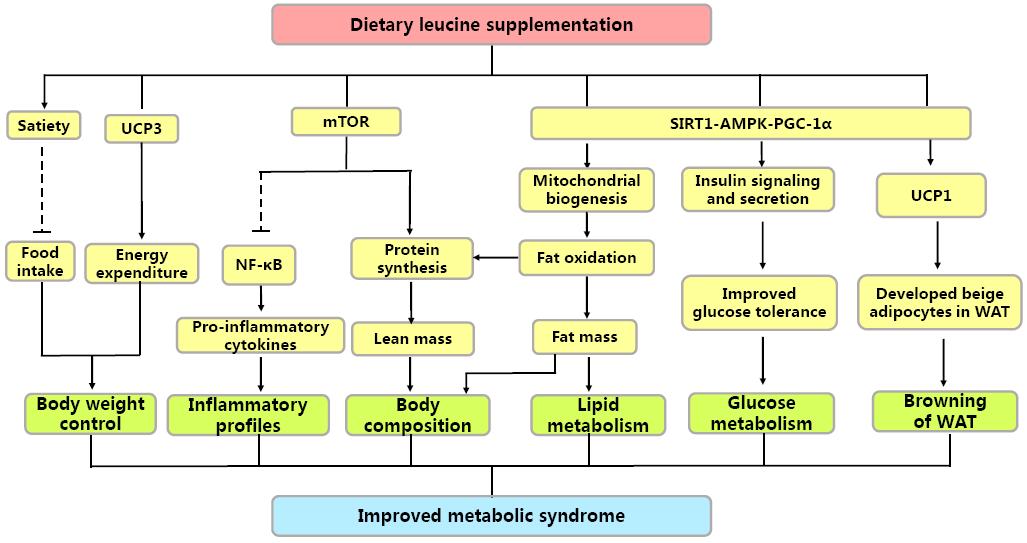
Recently, a team of researchers from China Agricultural University, and the Institute of Subtropical Agriculture of Chinese Academy of Sciences (ISA) highlight leucine, an essential and branched-amino acid, as a compound with potential therapeutic value towards obesity and its associated metabolic disorders.

86-10-68597521 (day)
86-10-68597289 (night)

52 Sanlihe Rd., Xicheng District,
Beijing, China (100864)
Copyright © 2002 - Chinese Academy of Sciences


