Newsroom


China and Pakistan will conduct four cooperative scientific experiments aboard China Space Station, involving cyanobacteria, quinoa seeds and two types of composite materials, according to the Technology and Engineering Center for Space Utilization of Chinese Academy of Sciences.
The Pakistani astronaut on a short-term flight on China Space Station will carry out related experimental operations in orbit.
One of the experiments, proposed by Pakistan’s Space and Upper Atmosphere Research Commission, will examine how cyanobacteria grow and absorb carbon dioxide in space, providing data for future oxygen regeneration and biological production. Cyanobacteria are tiny organisms that use sunlight to grow and release oxygen. The organisms used in the experiment come from Pakistan.
Another experiment, led by the University of Agriculture Faisalabad, will expose 32 quinoa seed samples to the space environment to study their resilience and longevity.
Two materials experiments will test the protective performance of graphene-based composites and the repair efficiency of self-healing carbon fiber composites.
The Pakistani astronaut Muhammad Zeeshan Ali, who will take a short-term flight on China Space Station, will carry out related experimental operations in orbit, according to Chen Mengyun, International Cooperation Project Manager at the Technology and Engineering Center for Space Utilization of Chinese Academy of Sciences.
Chinese and Pakistani scientific teams will also jointly publish papers and share the results of the experiments, said Chen.
The space station will continue to solicit, select and implement new space science projects, Chen said.
She added that China Space Station, also the national space laboratory, is open to scientists worldwide. It solicits proposals for space science and application projects from global scientists on an ongoing basis each year. (CGTN)
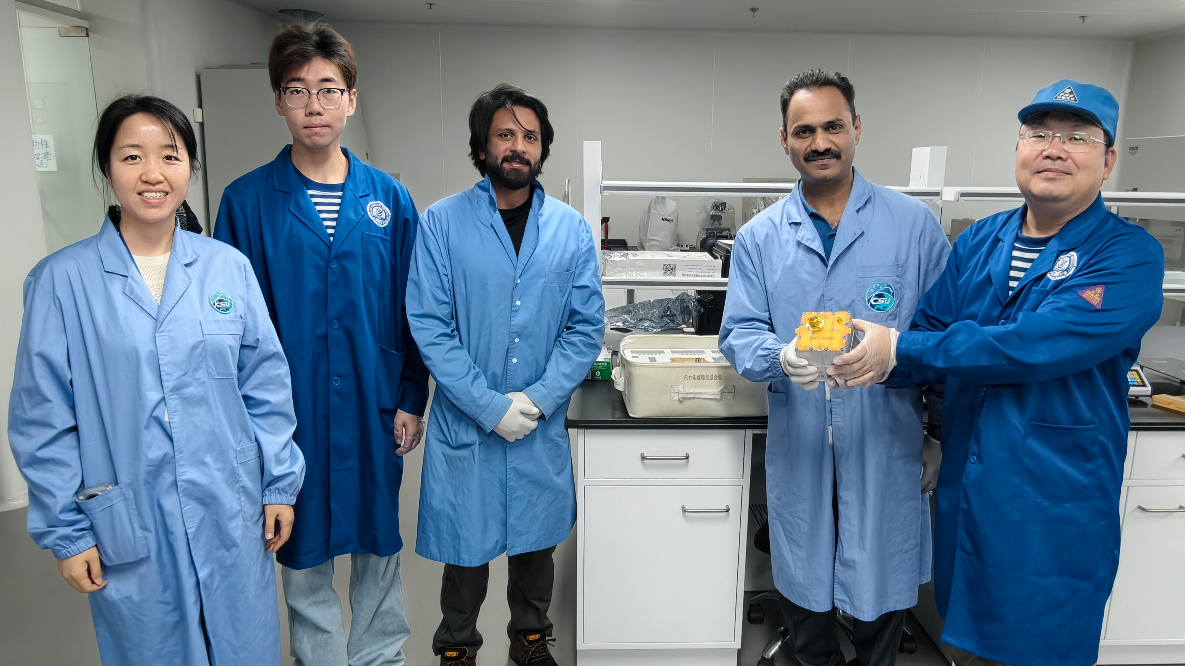
China and Pakistan will conduct four cooperative scientific experiments aboard China Space Station./ CSU