
Newsroom


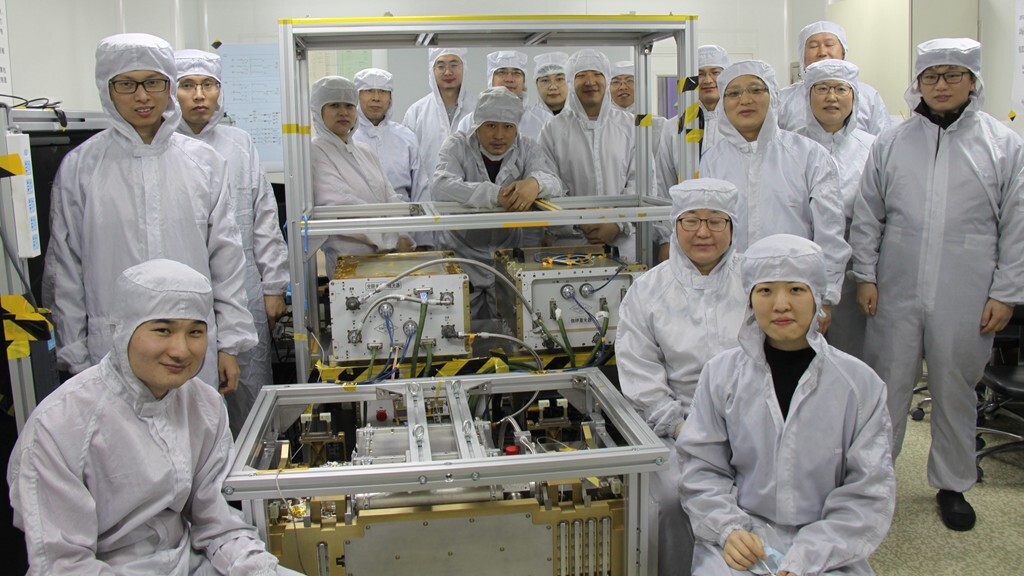
Group photo of the research team. /CSU
Chinese scientists have cooled a cloud of rubidium atoms aboard China's space station to an equivalent temperature of 9.7 trillionths of a degree above absolute zero, a record low according to the research team.
The researchers also observed the cloud expansion for seven seconds after release, providing a longer window for experiments that could probe quantum behavior and improve precision measurements.
The findings were online published in the journal Science on Friday. The experiment used the ultracold atom physics facility in the station's Mengtian laboratory module, involving researchers from Peking University, the Shanghai Institute of Optics and Fine Mechanics, and the Technology and Engineering Center for Space Utilization (CSU) of the Chinese Academy of Sciences.
The reported temperature, 9.7 picokelvin, characterizes the atoms' extremely slow expansion. It does not mean that the equipment or its surroundings reached the same temperature.
Wolfgang Ketterle, a physics professor at the Massachusetts Institute of Technology and a 2001 Nobel laureate in physics, highlighted why conducting the experiment in space matters.
"On Earth, it would fall down by about 250 meters, so it would actually crash to the ground unless you have a vacuum chamber, which is 250 meters high," he said of the cloud's seven-second expansion.
Why cool atoms in space?
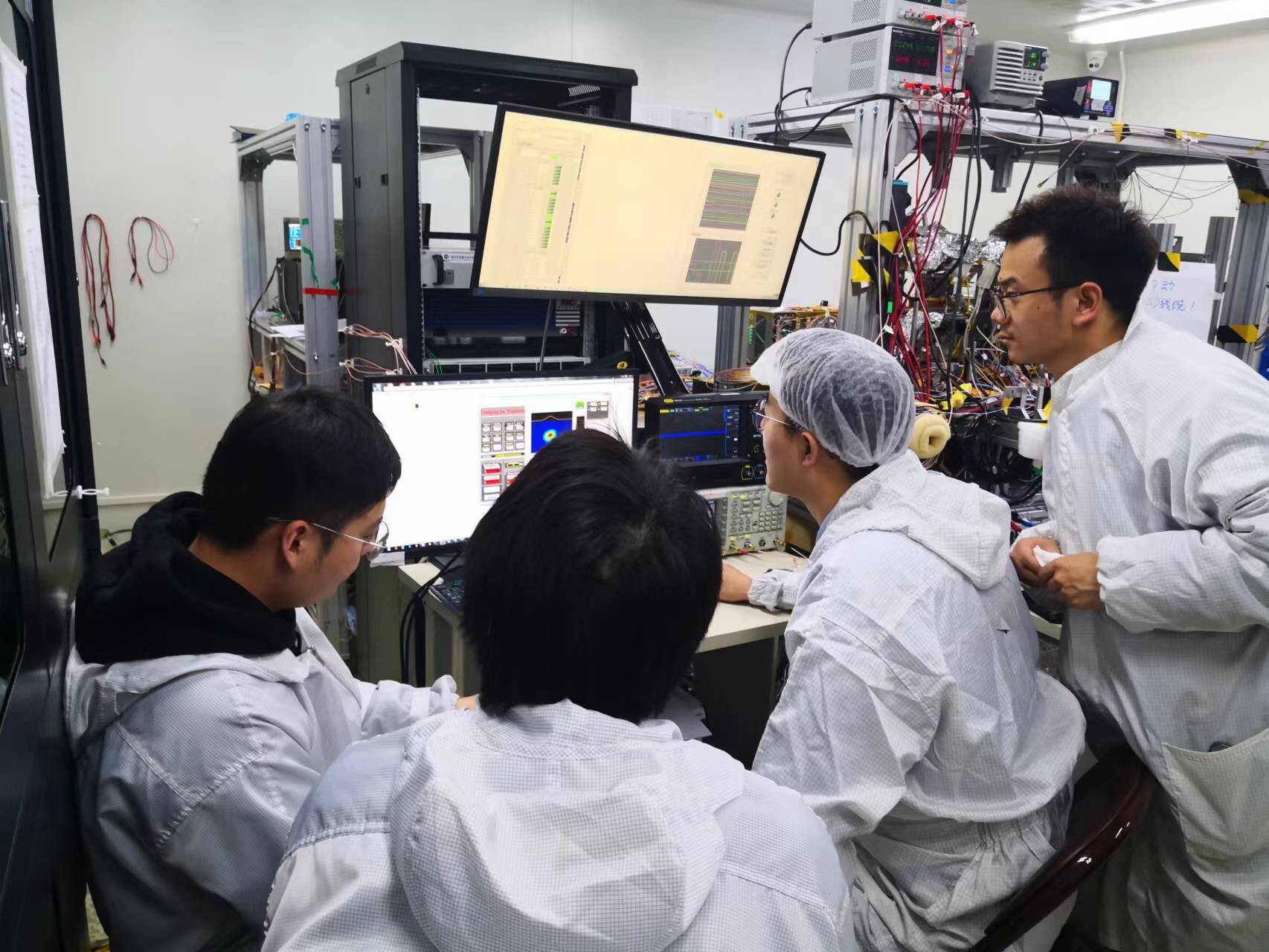
Researchers at work. /CSU
Cooling atoms slows their motion. At sufficiently low temperatures and high densities, they can form a Bose-Einstein condensate, a state in which an ensemble of atoms exhibits collective quantum behavior.
This gives researchers a way to study quantum phenomena on scales larger than individual atoms and build controlled experiments to investigate how matter behaves.
On Earth, gravity limits how weakly atoms can be confined and how long they can be observed after release. Weakening a trap helps cool the atoms, but gravity can pull them out before the desired conditions are reached.
The space station's microgravity environment allows much weaker confinement and longer observation. Taking advantage of those conditions, however, required a cooling system designed to work reliably in orbit.
The team used an all-optical trapping approach, holding and manipulating the atoms with laser light. Evaporative cooling, which allows more energetic atoms to escape, was followed by a further cooling stage using non-adiabatic expansion.
Evaporative cooling in an optical trap becomes less efficient in microgravity, according to the researchers. They developed a method using an additional magnetic gradient to improve the process and produce a condensate.
The experiment also required precise optical and electronic controls to limit disturbances that could disrupt the ultracold cloud.
Longer observation times increase the chances of detecting new, weaker physical phenomena, according to Peking University researchers Xiong Wei and Jin Shengjie, co-first authors of the paper.
A laboratory built for orbit
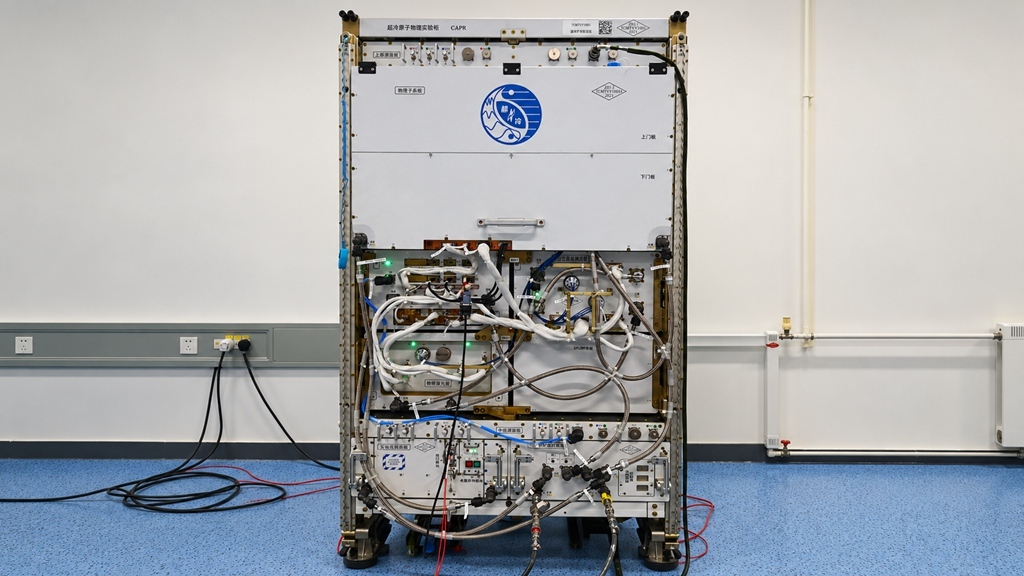
The Cold Atom Physics Rack, also referred to as an ultracold atomic physics experimental cabinet. /CSU
The facility was launched with Mengtian in 2022, following a project that began its initial assessment in 2011.
Its developers integrated a ground-based experimental system occupying about 20 cubic meters and weighing 10 tonnes into a spaceflight instrument of about 0.7 cubic meters and half a tonne.
That required integrating lasers, precision optics, an ultrahigh-vacuum system and automated controls while meeting the demands of spaceflight, including limited power and the need for reliable operation.
Beyond the temperature record, the optical system offers opportunities for quantum simulation.
It could support optical lattices, patterns of laser light that hold atoms in arrangements resembling a crystal. By changing those arrangements and experimental conditions, scientists can simulate aspects of materials that are difficult to study directly.
A longer window for precision measurements
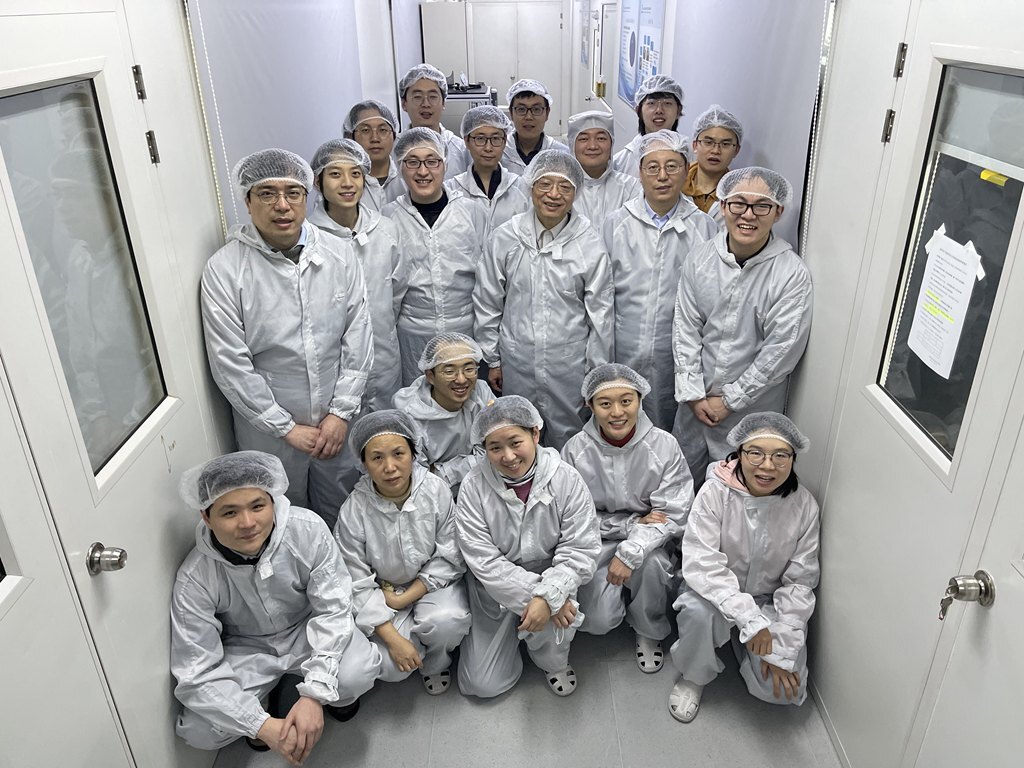
Group photo of the research team. /CSU
The work could also support atom interferometers, instruments that use the wave-like properties of atoms to measure effects such as acceleration and gravity.
"Atom interferometers highly benefit from sources providing a large number of atoms in an ultracold ensemble and long observation times," said Ernst M. Rasel, a physics professor at Leibniz University Hannover in Germany.
Rasel explained that their sensitivity increases with the square of the time atoms spend in the interferometer. He identified a next step as developing interferometers in orbit in which atoms remain coherently split for several seconds.
Such experiments could support measurements of Earth's gravity field and tests of fundamental physics, including investigations of dark matter models. These remain directions for further research.
Ketterle described the achievement as "an excellent starting point to advance atomic thermometry and precision measurements." (CGTN)
