Newsroom


A new global study has found that forest trees do not change their internal workings much when faced with long periods of drought, suggesting that such trees may not be able to adjust to drier conditions as easily as some scientists had hoped. This finding offers a robust scientific basis for forest conservation efforts.
The study, led by scientists from the South China Botanical Garden (SCBG) under the Chinese Academy of Sciences, is based on 40 experiments conducted across forests worldwide. It was recently published in the journal Proceedings of the National Academy of Sciences (PNAS).
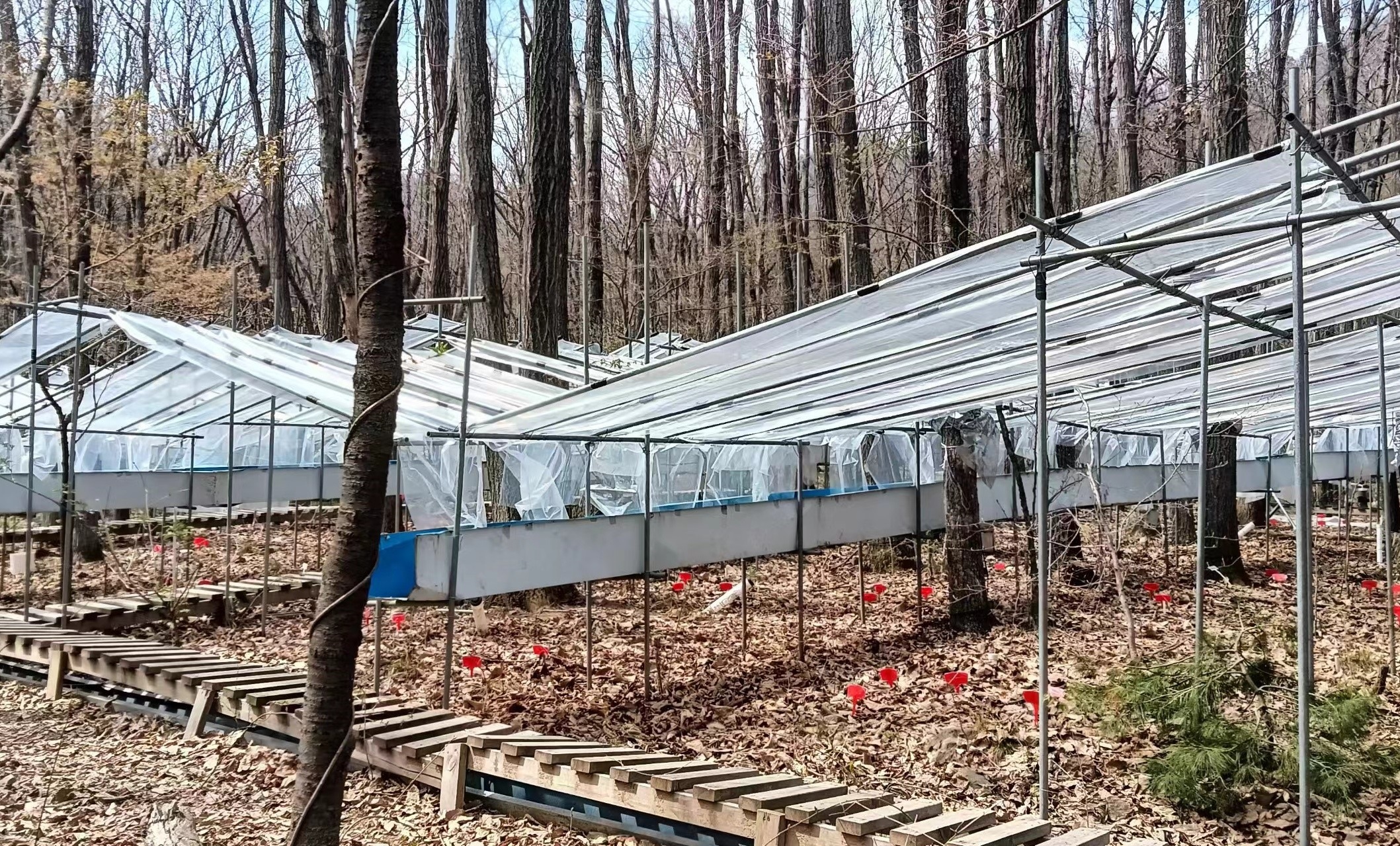
To get realistic results, the team used a special method. They set up gutters under the forest canopy to catch some of the rainwater before it hit the ground. As a result, the amount of water reaching the soil was reduced, while the trees remained in their natural environment. This gave a much truer picture of how forest trees react to drought compared with experiments using potted plants or comparing areas with different levels of natural rainfall.
The researchers looked at 24 different traits in trees, such as how they transport water, how they resist drought, and how they take in carbon dioxide for growth. They studied forests in many different climates and under various drought conditions. Overall, the trees showed very little change in these traits. Even when water was scarce for a long time, their hydraulic systems and photosynthesis abilities remained largely the same.
According to Liang Xingyun, a researcher from SCBG and first author of the study, this lack of change might actually help trees make the most of rainy periods. When rain returns, trees can quickly start absorbing carbon again because they have kept their full capacity for photosynthesis.
However, this stability comes with a risk. The study found that while the trees did not improve their ability to resist drought damage, their water levels dropped. This meant that the safety margin between their normal water status and the point where their water transport system could get harmed became much smaller. In other words, trees were operating closer to the edge of danger without becoming stronger against that danger.
Ye Qing, a researcher from SCBG and the corresponding author, explained that just because trees keep their normal functions does not mean they are safer. They may still be able to benefit from wet periods, but as the drought gets worse, they are pushed closer to their breaking point.
"The study challenges the common belief that forest trees will gradually adapt to a drier climate. It gives scientists a better basis for predicting how forests will respond to future droughts by improving the assumptions used in computer models," Ye added.
"More importantly, it highlights that the real danger for forests may not be a lack of carbon, but the shrinking safety buffer in their water systems. As droughts are expected to become more frequent and severe, understanding this limited ability to adapt will be crucial for protecting forests in the years ahead," Liang said. (Xinhua)