Newsroom


A new review led by Institute of Applied Ecology of the Chinese Academy of Sciences highlights how drought will impact grassland vegetation and pastoral livelihoods through interconnected ecological and social processes.
The review, published in BioScience, synthesized recent advances into a unified framework linking plant responses, grassland functioning and human land-use systems.
The review is set against the backdrop of a global context of increasing drought severity. From 1961 to 2024, dryland areas worldwide expanded by about 10 million square kilometers. Grasslands, which cover about 23 percent of the Earth's land surface, are particularly vulnerable to drought. As drought events become more frequent, intense, and prolonged, understanding how grasslands respond across biological and societal levels has become a scientific priority.
Led by LUO Wentao, the researchers integrated findings from ecological and social-ecological studies into a multi-level conceptual framework spanning organisms, ecosystems, and human systems. This framework organizes the impacts of drought across time and scale, from the physiological stress experienced by plants to changes in community composition, ecosystem productivity, livestock-based livelihoods, and land management decisions.
The researchers outlined two main trait-mediated pathways through which drought reshapes vegetation structure at the plant community level. One is species turnover and niche reorganization, whereby drought-tolerant species expand while water-sensitive species decline. The second pathway is intraspecific plasticity, whereby individual plants adjust functional traits, such as leaf structure, root allocation, and reproductive strategy, to cope with water stress. These two mechanisms alter both aboveground and belowground functional traits, influencing ecosystem processes such as nutrient cycling and productivity.
The researchers also explained how grassland productivity responds to drought and recovery. They noted that recovery trajectories are not uniform but instead depend on ecological thresholds. Once drought stress exceeds certain limits (tipping point), grasslands may follow different pathways, including full recovery, partial recovery, compensatory growth or system collapse. Prior drought exposure can either enhance resilience through ecological memory, meaning improved future adaptation, or increase vulnerability through cumulative stress effects. They emphasized that below-ground traits, such as bud bank density, remain underexplored despite their importance in post-drought recovery.
Beyond ecological dynamics, the review traces how drought impacts extend into pastoral social systems. Reduced forage availability can lead to livestock weight loss and higher mortality, which in turn causes economic losses for herders and contributes to land degradation. These feedbacks can reinforce cycles of ecological decline and social vulnerability.
In addition, institutional arrangements such as pasture privatization and broader economic globalization have reshaped traditional nomadic practices, creating a more complex adaptation process. In some cases, policy responses may unintentionally intensify these pressures. For instance, drought relief measures that focus solely on feed subsidies may encourage herders to keep their livestock during dry periods. This increases grazing pressure and can worsen ecosystem stress.
To strengthen future drought adaptation, the researchers identified three research priorities. They call for coordinated experimental networks to study sequential droughts across grasslands to distinguish cumulative impacts from adaptive responses. They also recommend integrating plant functional trait measurements with remote sensing and ecosystem modeling to build more comprehensive monitoring systems. Finally, they highlight the importance of stronger collaboration among ecologists, social scientists, policymakers and herders to design drought adaptation strategies.
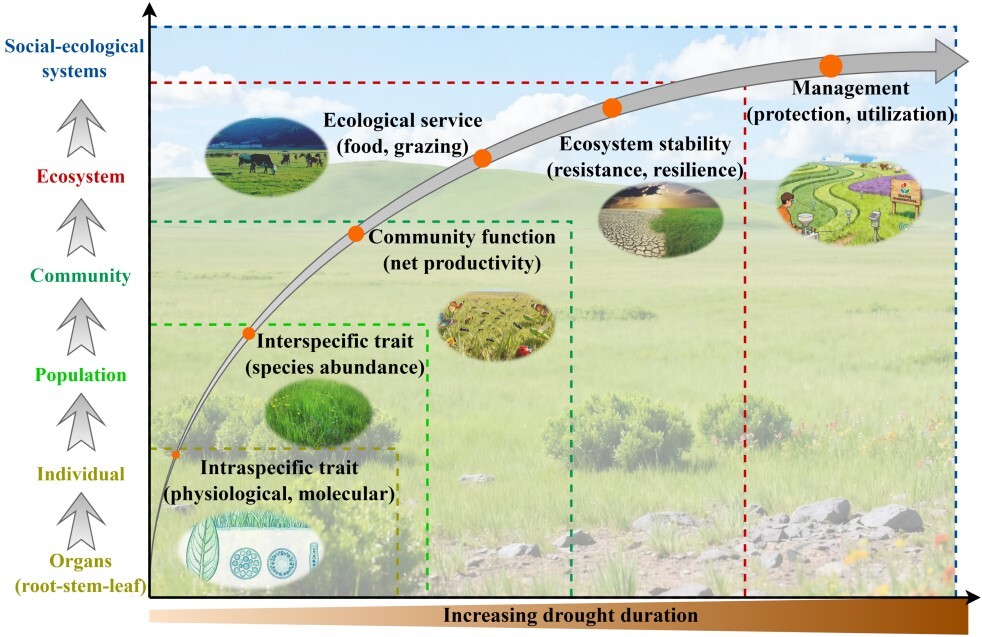
Conceptual framework of drought impacts on grassland vegetation across organizational levels and temporal scales (Image by LUO Wentao)
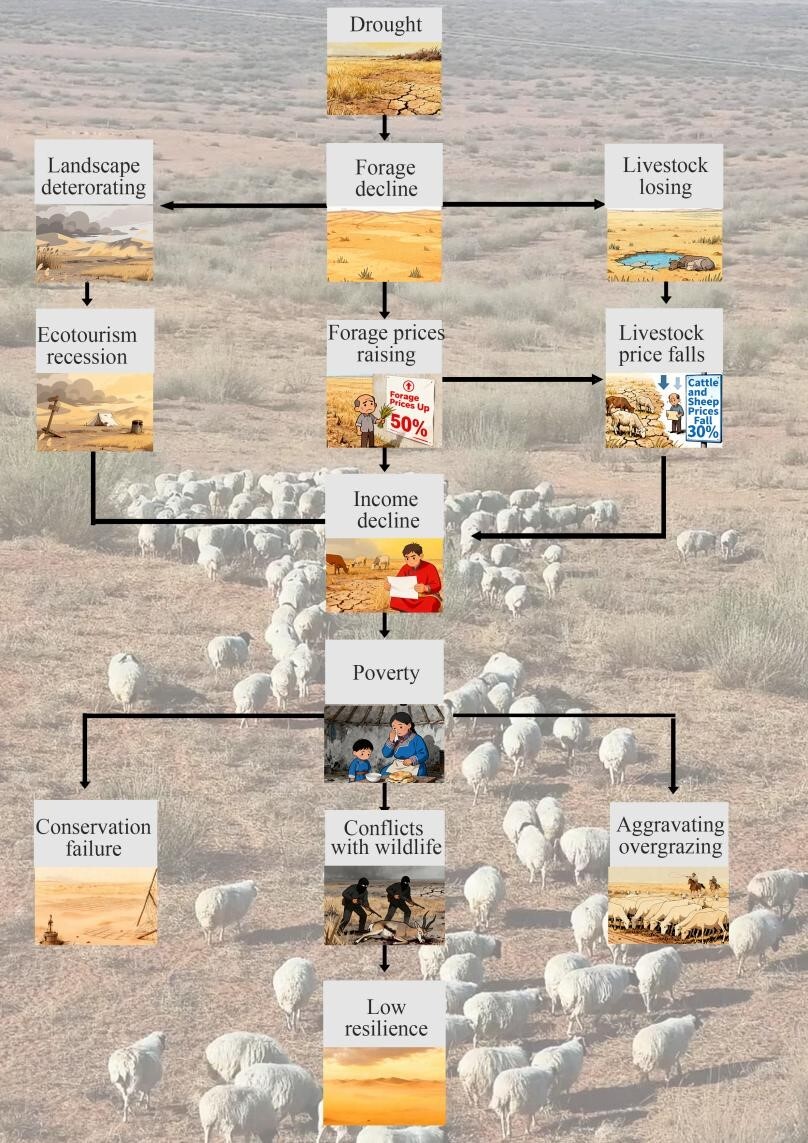
Cascading interactions between ecological change and pastoral livelihoods (Image by LUO Wentao)