
Newsroom


Researchers from Yunnan University, the Shanghai Astronomical Observatory (SHAO) of the Chinese Academy of Sciences, and the National Astronomical Observatory of Japan have unveiled new insights into the fragmentation mechanisms of high-mass star-forming regions.
Using the Atacama Large Millimeter/submillimeter Array (ALMA), the researchers observed an S-shaped massive star-forming region at high resolution, revealing a multi-scale fragmentation process driven by feedback from ionized regions. These findings provide observational support for the "clump-fed" model of massive star formation and offer crucial evidence for understanding the dynamics of stellar birth.
The study, published in Astronomy & Astrophysics, focuses on IRAS 19074+0752 (I19074), a massive star-forming region observed at a wavelength of 1.3 millimeters with a spatial resolution of approximately 6,000 astronomical units. The ALMA data reveal an elongated, S-shaped filament spanning 2.8 parsecs that resembles a dancing Chinese dragon. This filament is composed of a northern segment (Fn) and a southern segment (Fs).
Fn is closely associated with a bright infrared HII region, while Fs resides in a relatively quiescent, infrared-dark environment. The team proposed that the S-shaped morphology likely results from the compression and bending of an originally linear filament by the expanding HII region, shedding new light on filament formation and its interaction with the interstellar medium.
The researchers also revealed a hierarchical fragmentation pattern in I19074, following a "filament → clump → core" sequence. However, Fn and Fs exhibited distinct fragmentation mechanisms. Fn, influenced by the HII region, displayed a "shell-fragmentation" pattern, forming three clumps spaced roughly one parsec apart, consistent with the "collect-and-collapse" model driven by ionized gas expansion. In contrast, Fs showed only one clump at the filament's end, aligning with the "end-dominated collapse" mechanism, where gravitational instability triggers localized fragmentation.
Interestingly, the average spacing between cores within both Fn and Fs was approximately 0.17 parsecs. This spacing can be explained by near-spherical Jeans fragmentation, suggesting that small-scale core formation within clumps is largely independent of the large-scale environment. This finding underscores the fact that, while filament fragmentation is strongly influenced by external feedback, clump-to-core fragmentation adheres to universal physical laws—a pivotal insight for future studies.
Additionally, the researchers identified 26 dense cores in I19074, with masses ranging from 1 to 23 solar masses. Of these, 92% were gravitationally bound, and no clear candidate for a massive starless core was detected.
These results support the "clump-fed" model, in which cores grow into massive stars by continuously accreting material from surrounding clumps. This model provides new observational constraints on theories of high-mass star formation.
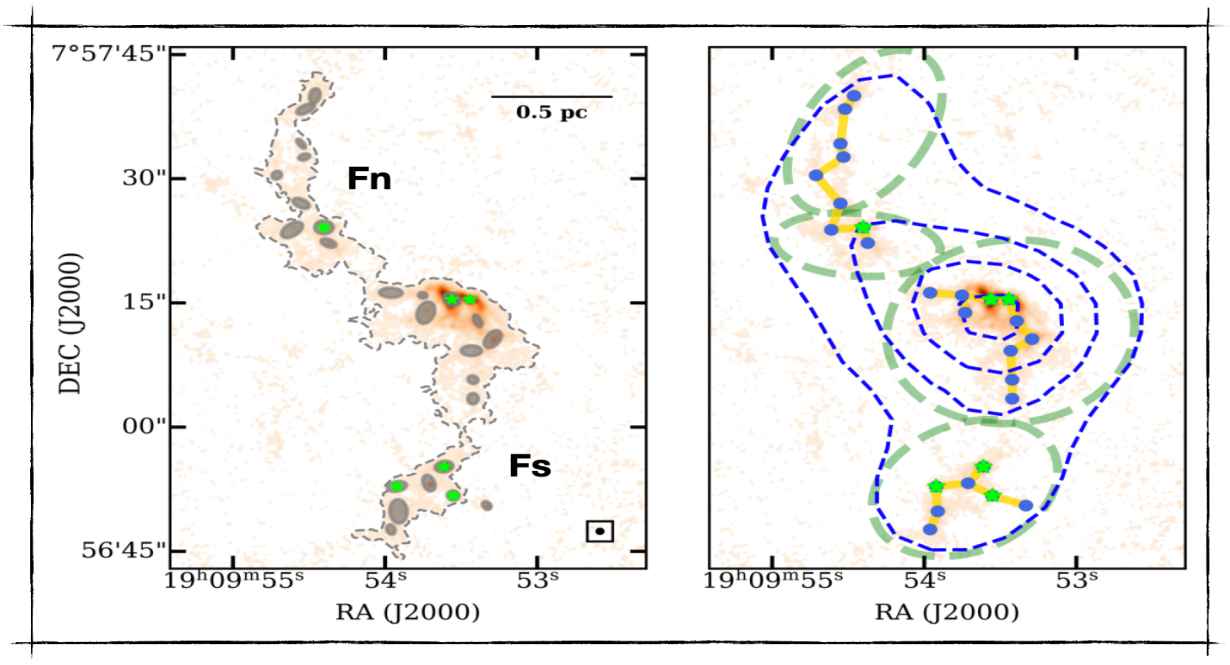
Left: The S-shaped structure in the target region I19074, with gray ellipses marking dense cores and green symbols indicating protostars. Scale bars and resolution indicators are shown in the upper-right and lower-right corners. Right: Distribution of core spacings within the S-shaped structure, where green ellipses represent clumps and blue dots denote cores. (Image by SHAO)


