
Newsroom


A tidal disruption event (TDE) takes place when a star draws near a supermassive black hole at the center of a galaxy and is torn apart by tidal forces. Some of the stellar material then falls back, forming a hot accretion disk that releases intense radiation. A research team led by the National Astronomical Observatories of the Chinese Academy of Sciences (NAOC), in collaboration with international partners, has released the strongest evidence to date of disk-jet co-precession in the TDE known as AT2020afhd—a long-predicted outcome of spacetime dragging caused by a spinning black hole.
This study was published in Science Advances on Dec. 10.
AT2020afhd is located at the center of the galaxy LEDA 145386, roughly 400 million light-years away from Earth. It was first identified in January 2024 via an optical sky survey. Soon after its discovery, the team launched an international coordinated observation campaign, utilizing space-based X-ray telescopes and radio interferometric arrays. These efforts were supplemented by optical observations from China's Xinglong 2.16-meter and Lijiang 2.4-meter telescopes, enabling over a year of high-cadence, multi-wavelength monitoring.
A systematic analysis showed that approximately 215 days after AT2020afhd's optical detection, its X-ray emission displayed notable quasi-periodic oscillations—with a period of 19.6 days and an amplitude exceeding one order of magnitude. Meanwhile, the radio emission also exhibited significant variations, with amplitudes more than four times greater, and these fluctuations were closely synchronized with those of the X-rays.
"Such cross-band, high-amplitude, and quasi-periodic synchronous variability strongly suggests a rigid coupling between the accretion disk and the jet, which precesses like a gyroscope around the black hole's spin axis," explained Prof. WANG Yanan, a co-first author of the study from NAOC.
The physical mechanism driving disk-jet co-precession is believed to stem from the Lense-Thirring effect. In this phenomenon, a spinning black hole drags the surrounding spacetime, leading a tilted accretion disk and the jet (which is perpendicular to the disk) to undergo co-precession. While this process has long been predicted by theoretical models and simulations, securing clear observational confirmation has proven extremely difficult.
"This marks the first time that disk-jet co-precession has been clearly observed in a black hole system," said Prof. HUANG Yang, a co-corresponding author of the study from the University of Chinese Academy of Sciences.
The team developed a disk-jet co-precession model that successfully replicated both the X-ray and radio variability patterns. This model also provided clear constraints on key system parameters, including the system's geometry, the black hole's spin, and the jet's speed. The researchers noted that this phenomenon may be relatively common in black hole systems but has likely gone undetected in the past due to limitations in previous observation strategies.
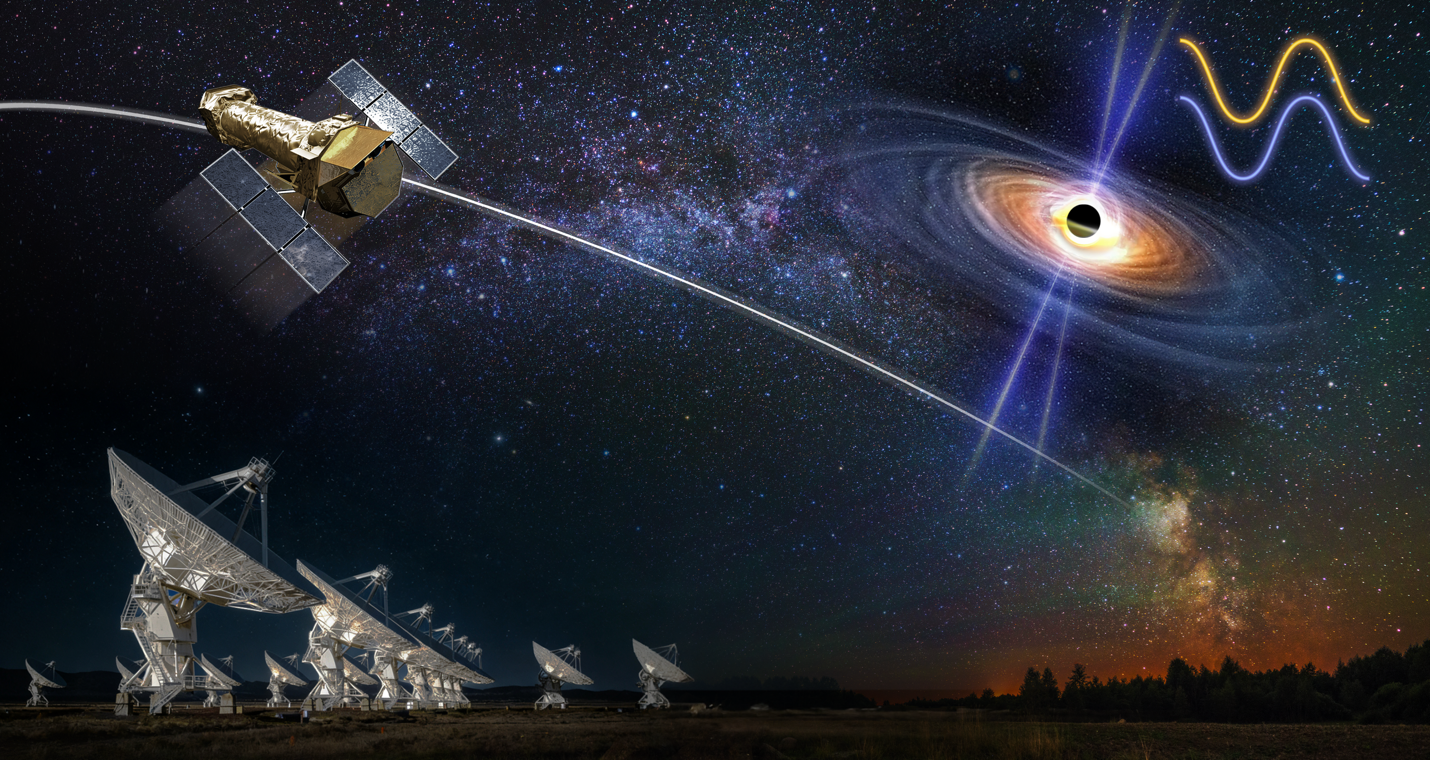
Artist's impression of disk-jet co-precession in a black hole system. (Image by XU Zhang)


