
Newsroom


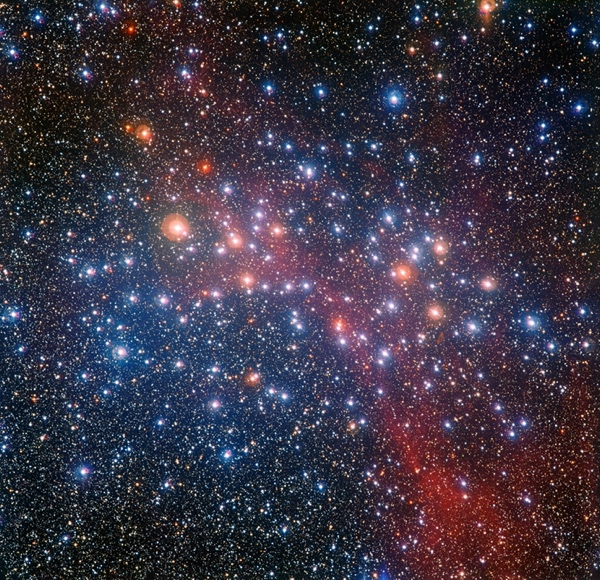
Figure 1. The open cluster NGC 3532. Open clusters serve as vital tracers for the structure and history of the Milky Way.(Credit: The MPG/ESO 2.2-metre Telescope at ESO's La Silla Observatory in Chile)
A research team led by Dr. LI Lu and Prof. SHAO Zhengyi from the Shanghai Astronomical Observatory (SHAO) of the Chinese Academy of Sciences (CAS) has released a new, homogeneous catalog of physical parameters for 1,232 open clusters derived from Gaia DR3 data.
Using their advanced Mixture Model for Open Clusters (MiMO), the researchers provided high-precision measurements of cluster ages, distances, extinctions, and metallicities. Importantly, the catalog is groundbreaking in that it includes the stellar mass function (MF) slope for each cluster. Using this dataset, the researchers identified an "MF Prime" subsample of 163 clusters with exceptional data quality. This establishes a robust observational foundation for future studies on the evolution of the galactic disk.
The findings have been published in The Astronomical Journal.
Open clusters are fundamental laboratories for studying stellar formation and evolution, acting as tracers of the Galactic disk's structure. However, accurately determining their physical parameters has long been hindered by the challenge of discriminating between cluster members and field stars.
Traditional methods usually depend on rigid thresholding, also known as "hard cuts," to eliminate background field stars and produce a clean sample. While this approach is effective at reducing noise, it often inadvertently discards genuine member stars, which compromises data completeness and introduces biases into age and mass distribution estimates.
To address this limitation, the researchers developed MiMO, a novel framework rooted in Bayesian statistics. Unlike conventional isochrone fitting methods that depend on pre-selected members, MiMO models the color-magnitude diagram (CMD) as a probabilistic mixture of single stars, binaries, and field stars. By explicitly incorporating field star contamination into the model rather than discarding it, MiMO maximizes the utilization of observational data. This approach significantly enhances both the precision and robustness of parameter determination and enables the self-consistent derivation of key properties, such as the stellar mass function.
The resulting catalog contains 1,232 open clusters. A unique feature of this release is the inclusion of the full posterior probability distributions (posterior chains) for the inferred parameters, rather than just the best-fit values.
"Providing the posterior chains is essential for reproducibility and deeper scientific exploration," said Dr. LI, the paper's lead author and a data scientist at the National Astronomical Data Center (NADC). "It allows other researchers to re-analyze our results using different priors, such as new spectroscopic metallicities, without starting from scratch."
The catalog also provides independent photometric membership probabilities for individual stars and highlights a "MF Prime" sample of 163 clusters. These prime clusters exhibit clear, narrow main sequences, making them ideal targets for studying the initial mass function and dynamical evolution of star clusters.
This study was a collaborative effort involving researchers from SHAO, Nanjing University, and the Purple Mountain Observatory of CAS.
To support open science, the full catalog (including posterior chains) and the open-source MiMO code have been officially deposited in the NADC.
This work was supported by the National Natural Science Foundation of China (Young Scientists Fund), the NADC Young Data Scientist Project, and the China Space Station Telescope (CSST) project.
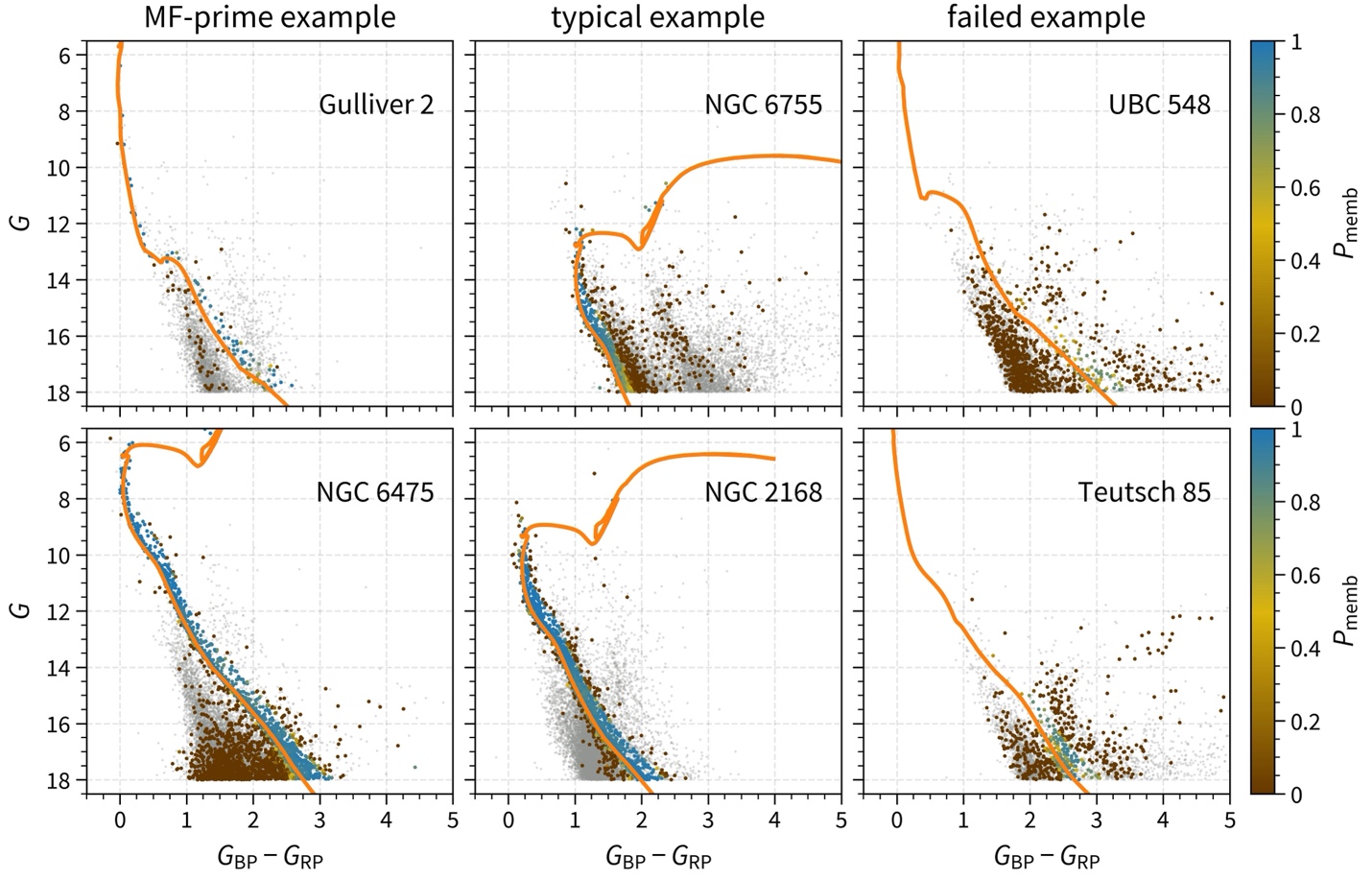
Figure 2. Performance of the MiMO method on clusters with varying data quality. The left panel shows a "MF Prime" cluster (Gulliver 2) with a well-defined main sequence, allowing for reliable mass function determination. The orange line represents the best-fit isochrone derived by MiMO. (Image by SHAO)
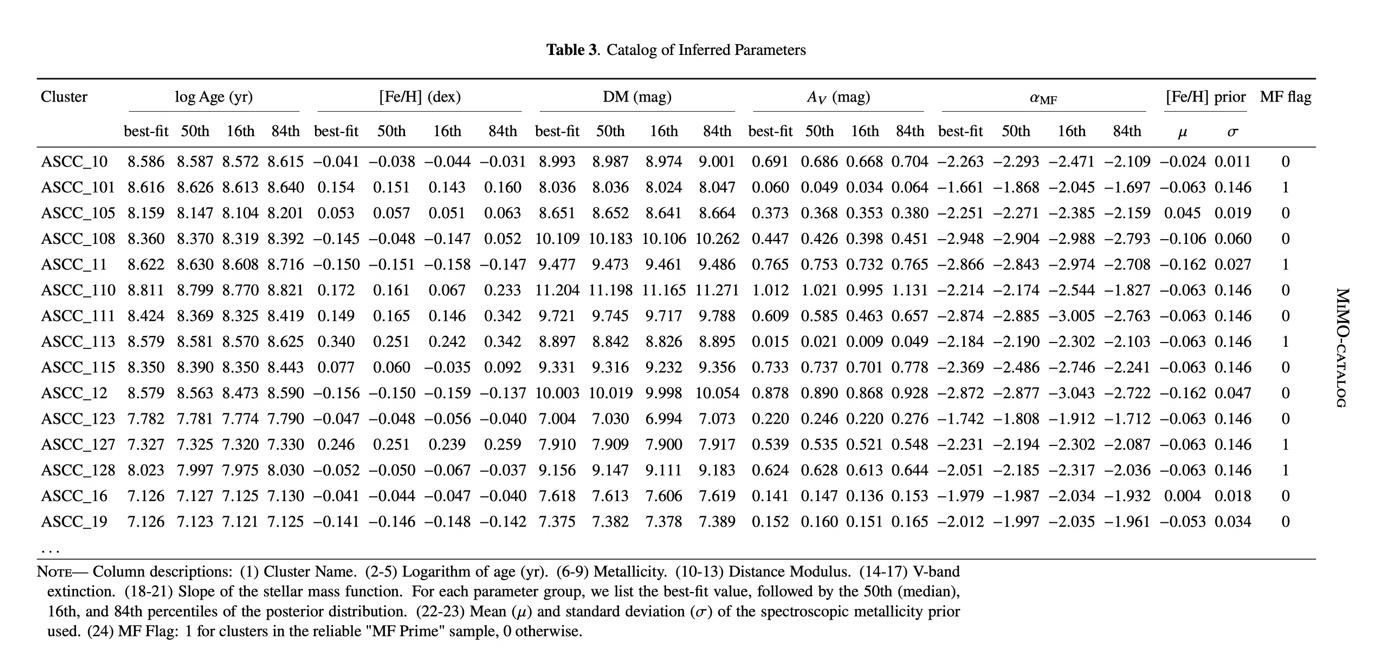 Figure 3. A snapshot of the MiMO catalog. The table lists homogeneous physical parameters—including age, metallicity, distance modulus, extinction, and mass function slopes—for 1,232 open clusters. (Image by SHAO)

