Newsroom


A research team led by Prof. ZHAO Bangchuan from the Hefei Institutes of Physical Science of the Chinese Academy of Sciences (CAS), in collaboration with Prof. ZHONG Guohua from the Shenzhen Institute of Advanced Technology of CAS and Prof. LI Qiang from Qingdao University, has achieved real-time tracking of electronic/magnetic structure evolution in Li-rich Mn-based materials during initial cycling through the self-developed operando magnetism characterization device.
Their study, published in Advanced Materials, provides new insights into the critical mechanism underlying the oxygen redox reaction.
As demand for high-energy-density batteries rises, driven by the electric vehicle and low-altitude economy sectors, Li-rich Mn-based materials have garnered attention due to their high capacity, wide voltage range, and cost-effectiveness. However, challenges such as oxygen release, transition metal migration, and irreversible structural evolution lead to voltage decay and capacity loss, limiting their practical application. Real-time monitoring of these variations is crucial for understanding the oxygen redox mechanism.
In this study, the researchers developed a high-precision operando magnetism testing platform by integrating electrochemical testing with a Superconducting Quantum Interference Device magnetic measurement system, allowing real-time tracking of key structural and electronic transformations in Li-rich Mn-based materials.
By observing magnetic changes during charge and discharge cycles, the researchers uncovered dynamic relationships between magnetization, electronic structure, and oxygen interactions—offering new insights into how oxygen redox reaction contributes to specific capacity.
Their findings reveal a two-stage process in magnetization evolution. In the early charging stage below 4.5 V, magnetization decreases as Ni2+ oxidizes to Ni3+/Ni4+, signaling the activation of transition metal redox. When the voltage exceeds 4.5 V, oxygen redox reaction dominates the charge compensation, leading to an unexpected rebound in magnetization.
This study offers new perspectives for the rational design of high-performance anion redox reaction-based cathode materials, according to the team.
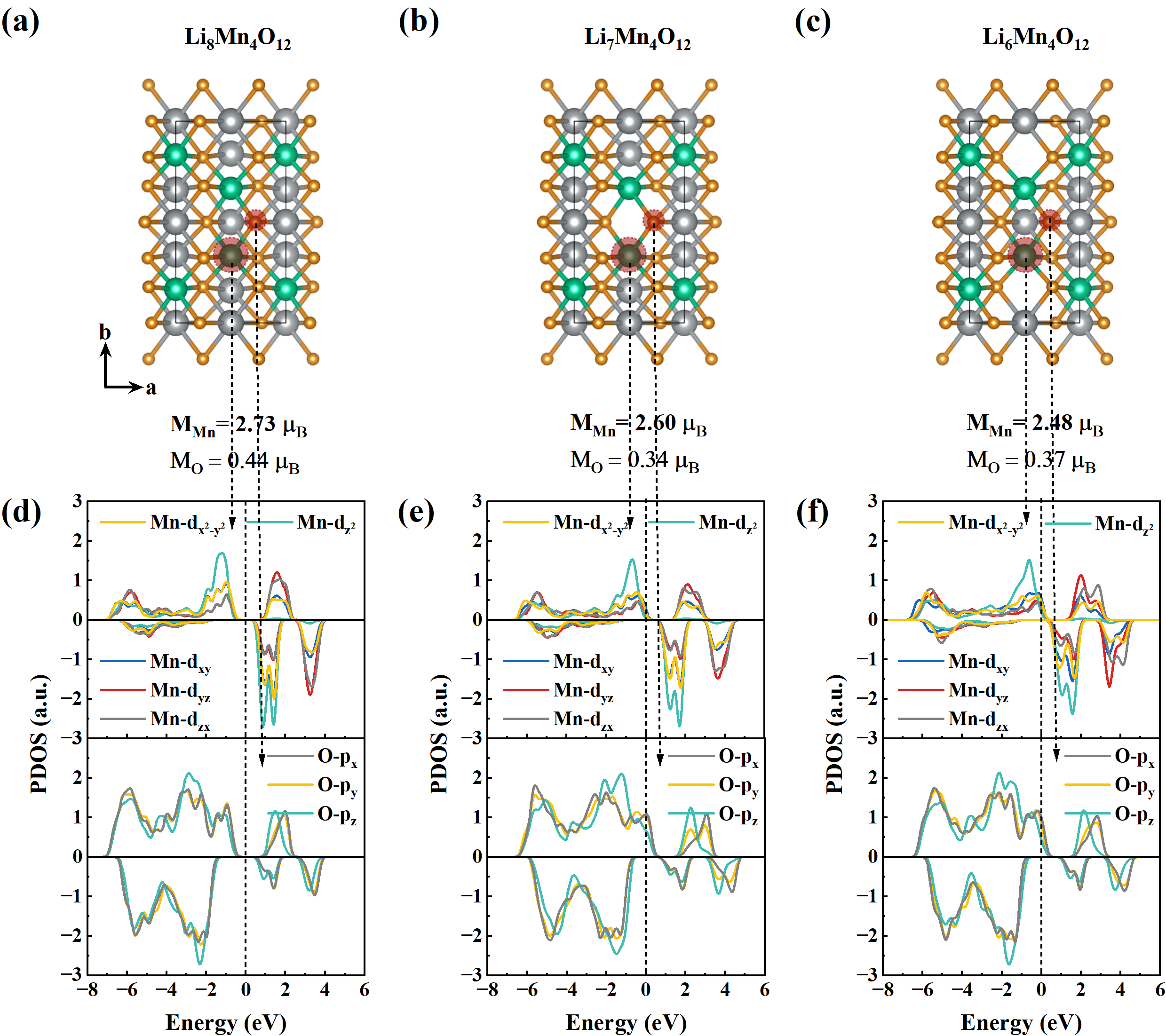
The structure model of Li2MnO3 at different charged states and corresponding projected density of states of Mn and O. (Image by QIU Shiyu)