Newsroom


In a paper recently published in Physics Review Letters, a team led by Prof. CAI Yifu from the University of Science and Technology of China of the Chinese Academy of Sciences and the collaborators discovered the hypothetical possibility of resonantly generating primordial gravitational waves within the high energy physics when the universe was in the babyhood.
The researchers found that the originally invisible gravitational wave signals can be amplified by parametric resonance by four to six orders of magnitude or even larger through this phenomenon, and then become likely to be probed by primordial gravitational wave detectors, hence, validating some theoretical models of the very early universe that are "inaccessible" in traditional observational windows.
In the baby universe, all matters once existed as extremely tiny elementary particles. The temperature of the baby universe was far beyond the highest temperature (energy scale) that human can reach in any high-energy experiments. Therefore, the new physics of this period is called the desert zone of high-energy physics.
At present, the major method for exploring the origin of the universe is to search for primordial gravitational waves whose magnitude is directly determined by the energy scale of the baby universe. Therefore, capturing primordial gravitational waves has become almost the only chance for humans to reach new physics at high-energy scales beyond the standard model of particle physics. However, if inflation occurred in the desert zone of high-energy physics, the amplitude of primordial gravitational waves will be too small to be detected. Thus, the traditional academic perspective considers it almost as a “mission impossible” to search for primordial gravitational waves and the related new physics in this energy scale.
In this study, the team led by Prof. CAI and Misao Sasaki from University of Tokyo introduced a heavy field with a behavior of parametric resonance to nonlinearly couple with primordial gravitational waves, thereby providing an adequate energy source for the resonant amplification of primordial gravitational waves. In addition, the special dynamical properties of the background evolution of inflation can ensure that the newly introduced heavy field can hardly interfere with the observed primordial density perturbations, and thus the new theory can perfectly fit to current cosmological observations.
To be specific, by constructing a concrete example of the background model, the researchers accurately demonstrated that, even if inflation occurred in the desert zone of high-energy scale that exceeds the standard model of particle physics, primordial gravitational waves can be resonantly generated with a sufficiently large magnitude that is of observable interests. From the theoretical perspective, this result explicitly showed that, even in the dune of high-energy physics there exists some oasis sustaining the life of new physics.
This study provides an important scientific goal for the present and upcoming primordial gravitational wave experiments worldwide, and opens a novel window for searching for high-energy new physics beyond the standard model of particle physics.

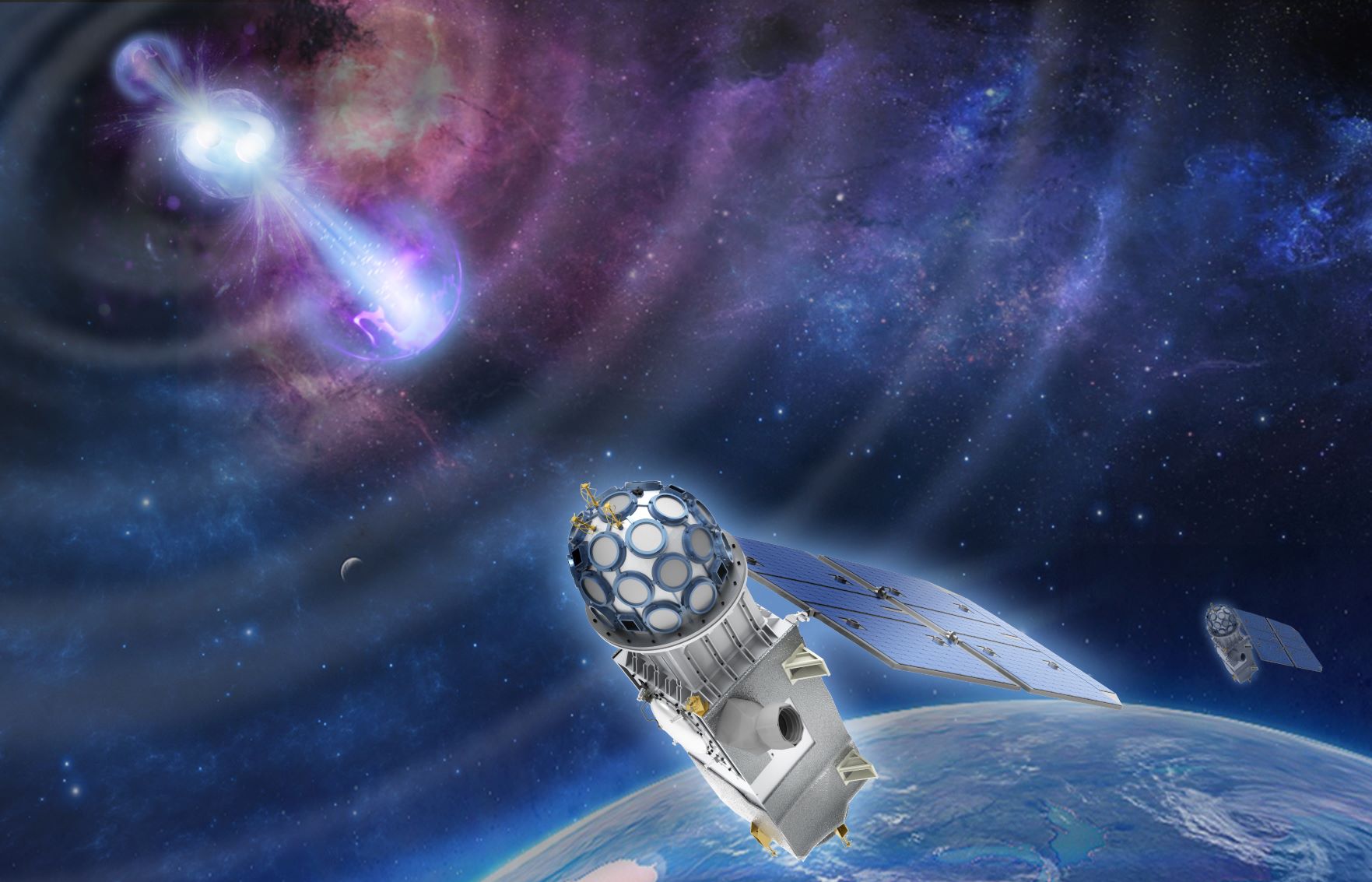
The originally invisible gravitational wave signals were amplified by parametric resonance gain mechanism, and then detected by primordial gravitational wave detectors. (Image by European Space Agency/Planck Cooperation Group)