Newsroom


The exploration of extrasolar planets has never been stopped and scientists always dream to discover an Earth-like planet in the vast universe. During the search of extrasolar planets, a variety of instruments have been developed to accelerate the search process, and one of the most effective method is to use the radial velocity implemented by common-path coherent-dispersion spectrometer (CODES).
A research team led by Prof. WEI Ruyi from the Xi'an Institute of Optics and Precision Mechanics(XIOPM) of the Chinese Academy of Sciences (CAS) recently proposed a novel method to design efficient common-path coherent-dispersion spectrometer. Their result was published on the Journal Applied Optics.
Although traditional radial velocity measurements have been greatly optimized, which can be obtained by deriving the phase shift of the interference fingers created an interferometer with fixed optical path difference between the two optical paths of interferometer, the explorations of Earth-like planets has been severely hindered by the current accuracy of radial velocity measurements from instrumental and photonic noise.
According to the researchers, they have been inspired by the new type of the asymmetric CODES, which has advantages of high stability, high throughput, and wide spectral range. However, the balance between optical path difference and visibility still need to be considered to obtain the satisfied radial velocity precision.
On this base, they proposed a temperature-compensated optimal optical path difference (TOOPD) method in order to improve the performance of the instrument as much as possible.
By assuming the spectral line with a Gaussian-type power spectral density distribution, the researchers derived the relationship between the visibility and the optical path difference for the absorption/emission line in the new CODES system. Then the values of the optimal optical path difference under different wavelengths were deduced according to the efficiency function, which provides the basis for the CODES to choose the optimal optical path difference.
They achieved an approximately optimal combination of materials for optical path difference. The simulation results indicate that the maximal difference between the optimal optical path difference and the optical path difference generated by the combination of materials means higher detection precision.
Meanwhile, the influence of temperature on the optical path difference can be reduced by 2–3 orders of magnitude by material combination, which greatly ameliorates the stability of the whole spectrometer.
This method provides a new idea for further improving the high-precision radial velocity detection of the asymmetric common-path CODES.
This work was supported by the National Natural Science Foundation of China and the Shaanxi Science and Technology Project.
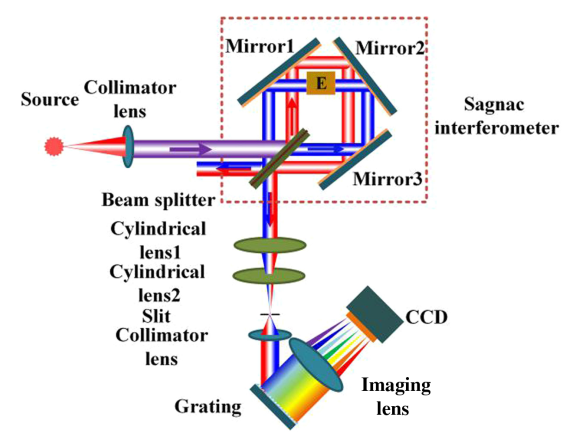
Schematic diagram of the asymmetric common-path CODES. (Image by XIOPM)