
Newsroom


A research team led by Profs. LI Ming and XIAO Xiao from the Kunming Institute of Zoology of the Chinese Academy of Sciences has published the most comprehensive genetic study of bipolar disorder (BD) to date across East Asian and European populations.
Their findings, published in Nature Neuroscience on November 25, provide critical insights into the genetic basis and cell-type-specific mechanisms of bipolar disorder.
The researchers combined a Han Chinese genome-wide association study (GWAS) comprising 5,164 cases and 13,460 controls with datasets from East Asian and European consortia, culminating in a trans-ancestry meta-analysis of approximately 90,000 cases and 960,000 controls. They identified 93 independent genome-wide significant loci, including 23 novel associations. The genetic correlation between East Asian and European samples was high (approximately 0.86), indicating substantial overlap in the genetic architecture of common variants.
Through fine-mapping and variant-to-gene analyses, the researchers prioritized 39 high-confidence bipolar disorder risk genes. Cell-type enrichment analyses, leveraging single-cell transcriptomic data, showed that genetic risk of bipolar disorder is predominantly enriched in fetal cortical GABAergic interneurons and, postnatally, in deep-layer excitatory neurons. Additionally, interneurons in subcortical regions, such as the amygdala and hippocampus, are closely related to bipolar disorder.
Fifteen of the prioritized genes showed altered expression in patient-derived brain tissues, while 22 encode proteins that are either druggable or current drug targets, suggesting potential therapeutic repurposing, particularly of antiepileptic drugs.
This work underscores the importance of diversifying genetic study samples beyond European ancestries to enhance discovery power and refine causal inferences. It is a significant step toward precision psychiatry and offers a foundation for developing targeted interventions for bipolar disorder.
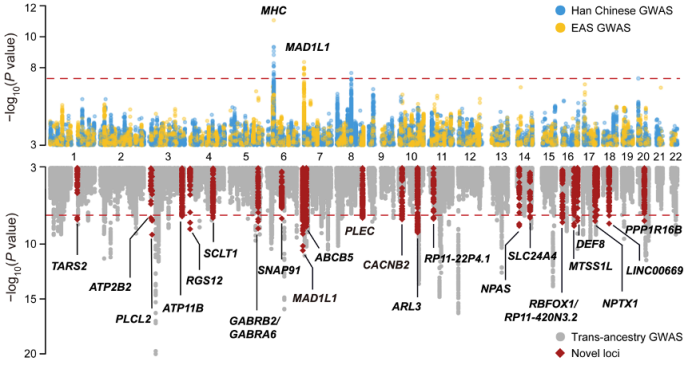
Upper: Manhattan plot for both Han Chinese GWAS and EAS GWAS; Lower: Manhattan plot for trans-ancestry GWAS with 93 GWS loci, among which 23 are novel. (Image by LI Ming)
