Newsroom


Breast cancer represents a major threat of women health. Due to high heterogeneity, most cancer therapies are often defeated by a minor subpopulation of cancer cells with enhanced therapy resistance, named cancer stem-like cells (CSCs), which leads to tumor recurrence and eventually therapy failure.
Two populations of breast cancer stem-like cells (BCSCs) characterized by CD44+ CD24low/- and high aldehyde dehydrogenase (ALDH) respectively have been identified. Although the intracellular and microenvironmental cues that regulate breast cancer stemness have been identified, understanding towards CSCs remains incomplete. Elucidating the molecular underpinning of BCSCs, especially the common regulators of different BCSC types with clinical relevance, is important for rational designing of new CSC-targeting strategies in cancer treatment.
In a study published in Nature Communications, a research group led by Dr. HU Guohong from Shanghai Institute of Nutrition and Health (SINH) of the Chinese Academy of Sciences revealed that SH3 domain containing ring finger 3 (SH3RF3), a scaffold protein, promotes cancer stem-like properties of breast cancer by activating JNK-JUN -PTX3 axis.
The researchers showed that overexpression of SH3RF3 in breast cancer cells expands the CD44+CD24low/- and ALDH+ cell population of breast cancer cells, accompanied by increase of tumorsphere formation in vitro and tumorigenicity in vivo.
They also confirmed the function of SH3RF3 on tumor stem-like properties facilitation by the culturing of breast cancer patient-derived organoids.
Clinical relevance analysis revealed that the expression of SH3RF3 is positively correlated with BCSC properties in breast cancer samples and predicts poor prognosis.
Mechanistically, SH3RF3 interacts with the MKK-JNK complex, leading to the activation of JNK-JUN pathway in a JIP-dependent manner. Furthermore, the JNK-JUN signaling promotes CSC properties in breast cancer by transcriptionally activating Pentraxin 3 (PTX3) expression.
This study elucidates the role of SH3RF3 and JNK-JUN-PTX3 pathway in breast cancer stemness regulation, and it may provide potential diagnostic biomarkers and therapeutic targets.
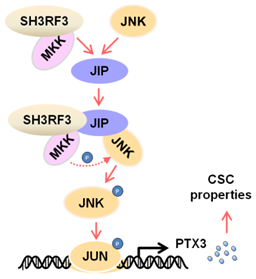
Schematic model of the role of SH3RF3 in BCSC regulation. (Image by Dr. HU Guohong's Group)