
Newsroom


Coastal ecosystems are increasingly exposed to multiple stressors, including environmental changes, land-based inputs, and overfishing. However, developing a systematic approach to analyze the dynamic patterns of stock recovery driven by both environmental changes and human activities—and establishing a comprehensive framework to evaluate ecological restoration effectiveness under complex habitat conditions—has emerged as a core challenge in current research.
To address this issue, a research team led by Prof. ZHANG Hui from the Institute of Oceanology of the Chinese Academy of Sciences (IOCAS) quantified the adaptive mechanisms and sensitivity thresholds that govern fishery stock recovery under multiple stressors over a long time scale.
The study was recently published in the Journal of Environmental Management.
Portunus trituberculatus (three-spined swimming crab), a key fishery resource in China, once suffered a sharp decline due to overfishing and habitat degradation. In recent years, its population has partially recovered thanks to stock enhancement measures, making it a typical case of recovering marine fishery stocks in China.
Focusing on this species, the research team constructed a multi-factor analytical system by examining nearly 15 years of monitoring data on biological resources and habitat environments in the Yangtze River Estuary and its adjacent waters. This effort resulted in a complete analytical framework covering resource assessment, driver analysis, sensitivity ranking, and interaction effect evaluation.
The findings reveal that the stock biomass of Portunus trituberculatus in the Yangtze River Estuary exhibits significant seasonal variations, with its spatial distribution following a seasonal migration pattern. Among various driving factors, sediment concentration and runoff have notable impacts on the species' biomass. Sensitivity analysis further indicates that biomass is most responsive to changes in runoff. Additionally, interaction effect analysis identified a clear trade-off between stock enhancement and fishing pressure: excessively high fishing intensity can substantially diminish the resource replenishment effect of stock enhancement.
Based on these results, the team developed a four-dimensional evaluation framework encompassing "environmental regulation, land-based source control, balance of human activities, and adaptation to interaction effects," and formulated targeted resource management strategies. This framework breaks through the limitations of traditional single-species assessment and can be adapted to fishery resource assessment needs in different marine areas through parameter adjustments, providing a scientific basis for regional marine ecological protection and the sustainable development of fisheries.
"Our findings provide important scientific support for fishery stock restoration and sustainable fisheries management in China," Prof. ZHANG stated.
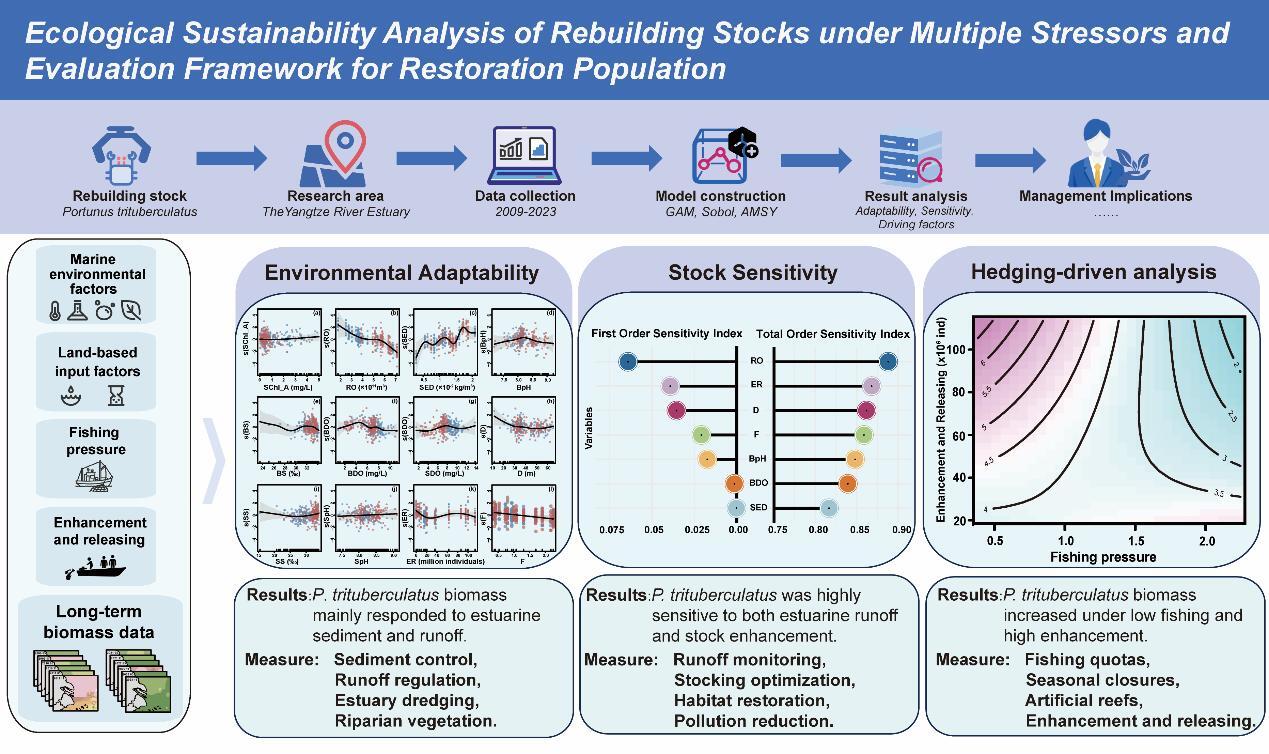
Research route and analytical framework. (Image by IOCAS)
