
Newsroom


Researchers from the Institute of Applied Ecology of the Chinese Academy of Sciences (CAS) have revealed the mechanism behind the dieback of natural Mongolian pine (Pinus sylvestris var. mongolica) forests on sandy land. Their findings were published in Forest Ecology and Management.
Mongolian pine naturally grows in the sandy land of Hulunbuir near the Greater Khingan Mountains in China. It exhibits remarkable ecological adaptations to extreme conditions, making it a keystone species for establishing windbreak and sand-fixation forests in arid and semi-arid regions. However, dieback of these forests has been widespread since 2018, raising concerns about their sustainability in afforestation programs.
Led by Prof. ZHU Jiaojun, the researchers hypothesized that this dieback is driven by two interrelated mechanisms, anthropogenic fire suppression disrupting the natural fire regime, and climate change-induced winter warming reducing snow cover duration and depth. To test the hypotheses, they quantified dieback using Green Normalized Difference Vegetation Index (GNDVI) across stands with varying fire histories via unmanned aerial vehicle (UAV)-based multispectral imagery, alongside long-term climatic observations (1960–2024) of temperature, precipitation, and snow dynamics from meteorological stations combined with remote sensing datasets.
The researchers identified an abrupt change point in 2018 for both annual precipitation and mean temperature, coinciding with the natural Mongolian pine dieback. A significant negative linear relationship was found between GNDVI (forest health) and the last fire interval, indicating that prolonged fire exclusion exacerbates dieback, possibly through pathogen/pest accumulation.
Winter temperatures rose significantly from 1960 to 2023, accelerating notably following an abrupt change point in 1987. Concurrently, winters from 2018 to 2023 exhibited pronounced warming, with a reduction in snow cover duration of 23 days and a decrease in snow depth of 7.6 cm.
These conditions reduced snowmelt-derived soil moisture (critical water source) recharge in early spring, exacerbating drought stress during critical growth periods and predisposing trees to pest and disease infestations. Their findings supported both hypotheses, demonstrating that dieback was synergistically driven by fire regime alteration and climate-mediated snowpack reductions.
The researchers proposed adaptive management strategies to restore ecological resilience in these vulnerable sandy ecosystems, such as planned and controlled low-intensity prescribed burning and converting pure pine forests into mixed pine-broadleaf forests via differentiated water sources.
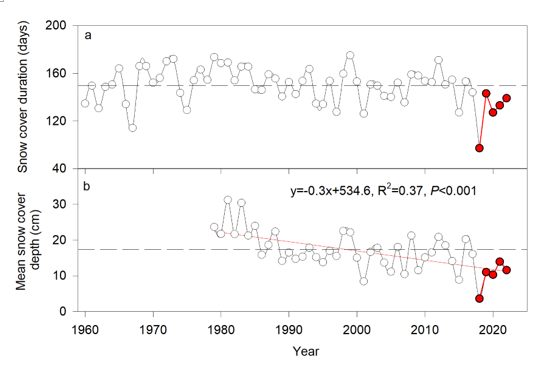
Long-term trends in (a) snow-cover duration and (b) snow depth in the Mongolian pine forest region (Image by SONG Lining)
