
Newsroom


Metal halide perovskites are promising for next-generation high-efficiency photovoltaic and optoelectronic devices due to excellent optoelectronic properties and solution processability. Recent fabrication techniques (such as spin coating, blade coating, and slot-die coating) have boosted perovskite solar cell power conversion efficiency (PCE) to record levels but face limitations in large-area manufacturing, deposition on complex or curved surfaces, and in-situ fabrication.
In contrast, spray coating is a non-contact, rapid, scalable solution-processing technique compatible with three-dimensional (3D) and complex substrates—ideal for building-integrated photovoltaics, vehicular optoelectronics, and non-planar devices. However, perovskite precursor droplets' complex crystallization kinetics during spray coating create high defect densities. Conventional solvents' slow evaporation, inconsistent crystallization driving forces across precursor components, and layer-by-layer deposition-induced surface corrosion lead to spray-deposited films with abundant phase impurities, disordered grain orientation, and high defects. Thus, spray-coated perovskite device performance has long lagged behind spin-coating and related methods.
To address this bottleneck, a research team from the Qingdao Institute of Bioenergy and Bioprocess Technology (QIBEBT) of the Chinese Academy of Sciences has developed a confined crystallization strategy. This approach reconstructs—i.e., redesigns—the crystallization pathway during spray coating at its source through solvation structure regulation. Specifically, the team established a localized high-concentration (LHC) precursor system within individual spray droplets, enabling precise control over nucleation behavior during film formation.
In this strategy, weak ligand solvents are introduced to restrict the diffusion of A-site cations while simultaneously enhancing their interaction with [PbIx]2-x coordination complexes. This effectively suppresses the formation of solvent-mediated intermediate phases and parasitic reaction pathways—issues commonly observed in conventional spray processes. Under such confined conditions, homogeneous bulk-phase pre-nucleation occurs within individual droplets, followed by the direct formation of α-phase perovskite with a high degree of crystallographic orientation during deposition. The confined crystallization mechanism reduces the activation energy required for precursor-to-crystal conversion, allowing the fabrication of low-defect, high-quality perovskite films via spray coating, with bulk trap-state densities as low as approximately 1014 cm-3.
By leveraging this strategy and employing machine learning for process optimization, the team achieved a PCE of 25.5% (with a certified 25.2%) in spray-coated perovskite solar cells. The team also demonstrated mini-modules with efficiencies exceeding 22.5%. With these changes, device performance approached that of state-of-the-art spin-coated perovskite solar cells. More importantly, it was still possible to achieve efficient device fabrication at relative humidity levels of around 80%, significantly expanding the environmental processing window for spray-coated perovskites.
This work overcomes the limitations of conventional planar fabrication by enabling the production of high-efficiency perovskite devices on rigid curved surfaces with non-zero Gaussian curvature (non-developable surfaces) without relying on spin coating. The spray-coated curved perovskite solar cells developed in this study exhibited efficiencies exceeding 23.2%, while the spray-coating strategy allows continuous thickness control from the nanometer to micrometer scale and is readily applicable to complex 3D structures and patterned deposition. Beyond achieving efficiencies comparable to spin-coated technologies, this approach offers distinct advantages, including compatibility with complex geometries, humidity tolerance, and scalability.
This study was published in the journal Joule on Dec. 16. It was supported by the National Natural Science Foundation of China, the Natural Science Foundation of Shandong Province, and other funding sources.
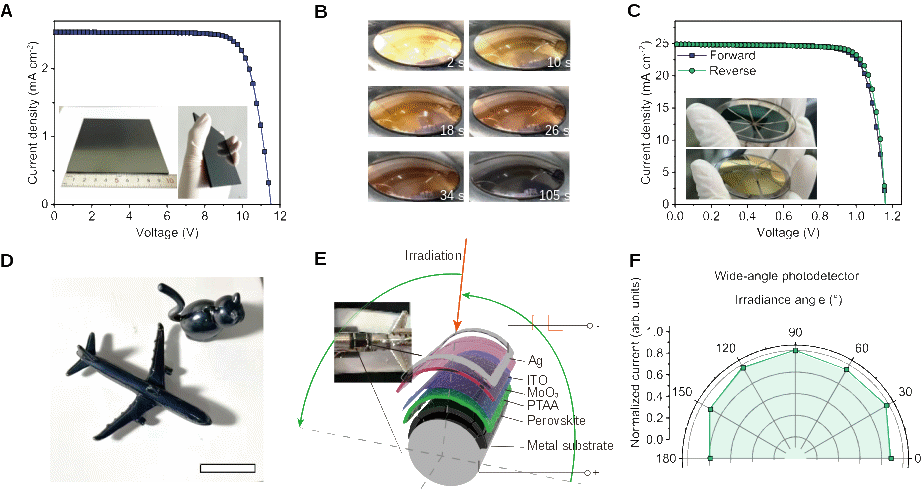
Applications of perovskite films fabricated by spray coating. (Image by QIBEBT)

