
Newsroom


In the fields of intelligent healthcare and robotic sensing, the development of ultra-thin flexible temperature sensors serves as a core prerequisite for achieving high conformability and integration. However, a fundamental bottleneck persists: the high-temperature processes required to ensure high sensitivity are incompatible with the low thermal tolerance of flexible substrates. Consequently, it remains challenging for ultra-thin devices to simultaneously achieve high sensitivity, excellent flexibility, and long-term stability.
To address thischallenge, a research team from the Xinjiang Technical Institute of Physics and Chemistryof the Chinese Academy of Scienceshas madeprogress in the field of ultra-thin temperature sensors. The team adopted a "water-soluble sacrificial layer-assisted transfer" strategy, which resolves the process compatibility issue between high-performance sensitive materials and flexible substrates. Using this approach, they fabricated an ultra-thin flexible temperature sensor with a total thickness of only 40 micrometers.
The key to this method lies in separating the high-temperature processing of sensitive materials from the subsequent fabrication of devices on flexible substrates. This design not only ensures the sensitive materials undergo the necessary high-temperature annealing to optimize performance but also prevents the flexible substrate from being damaged by high temperatures. In doing so, it provides a reliable technical pathway for integrating high-performance inorganic materials with flexible substrates.
To further ensure the quality of the material interface after transfer, the researchers designed and constructed a GeO2/Ta2O5/MCO heterojunction interface structure. This structure was developed through a combination of finite element simulation and experimental validation, allowing for active control over interface properties. The heterojunction effectively suppresses element diffusion and thermal stress mismatch at the interface, enhancing the device's reliability and structural integrity.
Built on this transfer strategy and interface design, the ultra-thin sensor demonstrates exceptional overall performance. Its Temperature Coefficient of Resistance (TCR) reaches as high as -4.1 %/℃, with a response time of just 192 milliseconds. Moreover, it maintains stable operation even under repeated bending and thermal shock tests. This achievement not only elevates the overall performance of ultra-thin flexible temperature sensors but also provides crucial technological support for advancing next-generation flexible intelligent perception systems, such as electronic skin and wearable devices.
The findings of this study were recently published in ACS Applied Materials & Interfaces. The research wassupported by the National Key Research and Development Program, and the Xinjiang Tianshan Talents Program, among other sources.
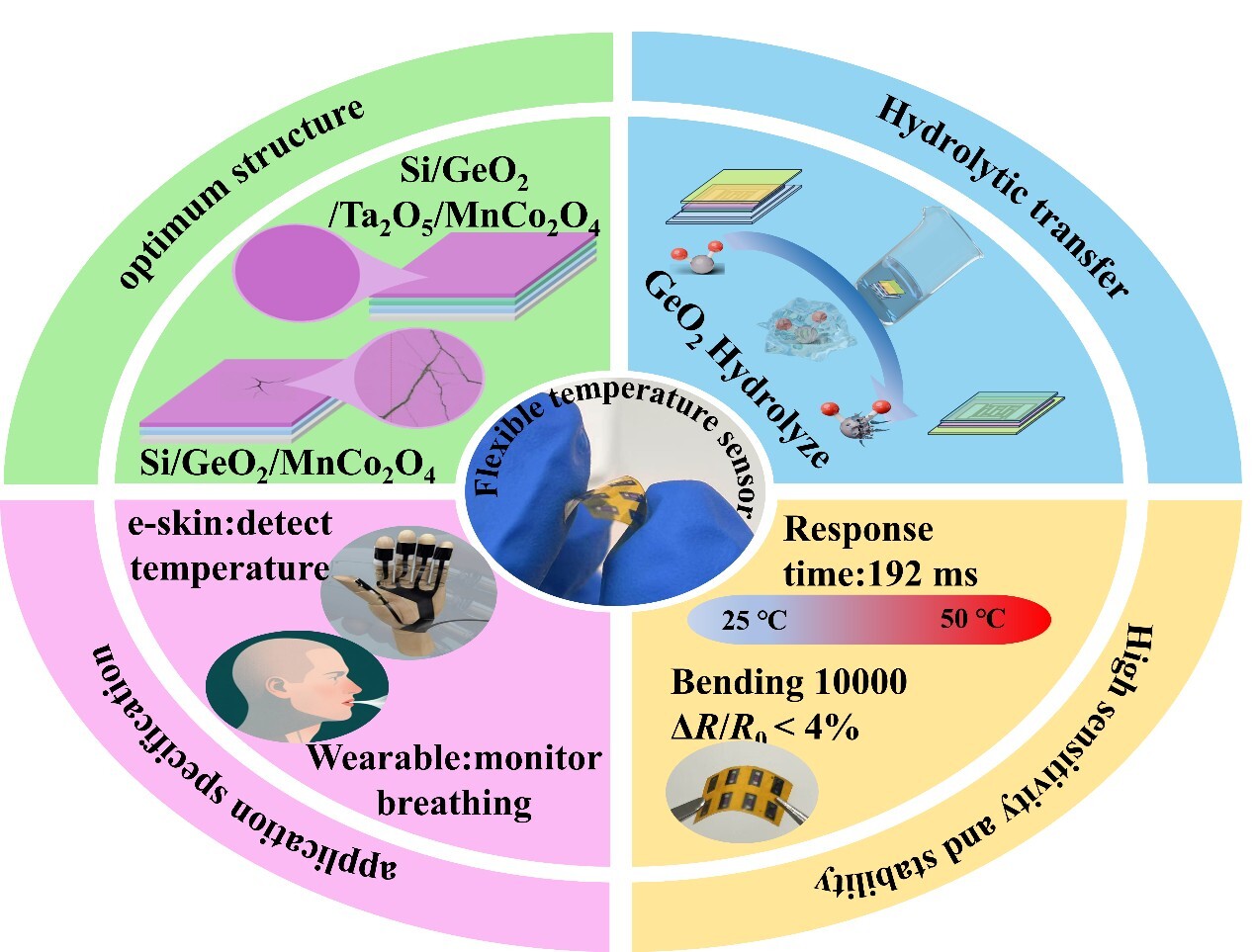
PI/MnCo2O4/Ta2O5 Flexible Temperature Sensor. (Image by YAN Xijun)
