
Newsroom


A new study revealed that gut microbiota-derived extracellular vesicles play an important role in regulating lipid metabolism by delivering bacterial small RNAs to intestinal cells.
The study, published in the Journal of Extracellular Vesicles on September 28, was conducted by a research team led by Chinese Academy of Sciences (CAS) Member YIN Yulong from the Institute of Subtropical Agriculture (ISA) of CAS.
The small intestine is central to digesting and absorbing dietary fat, and efficient fat utilization is tightly linked to intestinal health in young piglets.
Previous studies mostly focused on bacterial metabolites to explain microbiota-host crosstalk in fat processing. This work shifts attention to tiny membrane-wrapped packages known as extracellular vesicles released by gut microbes. Based on differences in crude-fat digestibility among weaned piglets, the team found that piglets with superior fat utilization harbored lower levels of Clostridium butyricum in the ileal mucosa.
Animal trials verified that this bacterium suppresses intestinal fat absorption and oxidation. Rather than its well-known metabolite butyrate, its secreted extracellular vesicles act as key messengers. These vesicles enter gut epithelial cells and deliver bacterial milRNAs. Among these, milRNA-3020179 targets the host genes PPARα and Rxra to modulate lipid-related signaling pathways.
In mouse models fed a high-fat diet, both live bacteria and purified vesicles mitigated excess lipid accumulation and metabolic disturbances. When milRNA-3020179 was knocked out in intestinal organoid tests, the bacterium largely lost its lipid-inhibiting function, supporting the vital role of this vesicle-loaded small RNA in bacteria-host metabolic crosstalk.
According to the researchers, this study expands our knowledge regarding C. butyricum function and constructs a regulatory framework for interactions between bacteria, extracellular vesicles, small RNAs and the host. It further provides new insights for developing microbiota-based strategies to improve fat utilization and gut health in pig farming.
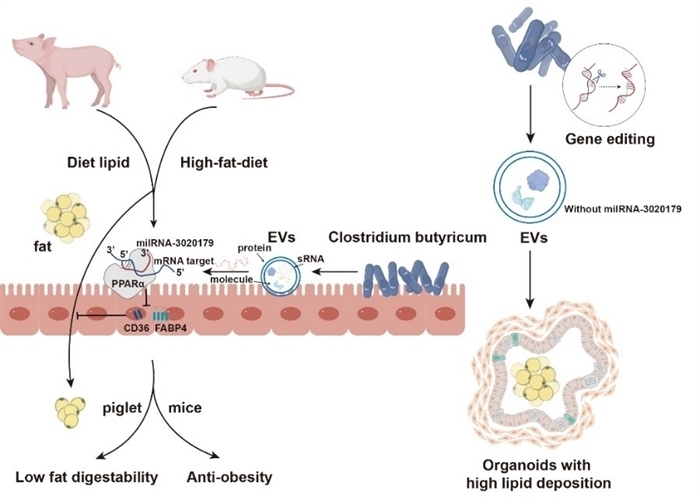
Graphical abstract showing how C. butyricum-derived extracellular vesicles regulate intestinal lipid metabolism. (Image by ZHOU Xihong)
