
Newsroom


The massive loss of cardiomyocytes following acute myocardial infarction (MI) leads to ventricular remodeling and heart failure. Studies have shown that cardiomyocyte necroptosis plays a critical role in MI-induced cardiomyocyte death, with receptor-interacting protein 3 (RIP3) serving as a key determinant.
However, the regulatory mechanisms of RIP3 levels in cardiomyocytes post-MI have not been elucidated. Besides, identifying endogenous inhibitory proteins targeting cardiomyocyte necroptosis is an important direction for the treatment of ischemic heart disease.
In a study published in Science China Life Sciences on August 7, a research team led by Prof. YANG Huangtian from the Shanghai Institute of Nutrition and Health of the Chinese Academy of Sciences revealed the critical role of insulin-like growth factor-binding protein 7 (IGFBP7) in suppressing cardiomyocyte necroptosis and promoting cardiac repair following MI.
Using a mouse MI model, researchers found that IGFBP7 expression was significantly elevated, reaching a peak at seven days post-MI. To explore the function of IGFBP7, they then generated a cardiomyocyte-specific IGFBP7 knockout (Igfbp7CM-/-) mouse model.
Researchers discovered that the cardiomyocyte-specific deficiency of IGFBP7 exacerbated MI-induced cardiomyocyte necroptosis, cardiac functional worsening, and scar formation. The injection of human recombinant IGFBP7 (hIGFBP7) protected infarcted mice hearts and oxygen-glucose deprivation (OGD)-injured murine and human cardiomyocytes via an IGF-independent pathway.
Mechanistically, IGFBP7 interacts with RACK1 protein and promotes its degradation, which disrupts RACK1-mediated stabilization of Rip3 mRNA, accelerates Rip3 mRNA degradation, and inhibits MI-induced upregulation of RIP3. Using a Rip3 knockout mouse MI model, it was confirmed that IGFBP7 effectively inhibits necroptosis in injured cardiomyocytes by targeting RIP3.
This study reveals the anti-necroptotic and reparative roles of IGFBP7 in injured cardiomyocytes and infarcted hearts. It broadens the understanding of post-transcriptional regulatory mechanisms of cardiomyocyte necroptosis, and provides a potential therapeutic strategy for treating ischemic heart disease by utilizing a natural protein to target and regulate Rip3 mRNA stability.
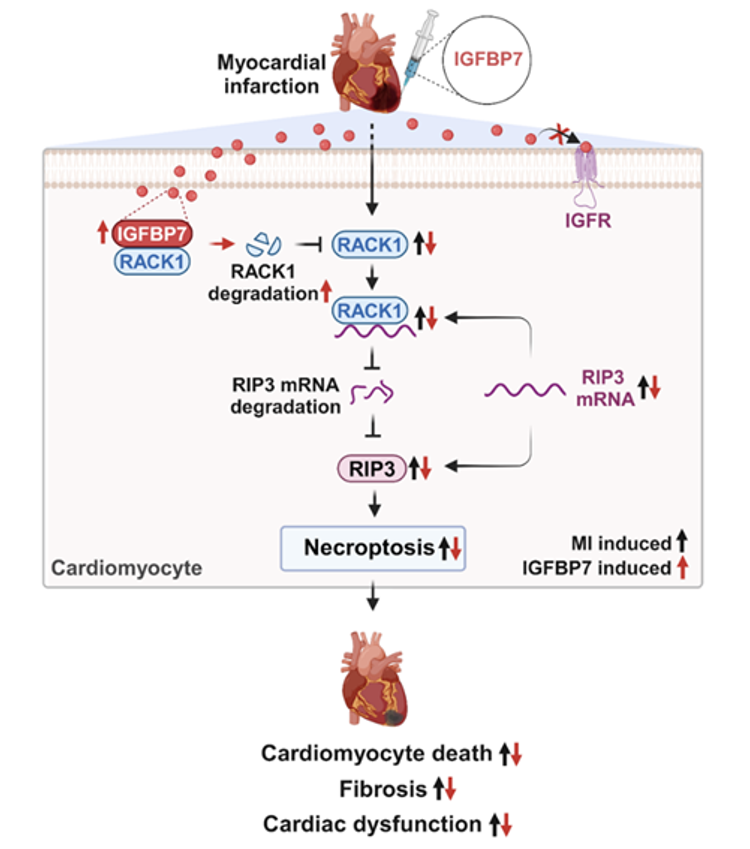
Schematic model of IGFBP7 suppressing cardiomyocyte necroptosis and promoting cardiac repair post-MI. (Image by Prof. YANG's group)
