
Newsroom


An international research team has developed a new quantum-classical framework for computing quantum many-body structure and dynamics. The findings were published in Physical Review C.
Ab initio many-body calculations serve as a fundamental tool for understanding strongly correlated quantum systems, with broad applications in quantum chemistry and nuclear physics. However, the Hilbert space of such systems grows exponentially with the number of particles, creating a major bottleneck for classical computers.
Quantum computing is regarded as a promising technology for overcoming this "exponential wall". Nevertheless, most existing quantum algorithms are restricted to determining the structural information such as the complete bound-state spectrum and total angular momentum. In addition, traditional encoding schemes often require prohibitive circuit-compilation overhead, which severely limits their practical application to realistic nuclear many-body problems.
To address this challenge, a theoretical physics team at the Institute of Modern Physics (IMP) of the Chinese Academy of Sciences (CAS), together with collaborators, has developed a universal quantum-classical framework for calculating Green's functions and spectral functions of nuclear many-body systems.
The team introduced a new quantum encoding scheme for multi-fermion Hamiltonians that avoids the large compilation overhead associated with traditional approaches. This encoding scheme preserves the Hamiltonian's intrinsic symmetries while requiring only a low gate count. Based on this scheme, the researchers established a new quantum-classical computational framework.
To validate the effectiveness of the framework, the researchers applied the quantum algorithm to a nuclear many-body Hamiltonian with realistic nucleon-nucleon interactions and obtained the full bound-state spectrum of oxygen-20, together with the corresponding total angular momentum quantum numbers. The quantum simulation results obtained using a classical simulator showed good agreement with classical full-configuration interaction calculations and were consistent with available experimental data.
With advantages in both universality and scalability, this framework provides a potential pathway for conducting ab initio investigations of nuclear structure and dynamics on future fault-tolerant quantum computers. It can also be extended to the study of strongly correlated many-body problems in other research fields.
This work was carried out jointly by IMP, the Advanced Energy Science and Technology Guangdong Laboratory and Technology, Iowa State University, and Lawrence Berkeley National Laboratory.
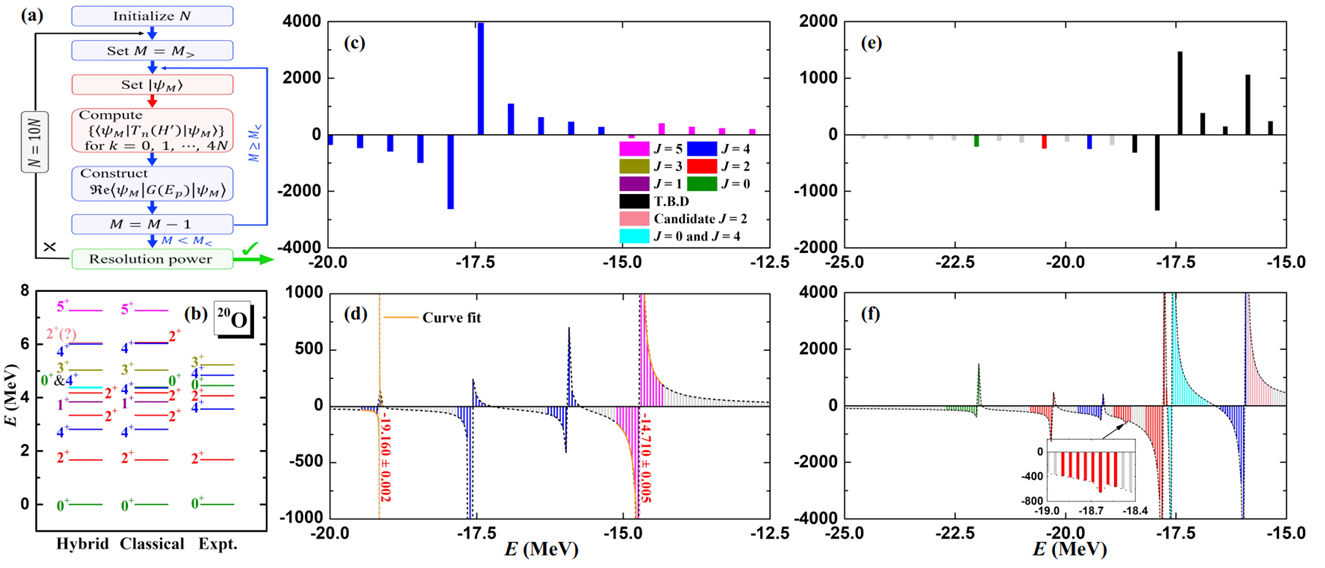
(a) Schematic illustration of the quantum-classical hybrid algorithm framework. (b) Excitation energies and total angular momentum J values of the energy eigenstates of oxygen-20 calculated based on this framework, and their comparison with classical full configuration interaction results and experimental values. (c-f) Schematic illustrations of spectral-function scans of oxygen-20 under different total angular momentum projections and energy resolutions. (Image from IMP)
