
Newsroom


Scientists have developed a Raman-activated cell sorting strategy for the high-throughput discovery of ethanol-tolerant microorganisms based on their metabolic activity rather than growth.
The study, led by researchers from the Qingdao Institute of Bioenergy and Bioprocess Technology (QIBEBT) of the Chinese Academy of Sciences and the COFCO Nutrition & Health Research Institute, was published in Bioresource Technology on July 14.
Conventional microbial screening generally follows an "isolate first, test later" workflow, in which cells are cultivated under selective pressure, isolated, and evaluated. This approach is slow, labor-intensive and biased toward fast-growing or abundant microbes. This is important in solid-state baijiu fermentation, where rising ethanol concentrations stress microbial communities, while valuable but low-abundance active microbes are easily overlooked.
Therefore, the researchers shifted the criterion from whether a cell could grow under ethanol stress to whether it maintained active metabolism. They combined heavy-water (D2O) labeling with single-cell Raman spectroscopy and a high-throughput Raman-activated flow cytometer known as FlowRACS. Metabolically active cells incorporate deuterium from D2O into newly synthesized biomolecules, producing a characteristic carbon-deuterium (C-D) Raman signal. Based on this signal, the researchers derived a carbon-to-deuterium ratio (CDR) and a Raman tolerance index (RTI) to quantify the in-situ ethanol tolerance of individual cells.
The platform functionally sorted 2,400 cells per hour with an accuracy of 91.3%. One sorting round followed by culture from pit mud pretreated with 8% ethanol yielded six pure strains, all with an RTI above 50%, as opposed to only two among nine isolates from conventional agarose-plate screening. Overall, this strategy increased strain-mining efficiency 4.5-fold and phenotypic validation 7-fold, reducing the time required for key steps from days to hours.
Genomic and transcriptomic analyses revealed distinct tolerance mechanisms. Lactiplantibacillus plantarum (RTI = 85.1%) enhanced lactate dehydrogenase expression by 3.4-fold while maintaining high alcohol dehydrogenase activity, indicating adaptive redox balancing. Staphylococcus epidermidis (RTI = 62.2%) activated lipid synthesis and glycerol metabolism genes, indicating cell envelope remodeling. Both strains were rare in the original microbial community, demonstrating that function-based sorting recovers key microbes that are missed by abundance- or growth-based approaches.
"The key is not simply judging whether cells grow under stress, but determining whether they can maintain their metabolism," said Assoc. Prof. ZHANG Jia of QIBEBT, co-corresponding author of the study.
"Using metabolic phenotype as the direct sorting criterion allows us to isolate high-performing strains directly from complex microbiomes while substantially shortening the path from screening to functional validation," said Dr. ZHENG Xiaowei of the COFCO Nutrition & Health Research Institute, also a co-corresponding author.
The study could also be extended to acid, salt, and solvent tolerance, which would aid in building robust industrial chassis strain libraries. This work represents the latest progress of the iMAPS Consortium (in-situ Metabolic Atlas Projects @ Single-cell; www.iMAPS.info).
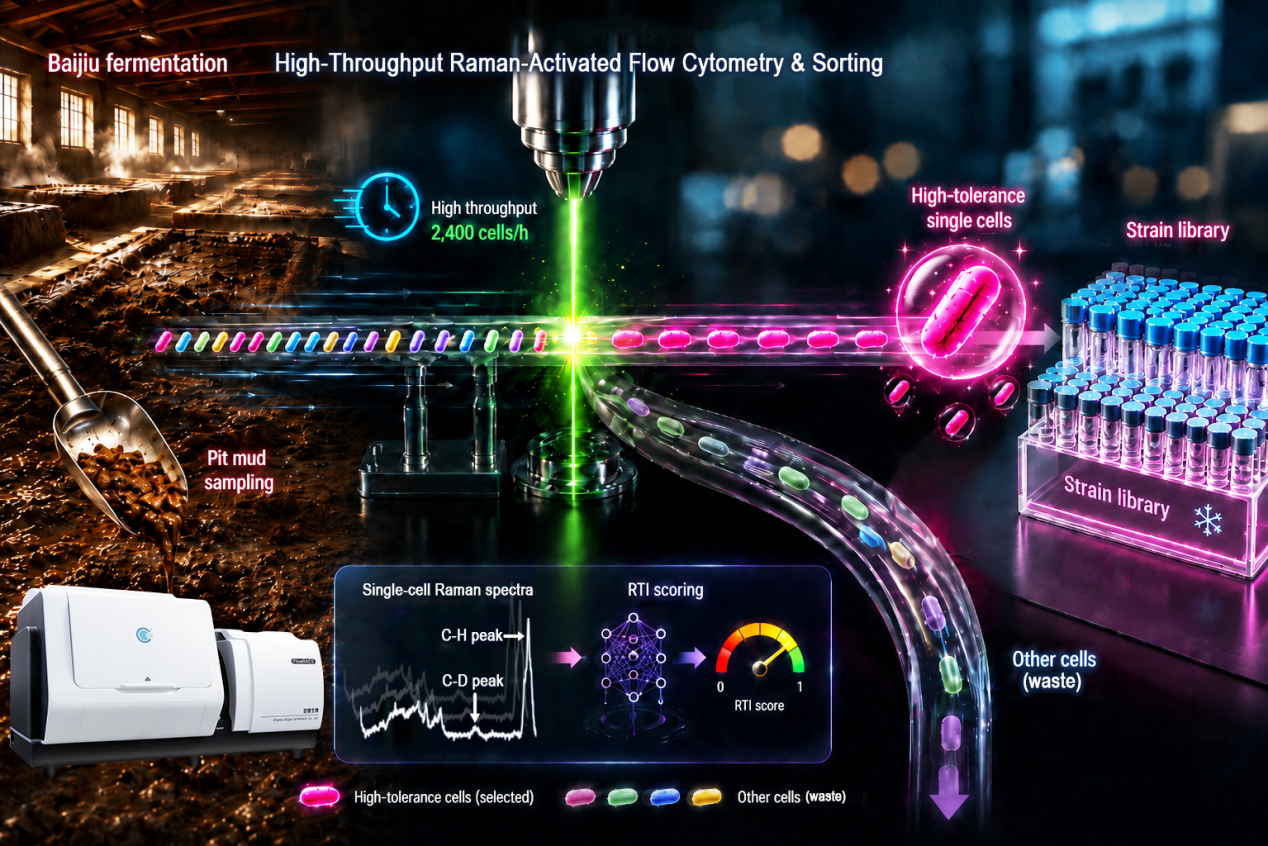
Ramanome-based "function-first" strategy for high-throughput mining of ethanol-tolerant microbes for the fermentation industry (Image by QIBEBT)

