
Newsroom


Climate warming is intensifying terrestrial water scarcity and drought risks worldwide. Meanwhile, rising atmospheric CO2 reduces plant stomatal conductance and improves water-use efficiency. In recent years, this process has been considered capable of alleviating land surface drying, but it may overlook the impact from vegetation-atmosphere feedback.
In a study published in PNAS on June 24, a research team led by Prof. YUAN Xing from the Institute of Atmospheric Physics (IAP) of the Chinese Academy of Sciences uncovered a critical indirect impact from atmospheric feedbacks which substantially limits the water-saving potential of vegetation under elevated CO2.
Based on Earth system models participating in the C4MIP under CMIP6, researchers isolated the indirect impacts of vegetation changes on evapotranspiration through atmospheric feedbacks. They found that vegetation responses to rising CO2, including increased leaf area and reduced stomatal conductance, alter surface energy balance, leading to warming and enhanced atmospheric evaporative demand, which drives greater surface water loss.
This indirect impact offsets 54% of the vegetation water-saving effect in northern mid-to-high latitudes under current climate conditions, and this proportion is projected to increase to 68% under a future 4×CO2 scenario.
The indirect impacts of vegetation changes exhibit strong latitudinal differences, with particularly pronounced effects in northern mid-to-high latitudes. In these regions, sustained water loss associated with atmospheric feedbacks undermines the potential benefits of vegetation in mitigating land surface water scarcity.
As droughts become more frequent under climate change, vegetation's role in regulating land surface water availability is becoming increasingly critical for agricultural production and water resource management. "This study warns against overreliance on CO2 physiological effects as a natural solution to drought," said Prof. YUAN.
"In low-latitude regions, although CO2 physiological effects may partially alleviate soil moisture drought, increasing compound heat and atmospheric drought stress are more likely to threaten ecosystem sustainability," said HAO Yi, the first author of the study.
The findings of this study highlight that vegetation's CO2 response alone cannot secure water resources or ecosystem stability under future climate change, underscoring the need for proactive adaptation strategies including improved irrigation efficiency, drought-resilient crop breeding, and sustainable water resource planning.
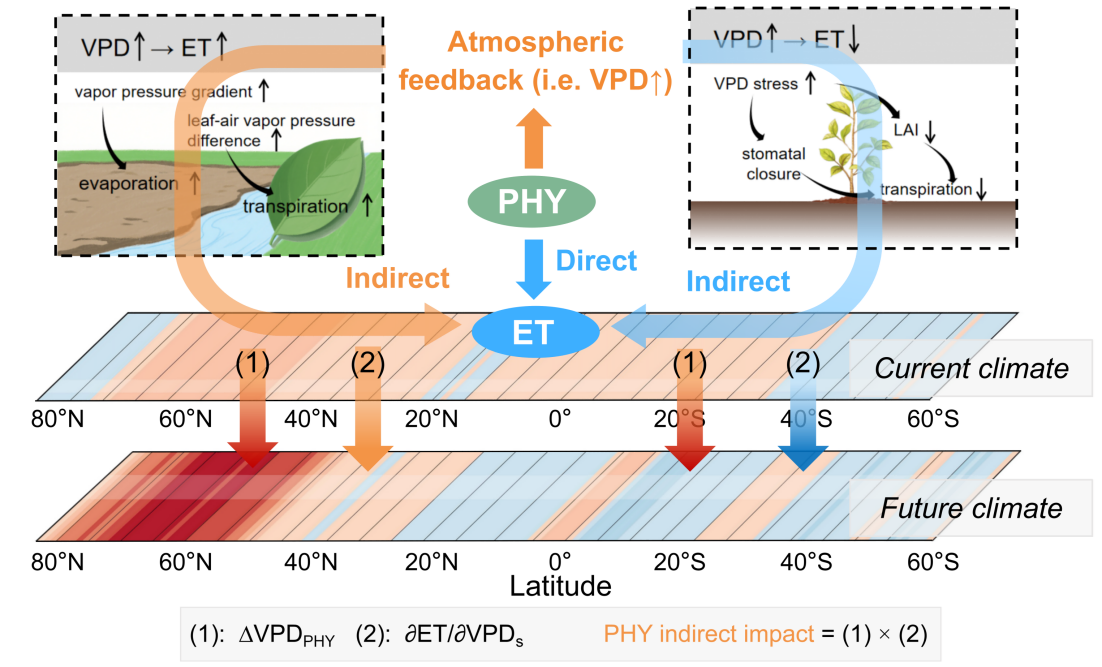
Direct and indirect pathways through which CO2 physiological effects influence evapotranspiration. (Image by IAP)
