
Newsroom


Desert shrubs in northwestern China face a dual climatic challenge: chronic drought in summer and repeated freeze-thaw cycles in winter. A new study has revealed how xylem adapts to both stresses, finding that species with vestured pits exhibit greater hydraulic efficiency and enhanced resistance to drought-induced embolism, but are more susceptible to freezing-induced embolism.
The study, led by Prof. ZHANG Yuanming from the Xinjiang Institute of Ecology and Geography (XIEG) of the Chinese Academy of Sciences (CAS), was recently published in Plant, Cell & Environment.
Chronic water deficit and recurrent seasonal frost stress compromise hydraulic safety by inducing xylem embolism and disrupting water transport. Some species have evolved protuberances—known as vestures—associated with pit chambers or outer pit apertures, yet the adaptive significance of these structures has been poorly understood.
By studying live collections from a temperate desert botanical garden in Northwest China, the researchers compared the structural and hydraulic functional characteristics of five shrub species with vestured pits against five without.
The results revealed that shrub species with vestured pits exhibit not only higher hydraulic efficiency and stronger resistance to drought-induced embolism, but also greater vulnerability to freezing-induced embolism. These hydraulic contrasts between the two functional groups are paralleled by differences in xylem structure at both tissue and pit levels. In particular, species with vestured pits have larger vessel diameters, larger pit membrane areas, and thinner pit membranes.
Vesture formation contributes to greater drought resistance while preserving relatively high hydraulic efficiency. This is of great adaptive significance in deserts, where maintaining hydraulic integrity during prolonged drought and efficiently transporting water after heavy rainfall are equally critical. However, their higher vulnerability to freezing-induced embolism may constrain the adaptability of these shrubs to frost-prone environments.
Collectively, the findings enhance our understanding of xylem adaptation complexity, demonstrating for the first time how pit vestures, in combination with other anatomical features, shape hydraulic adaptations to drought and frost in desert environments, according to the research team.
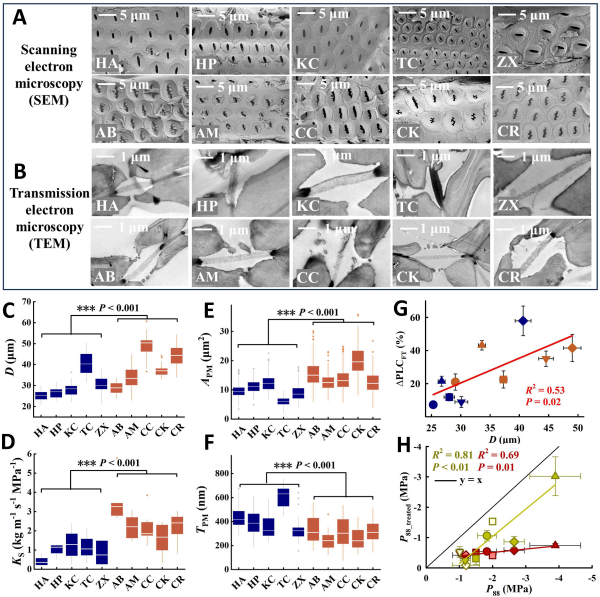
Stem xylem structural and hydraulic functions in the desert shrub species with non-vestured pits or vestured pits. (Image by XIEG)

