
Newsroom


A recent study published in Nature Synthesis developed a plasma-cascade process that enables the direct synthesis of cyclohexanone cyanohydrin [Cy(OH)CN] with nitrogen, methane, and cyclohexanone under mild conditions. The process achieved a Cy(OH)CN selectivity of 95.8%, a yield of 23.9%, and a formation rate of 0.60 mmol h-1.
The study was carried out by a research group led by Profs. DENG Dehui, YU Liang, and HUANG Rui from the Dalian Institute of Chemical Physics (DICP) of the Chinese Academy of Sciences (CAS).
Cyanohydrins are valuable chemical intermediates used in the production of antidepressants, antiviral drugs, and synthetic plastics. Their conventional synthesis relies on a multi-step process that involves energy-intensive production of ammonia and hydrogen cyanide, leading to high energy consumption, high carbon emissions and safety concerns associated with toxic reagents.
As a result, developing a direct route to cyanohydrins from abundant feedstock such as nitrogen and methane under mild conditions has long been a major challenge.
To address this challenge, the researchers proposed a plasma-driven radical cascade mechanism. Under non-thermal plasma, nitrogen and methane are excited to generate reactive species, including excited-state nitrogen as well as ·CH₃ and ·H radicals, which subsequently react with cyclohexanone.
They revealed that the plasma-generated ·H radicals first activate the C=O bond of cyclohexanone to form hydroxy-cyclohexyl intermediates. These intermediates then undergo C–C coupling with ·CH₃ radicals. The resulting α‑CHₓ cyclohexanol species further reacts with excited-state nitrogen to form a C–N bond. Assisted by ·H radicals, the N≡N bond is subsequently cleaved, ultimately yielding the target product cyclohexanone cyanohydrin along with high-value ammonia as a co-product.
"Our study establishes a new green reaction pathway for the direct one-step synthesis of cyanohydrins from nitrogen and methane with high selectivity, offering a new strategy for the direct and efficient utilization of inert small molecules under mild conditions," said Prof. DENG.
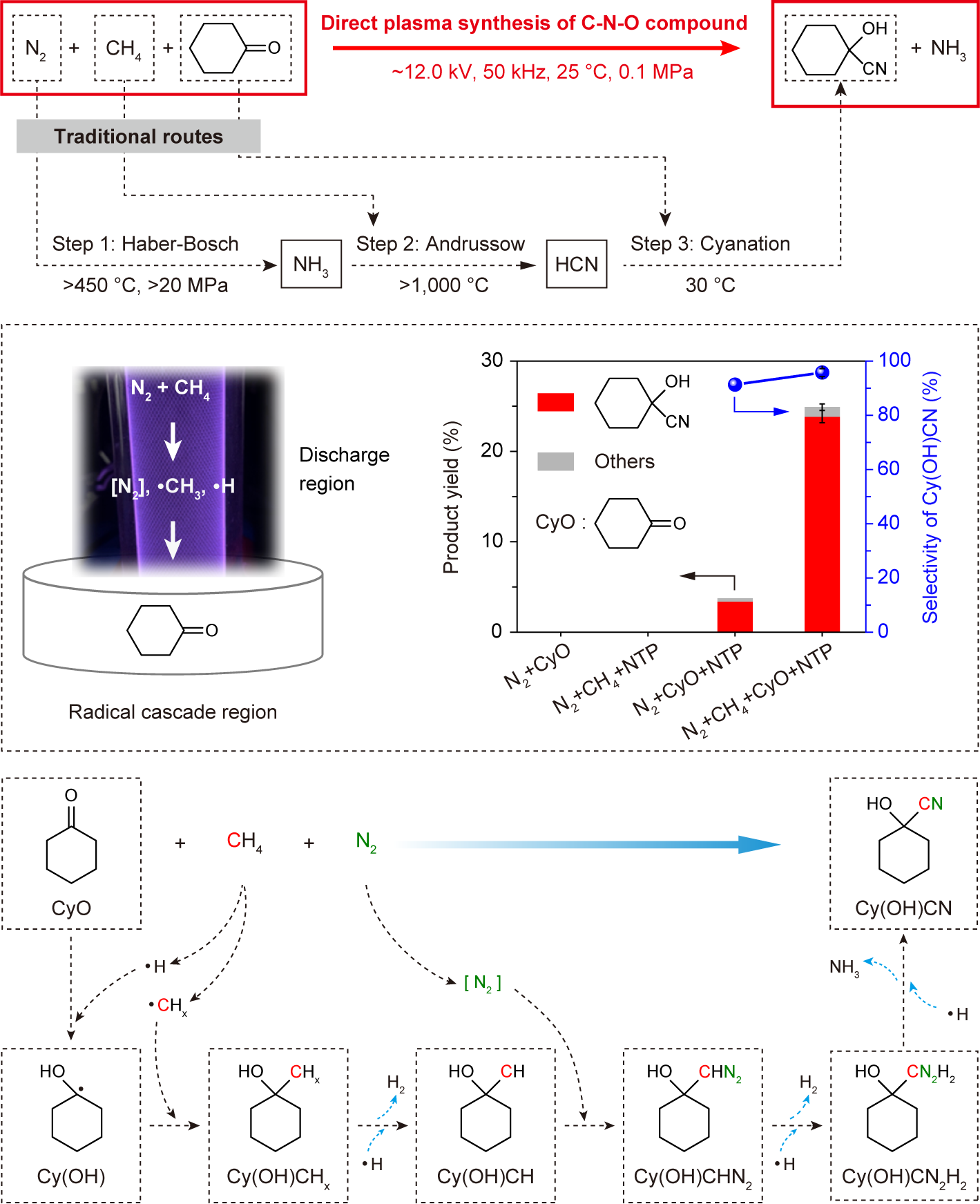
Schematic illustration of the performance and radical relay mechanism for the reaction of cyclohexanone and non-thermal plasma-activated nitrogen and methane. (Image by ZHANG Hao)
