Newsroom


What if farmers could grow more food while using less fertilizer and harming the environment less? A new study suggests foliar nano-selenium may hold the answer.
Foliar nano-selenium is an agricultural biofortification technique in which nano-sized selenium particles are applied directly to plant leaves. A recent study found that it can act as a "smart coordinator" linking photosynthesis, root nutrient allocation, and rhizosphere microbes. The approach improves crop yield and quality while cutting fertilizer use and greenhouse gas emissions — offering a promising new pathway for sustainable agriculture.
The study, conducted by a research team led by Prof. CHEN Yaning from the Xinjiang Institute of Ecology and Geography (XIEG) of the Chinese Academy of Sciences (CAS), was published in Trends in Plant Science.
Modern agriculture relies heavily on chemical fertilizers for high yields, yet excessive use — especially of nitrogen — poses serious environmental hazards. Striking a balance between productivity, environmental protection, and economic viability has emerged as one of the most pressing challenges in global agriculture.
The study reveals that selenium-engineered nanomaterials (SeNMs) serve as both micronutrient carriers and redox-active regulators inside plants. According to the research, they enhance photosynthesis, strengthen antioxidant defenses, regulate phytohormones, and reshape rhizosphere microbial communities. In effect, nano-selenium acts as a "communication bridge" connecting aboveground plant metabolism with belowground microbial activity.
In rice trials, the study found that SeNMs application increased photosynthetic performance by over 40% under reduced nitrogen conditions. Enhanced photosynthesis generated more carbohydrates, which were transported to roots and released into the rhizosphere, stimulating beneficial microbes involved in nitrogen cycling and nutrient mineralization. Related nitrogen absorption and transport genes were also activated, raising nitrogen use efficiency and curbing nutrient loss. Notably, the researchers reported that rice treated with SeNMs maintained full-fertilizer yields with 30% less nitrogen input.
The synergistic system also delivered substantial environmental, agronomic, and economic benefits, according to the study. Methane (CH₄), nitrous oxide (N₂O), and ammonia (NH₃) emissions decreased significantly through optimized microbial regulation and improved nitrogen utilization. Treated crops showed higher levels of protein, amino acids, starch, and selenium, while reduced fertilizer inputs enhanced grain quality and market value.
SeNMs also dynamically coordinate plant physiology, microbial function, and nutrient cycling, the researchers said. They describe nano-selenium as a "redox conductor" that continuously adjusts photosynthesis, sugar allocation, stress responses, and rhizosphere activity in response to changing environmental conditions.
The research envisions precision agriculture systems where nano-enabled technologies operate alongside crop breeding, microbial engineering, and real-time monitoring. Scientists may eventually track photosynthesis, nutrient allocation, microbial activity, and redox signals simultaneously — allowing crops to maximize productivity with minimal environmental impact. Such advances could help farmers produce more food with fewer fertilizers, lower greenhouse gas emissions, and greater resilience to climate change, the researchers said.
This study establishes a clear conceptual framework, researchers said. By coordinating plant-microbiome systems through nano-selenium-mediated redox regulation, agriculture may transition away from heavy agrochemical dependence toward more precise, efficient, and environmentally sustainable production — helping secure global food security in the face of accelerating environmental change, they added.
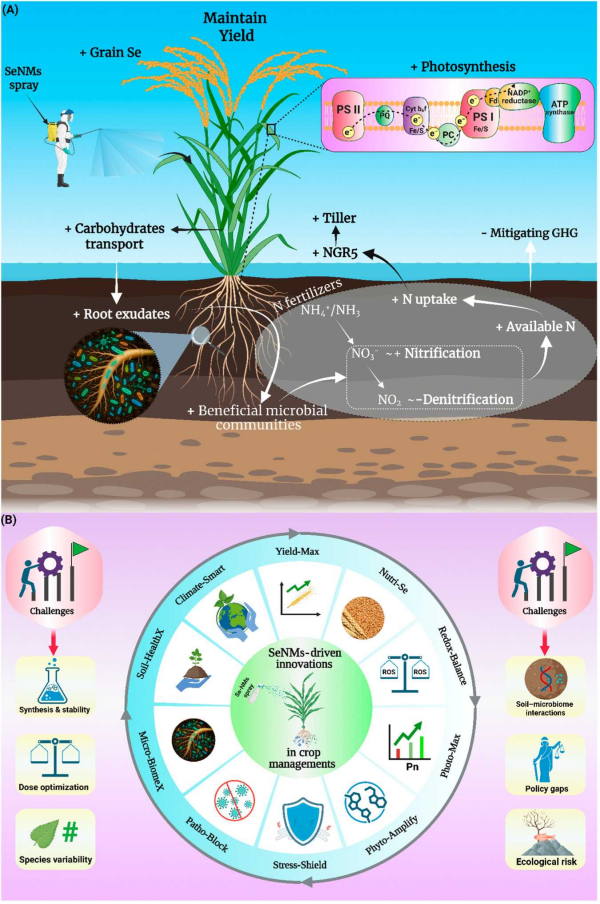
Conceptual framework illustrating foliar selenium nanomaterial-mediated redox regulation, enhanced photosynthesis, rhizosphere microbiome recruitment, optimized nitrogen turnover, stress resilience, reduced greenhouse-gas emissions, improved rice productivity, grain selenium enrichment, and associated biosafety and deployment challenges. (Image by XIEG)