
Newsroom


Difelikefalin is a kappa opioid receptor (KOR) peptide agonist for the treatment of chronic pruritus. However, as a balanced agonist that activates both G protein and β-arrestin signaling pathways, it is associated with side effects linked to β-arrestin signaling.
In a study published in Nature Communications, a team from the Hefei Institute of Materials Science of the Chinese Academy of Sciences (CAS), along with collaborators from the Shanghai Institute of Materia Medica of CAS, developed a KOR biased agonist with high efficacy and reduced side effects through structure-based rational design.
The researchers analyzed the cryo-electron microscopy structure of the difelikefalin–KOR–Gi complex, and identified Y3207.43 as a key residue responsible for signaling bias. Through structural analysis, they designed a peptide agonist, beta01, derived from β-amino acid substitutions, which strongly activates G protein signaling while recruiting minimal β-arrestin.
In mouse models, beta01 retained potent analgesic and antipruritic effects while significantly reducing sedation and anxiety-like behaviors, compared with difelikefalin. Structural and computational analyses including molecular dynamics simulations and nuclear magnetic resonance spectroscopy indicated that beta01 stabilizes KOR in a distinct conformation that reduces β-arrestin recruitment, providing a molecular basis for its improved safety profile.
This study offers promising candidates for chronic pain and pruritus, and provides a general framework for safer and more effective GPCR-targeted drug design. The study was supported by the Steady High Magnetic Field Facility (SHMFF), including a 9.4 T magnetic resonance imaging system and an integrated experimental animal platform.
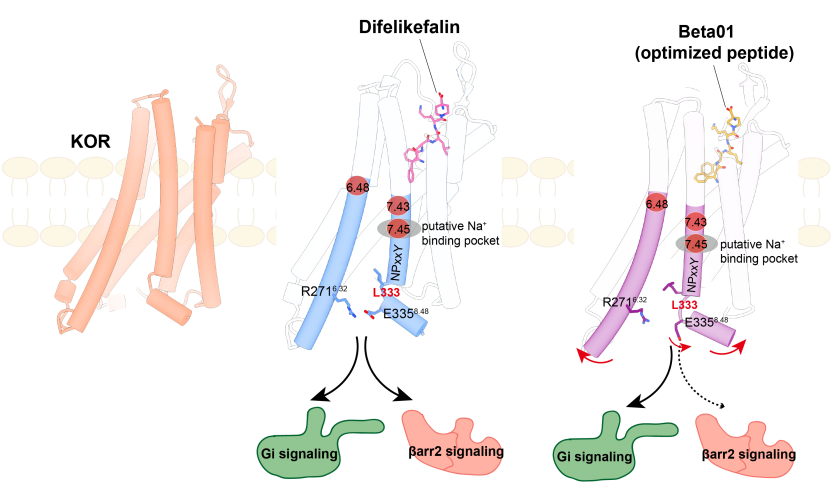
Beta01 achieves G protein biased activation by remodeling the intracellular conformation of KOR. (Image by ZHU Qingjun)
