
Newsroom


A recent study published in ACS Sensors found that in vitro biological neuronal networks can achieve both low power consumption and high-speed communication through predictable electrical stimulation. The study found that regular stimulation increased neural communication speed by 1.79-fold without increasing energy consumption.
Led by Prof. CAI Xinxia, Assoc. Profs. LUO Jinping and WANG Mixia from the Aerospace Information Research Institute of the Chinese Academy of Sciences (AIRCAS), the study offered a potential new pathway for next-generation brain-inspired computing system.
As artificial intelligence continues to expand, traditional computing architectures are facing growing pressure over energy efficiency and parallel processing capacity. Biological neuronal networks, by contrast, are capable of processing complex information with extremely low power consumption, making them an important area of research for future brain-inspired processors.
To support the study, the team developed a multi-channel in vitro microelectrode array using a platinum nanoparticle and conductive polymer composite coating for large-scale neural recording. The device achieved an impedance of just 15.33 ± 0.63 kΩ at 1 kHz, while also providing high charge storage capacity and strong biocompatibility.
According to the researchers, these properties create a stable hardware platform for long-term neural recording and precise stimulation.
The research team also refined the way neuronal communication velocity is measured. Conventional straight-line calculations can underestimate actual signal transmission speed. To overcome this limitation, the team designed a new algorithm based on actual propagation distance, significantly improving measurement accuracy.
Using hippocampal neural networks, the researchers then applied regular and predictable electrical pulses. The experiments showed that predictable stimulation significantly accelerated the network’s communication speed, allowing signals to travel faster without increasing power consumption.
According to the team, the findings deepen understanding of how living neuronal networks process information and could help lay the groundwork for in vitro brain-computer interface devices capable of low-power, high-speed communication.
The study could also support future advances in biohybrid processors, neuromorphic computing and energy-efficient AI systems, the research team said.
The work was supported by the Foundation for Innovative Research Groups of the National Natural Science Foundation of China.
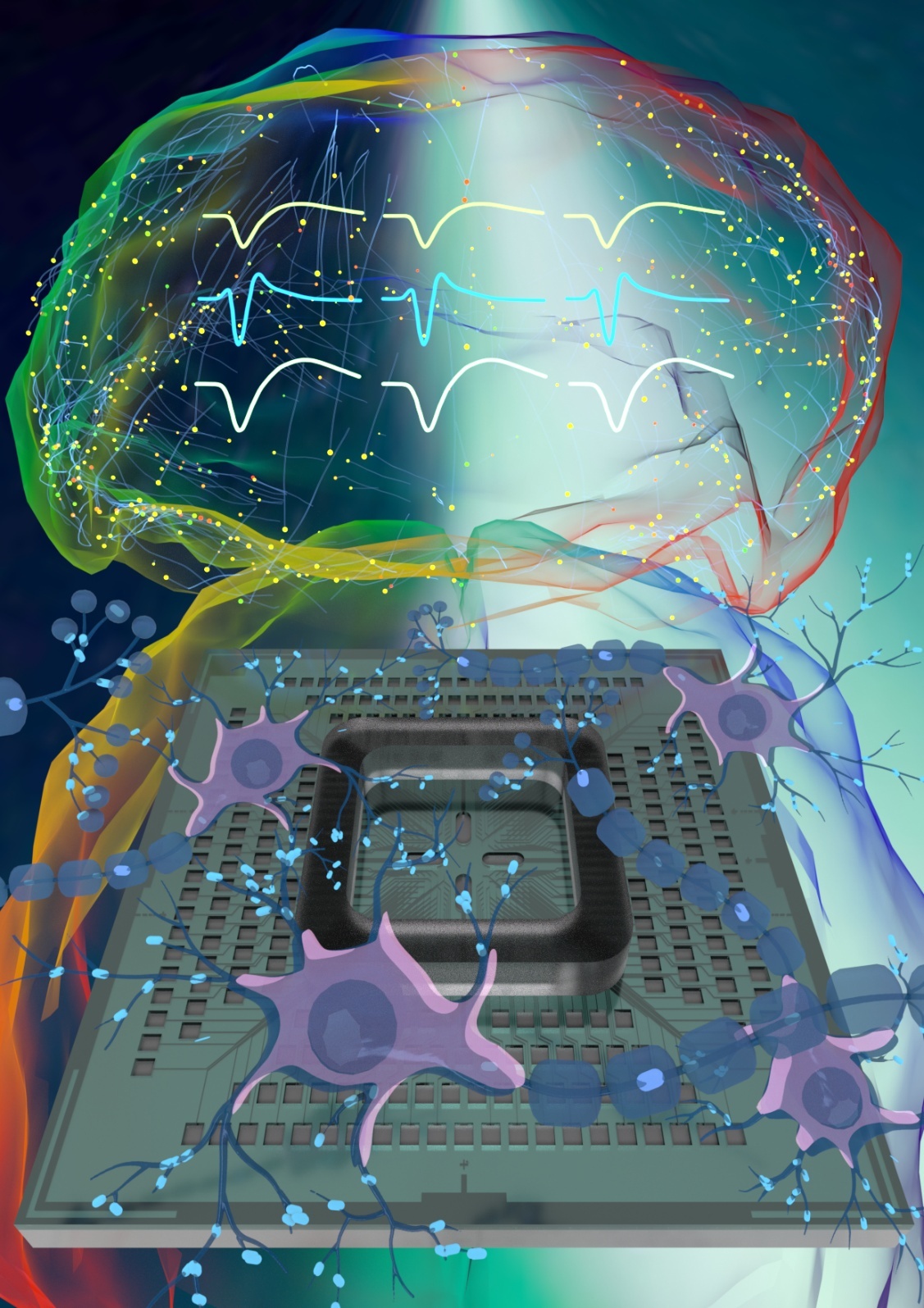
From living neurons to intelligent chips: a brain-on-chip platform enabling low-power, high-speed neural computing. (Image by AIRCAS)
