
Newsroom


Tumor microenvironment (TME) plays a critical role in tumorigenesis, progression, invasion and metastasis. However, the structural composition and organizational principles of pan-cancer TME remain largely unknown, due to limited sample size and computational challenge.
A research team led by Prof. LI Hong from Shanghai Institute of Nutrition and Health (SINH) of the Chinese Academy of Sciences identified consensus spatial niches across pan-cancer, and dissected their molecular characteristics and clinical implications. The study was published in Cell Reports Medicine on April 17.
Researchers defined 56 local cellular programs and 13 spatial niches at distinct scales, which represent consensus and fundamental spatial structural units across 12 cancer types.
Mechanistically, niche-related ligand-receptor interactions and cell type-specific differential expression are associated with niche organization. Clinically, multiple niches exhibit significant associations with patient prognosis and immunotherapy response. The macrophages play dual roles in both pro- and anti- tumor activities associated with their spatial distributions.
The study offers deeper insights into cellular communication and structural influences governing complex tumor ecosystems. Besides, it highlights that the spatial distribution of macrophages represents a promising biomarker for clinical outcomes.
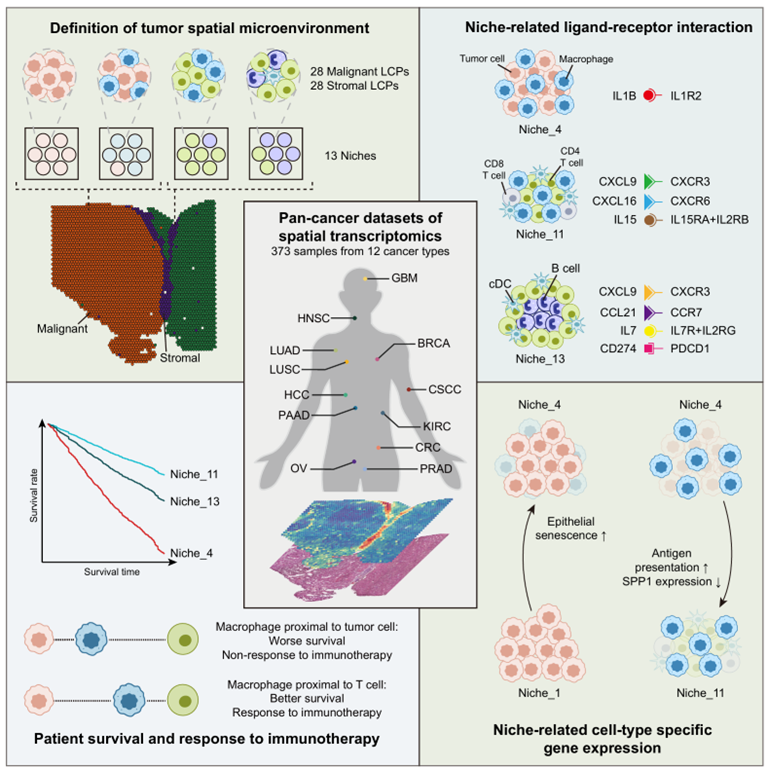
Pan-cancer spatial microenvironment: analysis strategy and result overview. (Image by Prof. LI Hong’s team)
