
Newsroom


Supereruptions are extremely large volcanic eruptions that eject more than 1,000 cubic kilometers of magma, rock and ash. They are among the most hazardous geological events on Earth and have profound impacts on the environment, climate, and human society. For this reason, understanding the subsurface processes behind supereruptions is essential for improving volcanic hazard assessments and mitigating risks.
Now, a research team from the Institute of Geology and Geophysics of the Chinese Academy of Sciences (IGGCAS) has developed a comprehensive three-dimensional geodynamic model of western North America that simulates the present-day dynamics of both the lithosphere and the underlying convecting mantle, revealing a mechanism for magma generation beneath supervolcanoes.
Their findings were published in Science on April 9.
Supervolcanoes—those that have produced supereruptions in the geological record—are traditionally thought to host long-lived, liquid-dominated magma chambers within the crust. Under this hypothesis, the accumulation of low-density magma increases pressure within the chamber, eventually triggering crustal failure, collapse, and eruption. However, recent studies suggest that persistent, liquid-dominated magma chambers are absent beneath active supervolcanoes worldwide. Instead, evidence suggests that magma exists as large, spread-out zones of partially molten rock—known as "magma mush" systems—that extend through much of the Earth's outer layer (the lithosphere).
The lithosphere is the cold, rigid outermost layer of the Earth, comprising the entire crust and the lithospheric mantle. Beneath it lies the asthenosphere, a ductile layer that flows slowly over geological timescales. Recent studies indicate that magma feeding supervolcanoes originates in the upper asthenosphere (the shallow mantle just beneath the lithosphere), although the mechanism of partial melting remains unclear. As this melt ascends into the lithosphere, it interacts with surrounding solid rocks, forming a highly viscous magma mush. The effective viscosity of such mushes is at least several orders of magnitude higher than that of liquid magma, thus challenging the buoyancy-driven mechanism of current supereruption model. Moreover, these magma mush systems are distributed diffusely throughout the lithosphere, in stark contrast to the localized magma chambers proposed in traditional models.
The Yellowstone caldera, a well-known supervolcano in western North America, has produced two supereruptions over the past 2.1 million years. It serves as a key natural laboratory, with extensive geological, geophysical, and petrological constraints. Previous studies indicate that Yellowstone hosts a long-lived, large-scale translithospheric magma mush system characterized by a southwest-dipping geometry. A shallow, liquid-rich magma body—analogous to the classical magma chamber—appears to exist only transiently prior to eruptions. While these findings provide important insights into the structure and evolution of Yellowstone's magmatic system, the underlying geodynamic forces had remained unclear until now.
Using their new model, the researchers discovered that Yellowstone's magma comes from the shallow asthenosphere rather than from a deep mantle plume. An eastward "mantle wind," driven by the subduction of the Farallon Plate—remnants of which lie deep beneath central and eastern North America—transports hot asthenospheric material toward the Yellowstone region. Unlike an atmospheric wind, the mantle wind is a broad, horizontal flow of hot, slowly moving rock within Earth's mantle. This buoyant material is subsequently pulled downward beneath the thick lithosphere, where the resulting vertical extension causes significant decompression melting. This result challenges the traditional hypothesis that Yellowstone is the surface expression of a deep mantle plume rising from the core–mantle boundary.
The mantle wind plays a critical role in shaping Yellowstone's translithospheric magmatic system. The eastward mantle flow exerts a horizontal push on the thick North American lithospheric root east of Yellowstone, while the buoyant lithosphere west of Yellowstone generates a counteracting westward-directed body force. The combined effect of these forces effectively "tears" the continental lithosphere, producing a southwest-dipping, channel-like conduit beneath Yellowstone.
This conduit provides favorable conditions for magma ascent, transport, and evolution within the lithosphere, thereby controlling the geometry and long-term evolution of Yellowstone's magmatic system. The model's predictions are consistent with independent geophysical and geochemical observations.
This study provides, for the first time, a more comprehensive explanation for the formation of magmatic systems beneath supervolcanoes, linking magma generation in the asthenosphere to its accumulation within the lithosphere. It also identifies a physical mechanism for sustaining long-lived, large-scale magma mush systems—a feature common to many supervolcanoes worldwide.
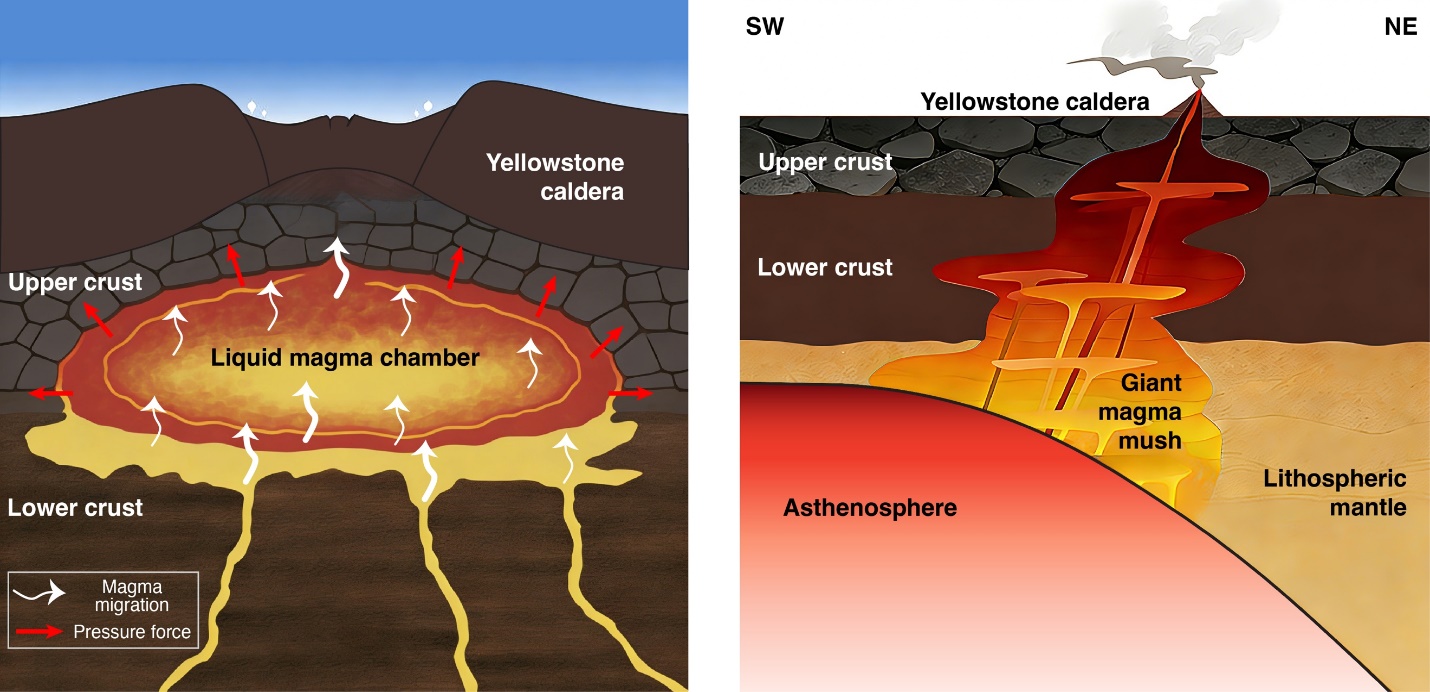
Schematics of Yellowstone's magmatic system. Left: schematics illustrating Yellowstone's magmatic system under the traditional magma chamber view. Right: schematics showing Yellowstone's translithospheric magmatic system under the magma mush view. (Image by LIU Lijun's Group)
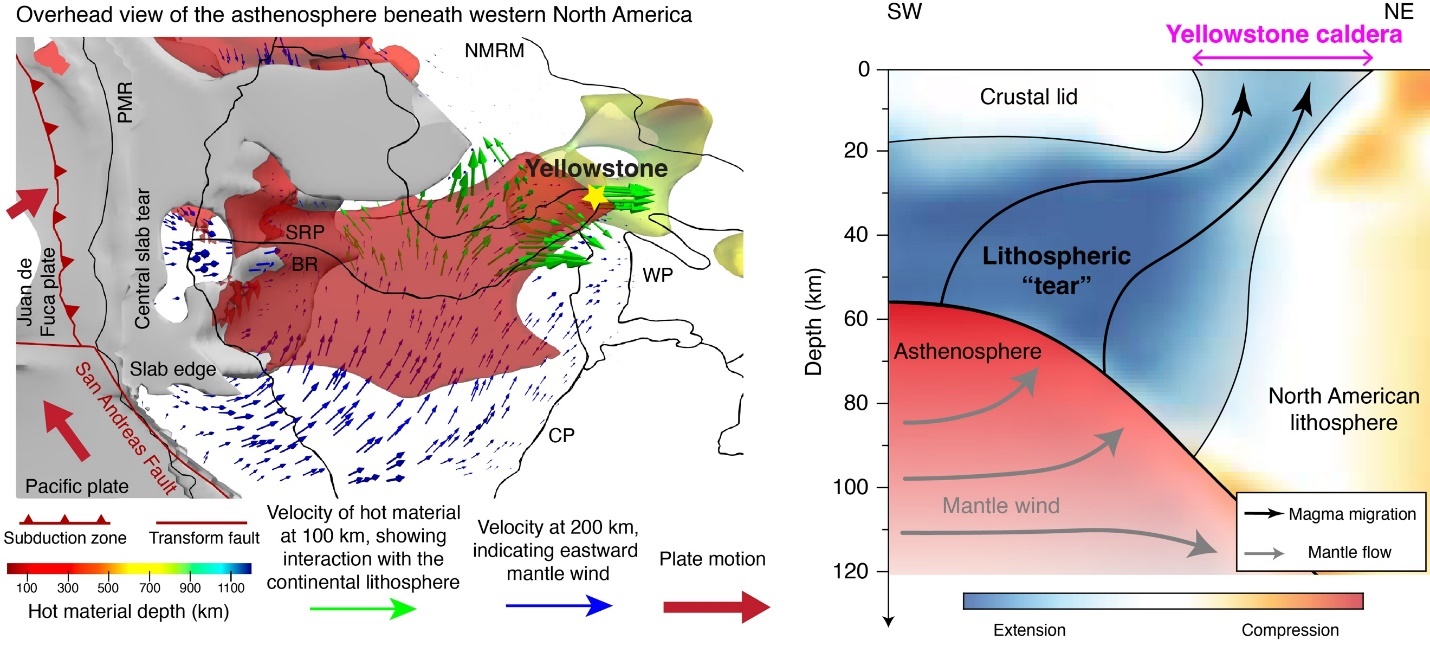
Schematics showing how Yellowstone's underground magmatic system forms. Left: the red iso-surface depicts the hot, shallow asthenospheric material transported eastward by the mantle wind. Right: schematics showing the lithospheric stress field and magmatic system beneath Yellowstone. (Image by LIU Lijun's Group)
